by William Eric McFadden
From the Tu-Endie-Wei State Park website:
-
At the junction of the Ohio and Kanawha Rivers, Tu-Endie-Wei stands as a monument to commemorate the frontiersmen who fought and died at the Battle of Point Pleasant. On October 10, 1774, Colonel Andrew Lewis’ 1,100 Virginia militiamen decisively defeated a like number of Native Americans led by the Shawnee Chieftain Cornstalk in a bloody, day-long battle. In the end, 230 Native Americans were killed or wounded and more than 50 Virginians had lost their lives, including Colonel Charles Lewis, brother of the commanding officer.
Considered a landmark in frontier history, some believed the battle to be the first of the American Revolution. This action broke the power of the ancient Americans in the Ohio Valley and quelled a general war on the frontier. Significantly, it also prevented an alliance between the British and Native Americans, which could have caused the Revolution to have a different outcome, altering the nation’s history. In addition, the ensuing peace with the Native Americans enabled western Virginians to return across the Allegheny Mountains to aid Revolutionary forces. The battle is recognized as the decisive engagement in a proactive series of Native American wars. The monument derives its name "Tu-Endie-Wei" from a Wyandotte word meaning "point between two waters."
From the Lewis and Clark National Historic Trail website:
-
The Lewis and Clark National Historic Trail is approximately 4,900 miles long, extending from Pittsburgh, Pennsylvania, to the mouth of the Columbia River, near present day Astoria, Oregon. It follows the historic outbound and inbound routes of the Lewis and Clark Expedition as well as the preparatory section from Pittsburgh, Pennsylvania to Wood River, Illinois.
Pictures
- Hillbilly Hotdogs: 1 | 2; photos by Len Touth
- Archer drives the schoolbus at Hillbilly Hotdogs
- Len Touth in front of the huge, old maple
- The 1796 Mansion House
- The Bartow James Bridge over the Kanawha River
- The Silver Memorial Bridge over the Ohio River
- Historic Marker: Point Pleasant Battle, 1774
- Underneath Old Glory
- Eric's Elecraft KX2 station
- Eric's mast and antenna
- A tug traveling light on the Kanawha River toward the Ohio
- A view of Tu-Endie-Wei State Park
- Barges and a tug on the Ohio
- Len operating: 1 | 2
- The 84-foot Battle of Point Pleasant monument
- The Ohio River: 1 | 2
Description
On Saturday, June 30, 2024, one member of the Southeast Ohio Radio Adventure Team performed successful simultaneous activations of Tu-Endie-Wei State Park and Lewis and Clark National Historic Trail in West Virginia as part of the Parks on the Air (POTA; link) program.
Following a lunch at the decidedly unique Hillbilly Hotdogs in Lesage, West Virginia, Eric McFadden, WD8RIF, visited Tu-Endie-Wei State Park in Point Pleasant for the two-fer activation. Eric was accompanied by Len Touth, W8VQ, who also performed a two-fer activation, by Len's wife Heidi, and by Eric's dog Theo. Eric's wife Vickie, his daughter Kate, his grandchildren Archer and Cynthia, and tiny Gracie-dog ate lunch at Hillbilly Hotdogs but didn't visit Tu-Endie-Wei State Park.
The original plan had been for Eric, Len, Vickie, and Heidi to take the Island Belle sternwheeler from Parkersburg to Blennerhassett Island so that Eric and Len could perform bicycle-portable two-fer activations of Blennerhassett Island State Park (US-1803) and Lewis and Clark National Historic Trail (US-4572), but they had discovered in time that the ferry wasn't going to be running on this day because of flooding along the Ohio River. As a fall-back, Eric and Len decided to visit Tu-Endie-Wei State Park, instead, to give Len his first West Virginia activation.
Because it was past lunchtime by the time the group started their drive south from Athens, they went straight to the very eclectic Hillbilly Hotdogs (link) on West Virginia Route 2 south of Point Pleasant, where Eric's grandson Archer had a great time in the dining-room schoolbuses and looking at all the treasures to be found throughout the place.
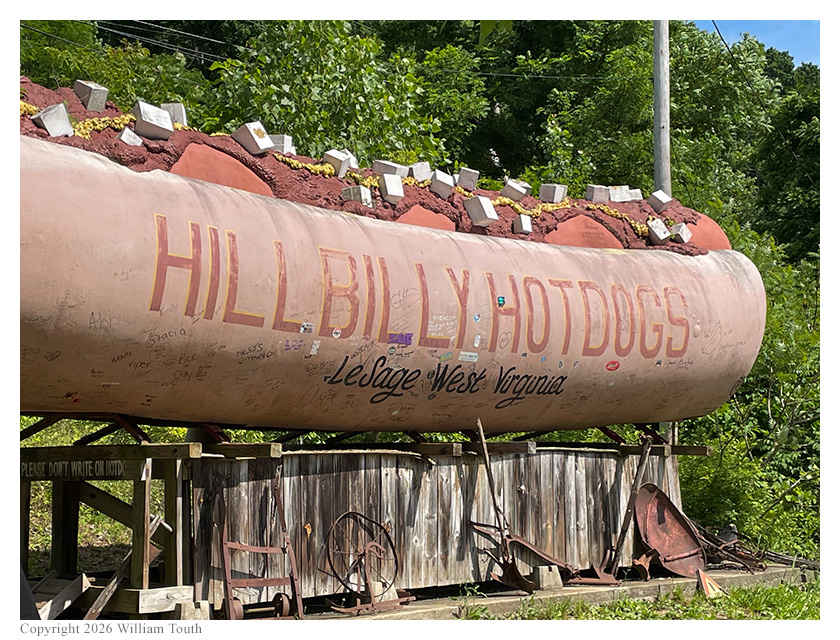
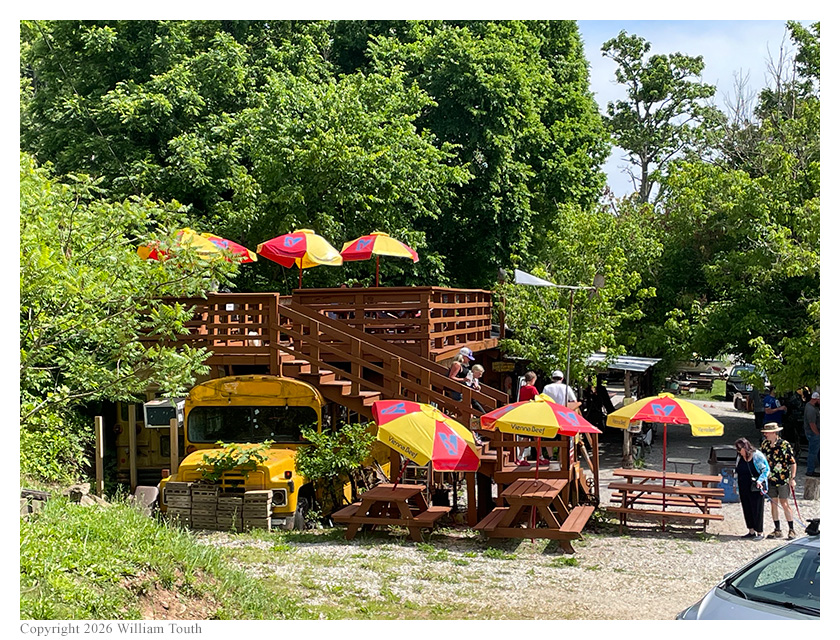
Hillbilly Hotdogs as photographed by Len Touth.

Archer "drives" one of the schoolbus
dining rooms at Hillbilly Hotdogs.
The two groups separated after lunch, with Eric, Len, Heidi, and Theo-dog visiting Tu-Endie-Wei State Park, and Vickie, Kate, Archer, Cynthia, and Gracie-dog returning to Athens.
Eric, Len, Heidi, and Theo-dog arrived at Tu-Endie-Wei State Park at the confluence of the Ohio and Kanawha Rivers in Point Pleasant, West Virginia, at about 2100 UTC. So that he and Len wouldn't have to fight each other's crossband-interference, Eric had planned that he would perform his activation first while Len and Heidi toured the 1796 Mansion House. Unfortunately, the Mansion House museum had closed just a half-hour before their arrival, and Len and Heidi weren't able to tour the Mansion House.
After a bit of exploring in the tiny state park, Len selected a picnic table nicely protected by a shade-tree, and Eric selected a bench similarly shaded by a tree. Len quickly threw a line through his tree and deployed his 40m EFHW antenna and set up his (tr)uSDX transceiver on the picnic table. Eric deployed his Tufteln (link) EFRW as a 29' sloper up to the top of his Goture Red Fox Super Hard 720 carbon-fiber mast bungied to a split-rail fence and placed two 17' counterpoise wires directly on the ground. Eric and Len were on the air almost simultaneously at about 2123 UTC.
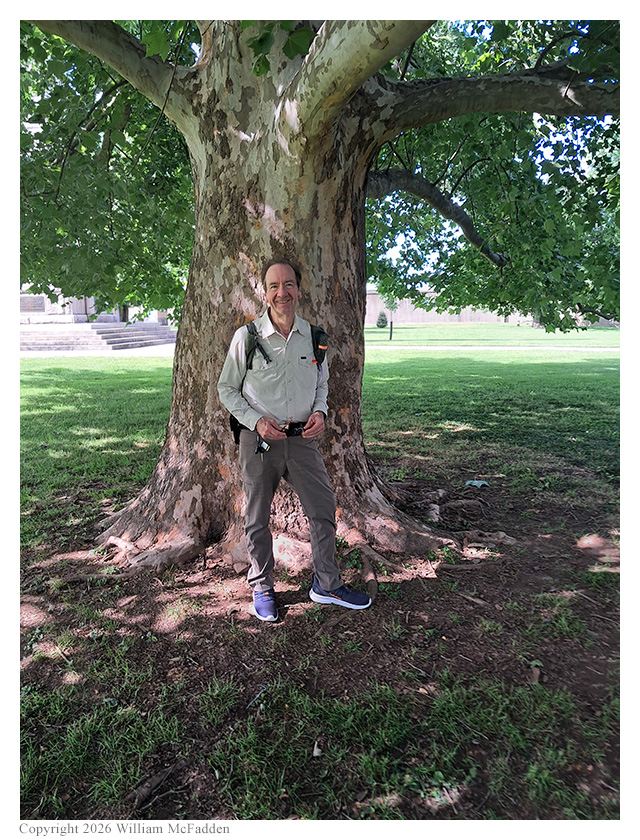
A huge old maple tree at Tu-Endie-Wei
, with Len in the photo to provide scale.
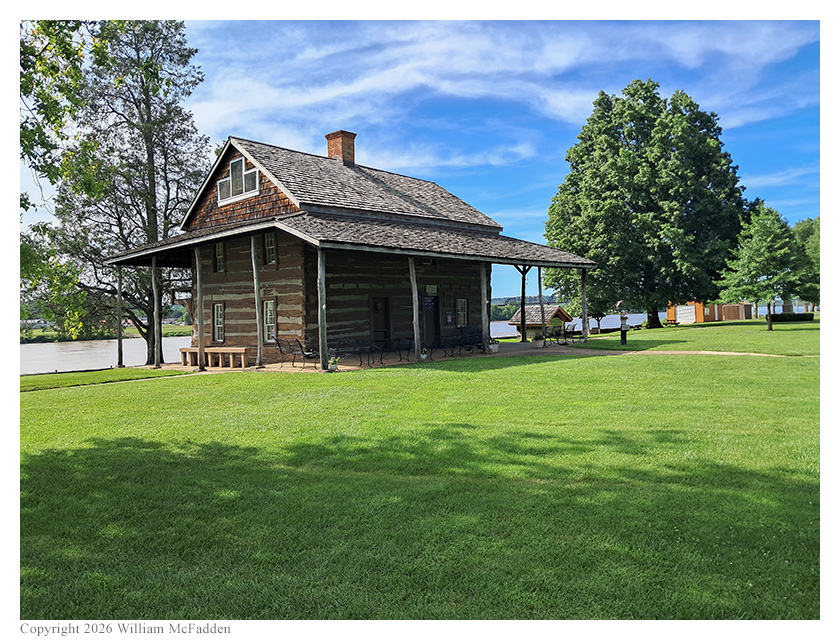
The 1796 Mansion House, which was, alas, closed for the day.
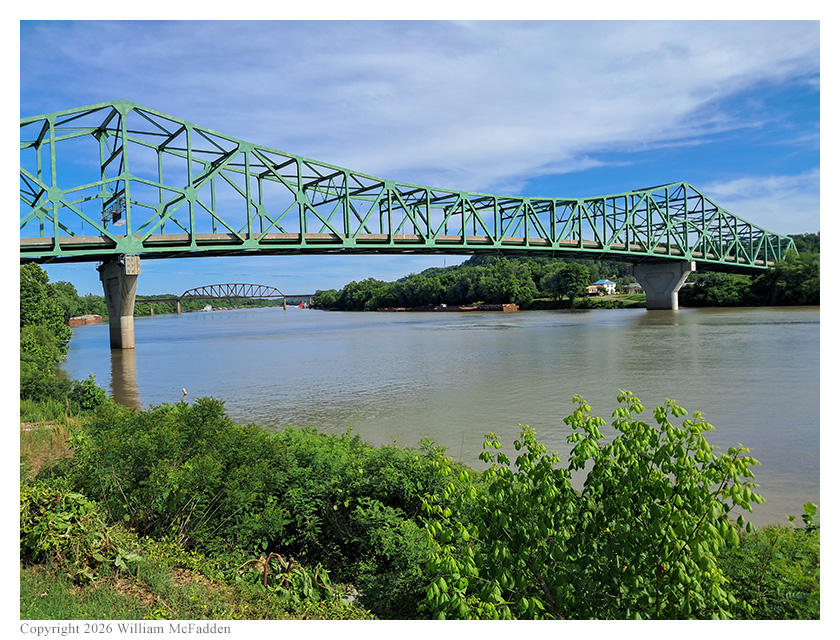
Looking south-east along the Kanawha
River and the Barton Jones Bridge.
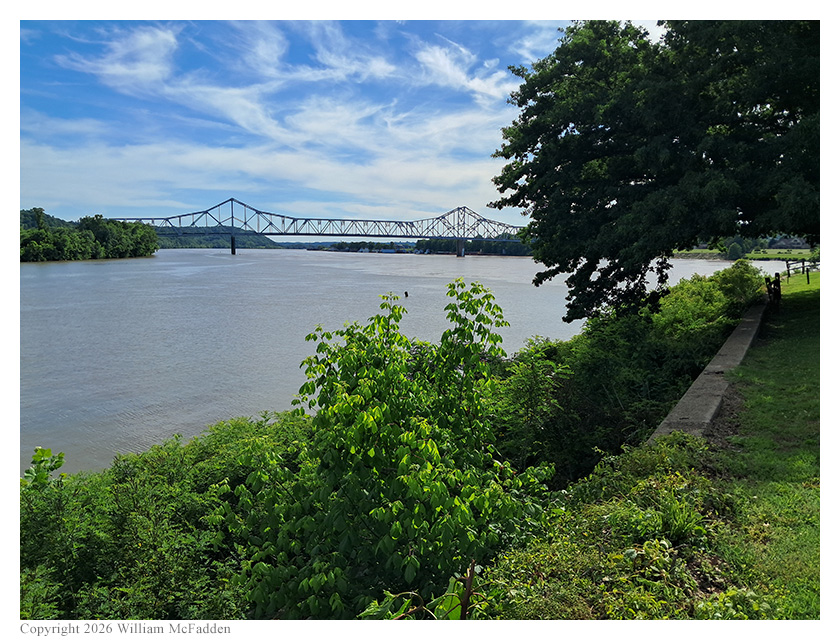
Looking south-west along the Ohio River
and the Silver Memorial Bridge.
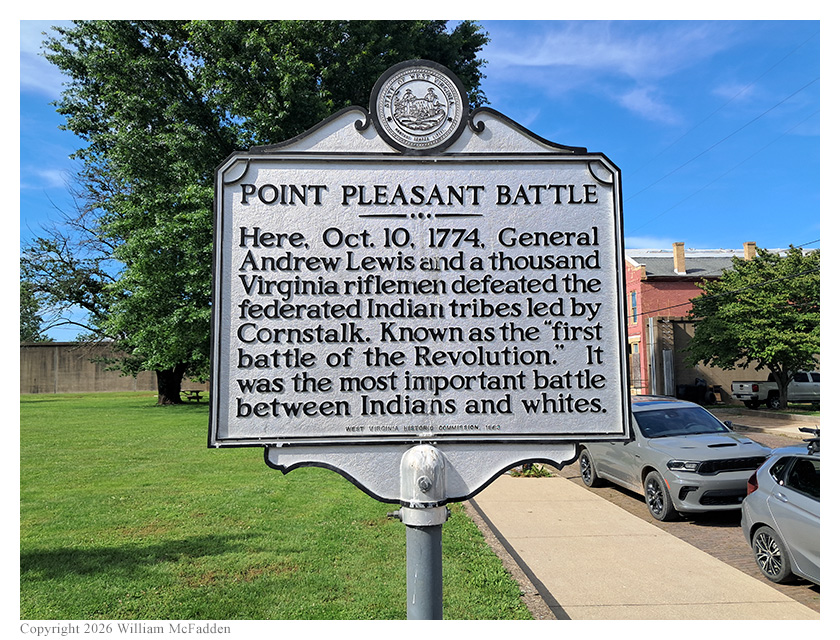
"Point Pleasant Battle: Here, Oct. 10, 1774, General
Andrew Lewis and a thousand Virginia riflemen
defeated the federated Indian tribes led by Cornstalk.
Known as the "first battle of the Revolution. It was
the most important battle between Indians and whites.
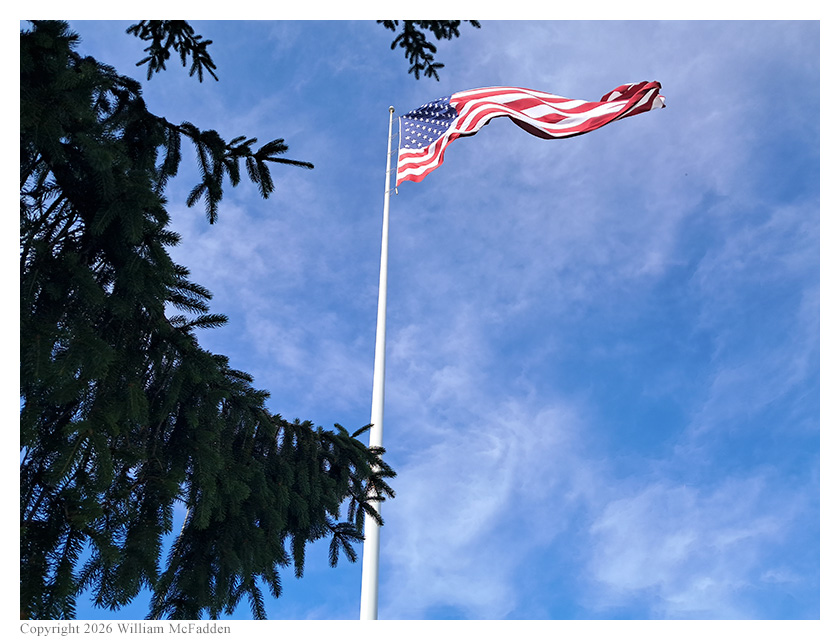
A spectacularly large American flag blows in
the wind above Eric's chosen park bench.
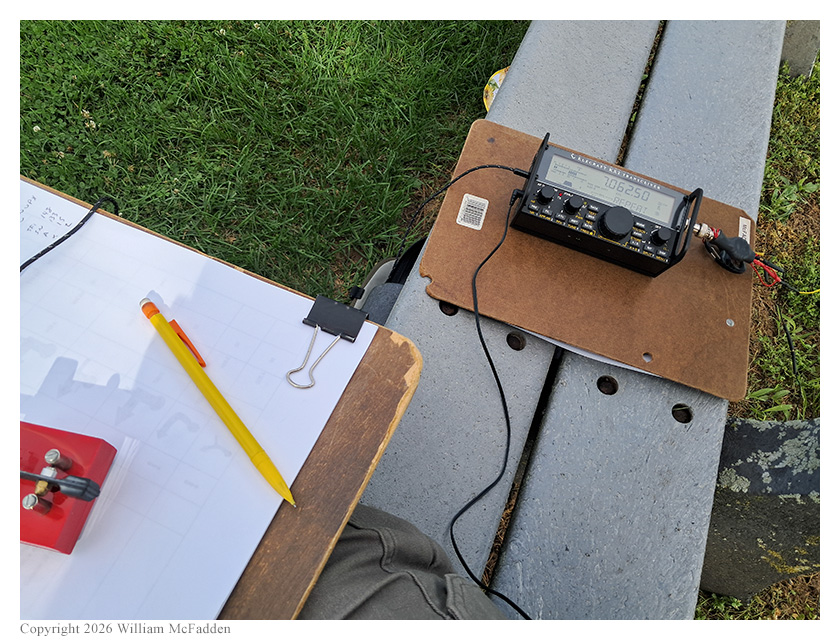
Eric's Elecraft KX2 station on the park bench.
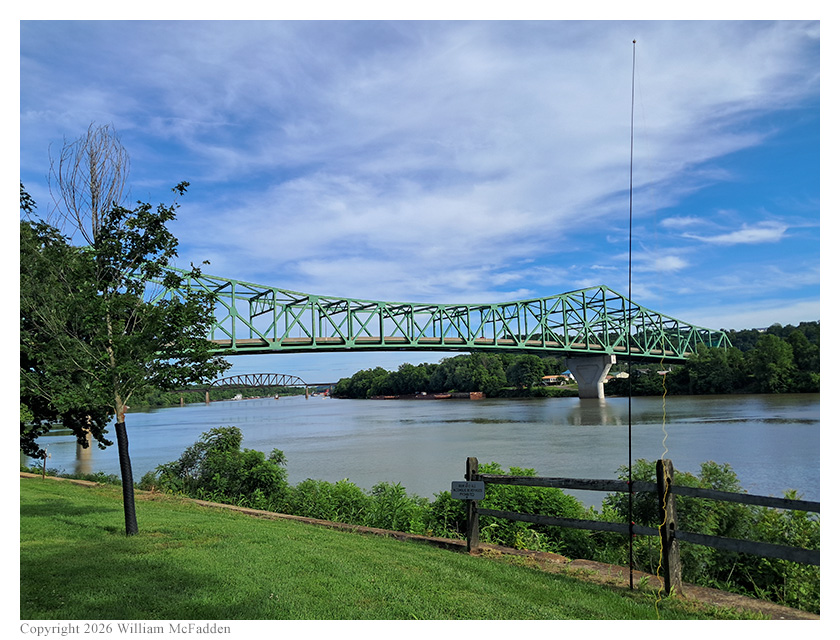
Eric's mast and antenna.
As Eric had expected, given the location of this park right in the town of Point Pleasant, both he and Len had excellent cell-signal and would able to self-spot themselves on the POTA Spots website and to look for park-to-park (P2P) QSO opportunities.
It must have been graduation-day in Point Pleasant because, during their operations, Eric and Len saw several families photograph their high school graduates on the scenic grounds. Eric spoke with one mother and daughter and learned that the daughter had been accepted at the Air Force Academy.
This was the weekend of the CQ World Wide Worked All Prefixes (CQ WW WPX) CW contest and Len and Eric both expected the non-WARC bands to be hopping with activity. Ceding 20m to Len, Eric began his operation on 40m, and was surprised to find his usual POTA frequencies near 7063 kHz to be free of contest activity. Len, on the other hand, found 20m to be hopping with activity, but he was able able to take advantage of this by tuning the band and working stations participating in CQ WW WPX, sending the full contest exchange of RST plus consecutive serial number.
Eric began his operation by finding himself a clear 40m frequency to run, began calling "CQ POTA", and self-spotted himself on POTA Spots. His first QSO came at 2127 UTC with WA4CHJ in North Carolina. QSOs came steadily, with Eric's thirteenth QSO coming at 2153 UTC with KM4QNA in Alabama. This run included QSOs with operators located in Alabama, Illinois, Indiana, New York, North Carolina (3), Pennsylvania, Tennessee (2), Virginia (2), and West Virginia.
Having succeeded in validating his activation, Eric ceded 40m to Len and began hunting for P2P QSOs. At 2202 UTC, he completed a P2P QSO on 40m with Len. At 2205 UTC, he completed a P2P QSO on 20m with WB0RLJ who was performing his activation number 1,202 (!) of Chalco Hills State Recreation Area (US-4101) in Nebraska.
While Len finished up his activation, and before tearing down his station, Eric explored the park and snapped some more photos.
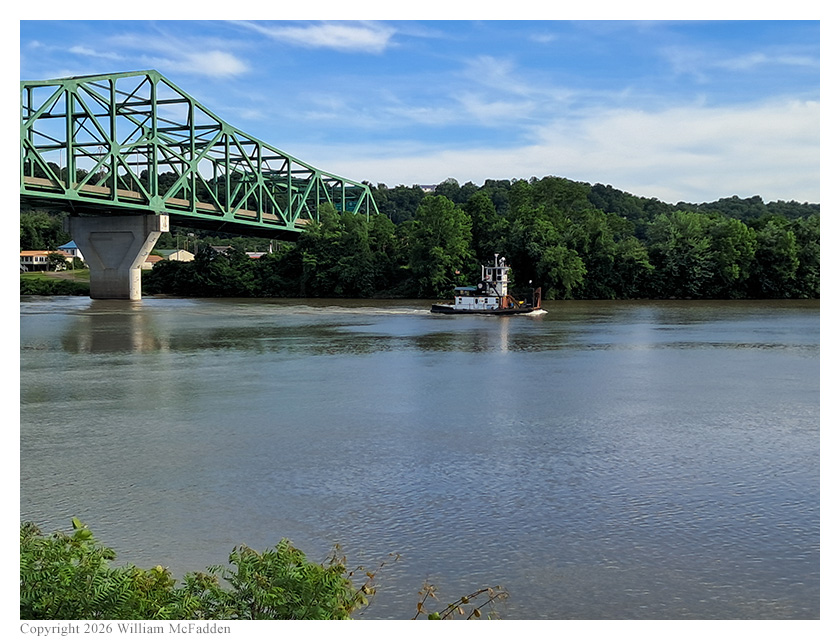
A tug traveling light on the Kanawha River, towards the Ohio.
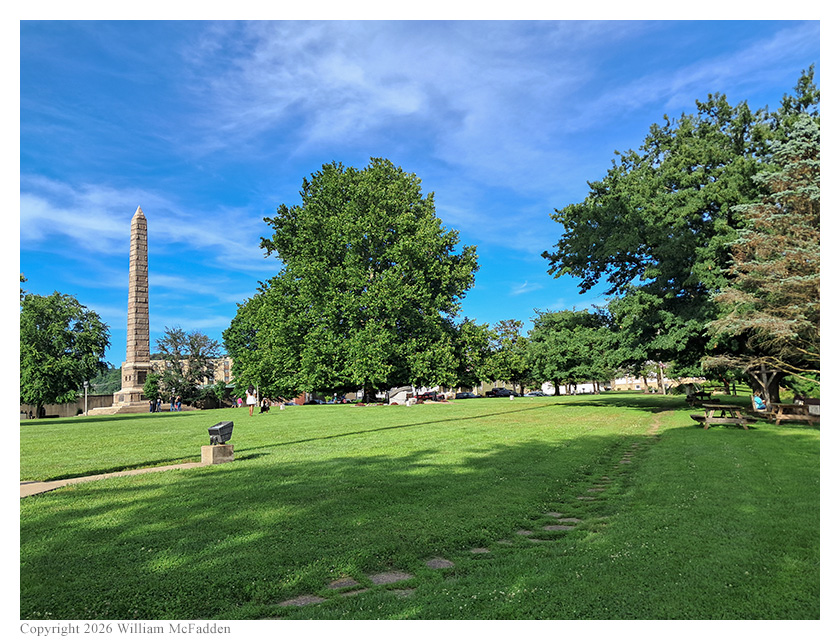
A view of Tu-Endie-Wei State Park.
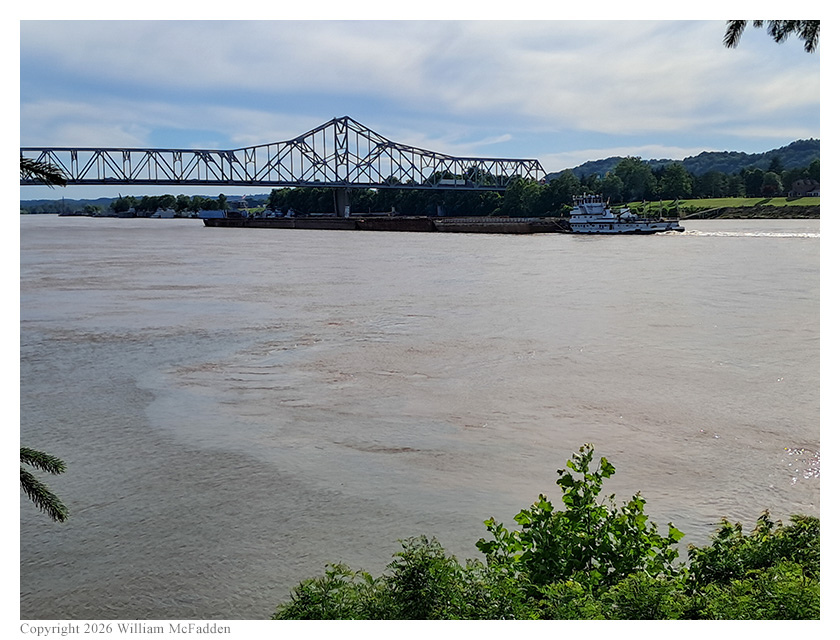
A string of barges passes by on the Ohio River.
Len began his operation on 20m, but CQ WW WPX activity forced him pretty quickly to change to 30m. On 30m, Len succeeded in making some QSOs. Once he recognized that he could work the CQ WW WPX participants for POTA credit, Len returned to 20m and quickly racked up QSOs in hunter mode. When Eric notified him that he could take 40m, Len found a clear frequency on this much-less-busy band and easily made several more QSOs.
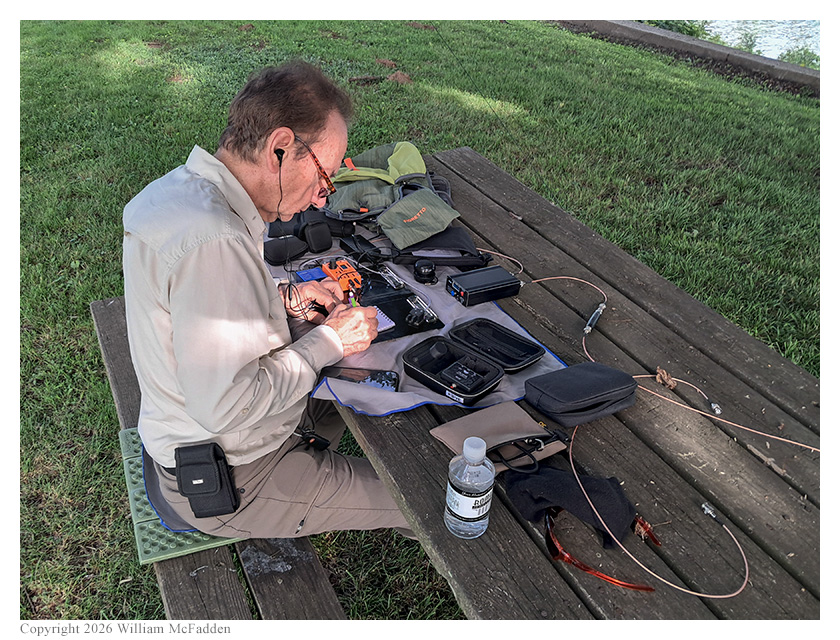
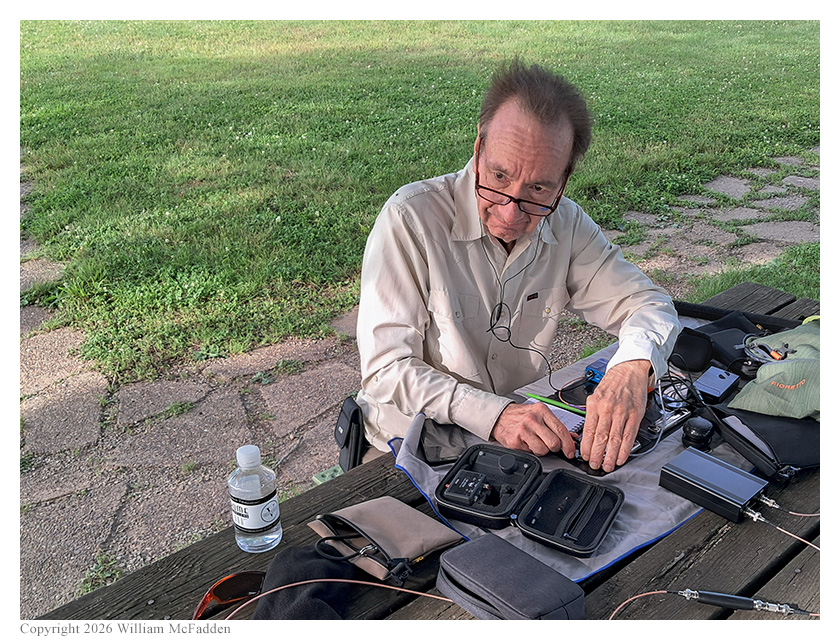
Len operates his (tr)uSDX station.
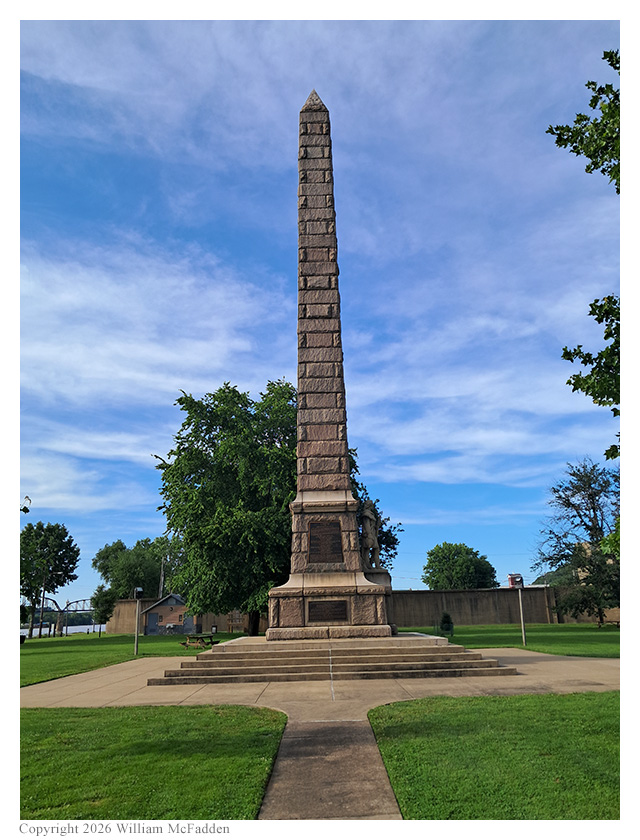
The 84-foot granite monument
commemorating the frontiersmen
who fought and died in the 1774
Battle of Point Pleasant..
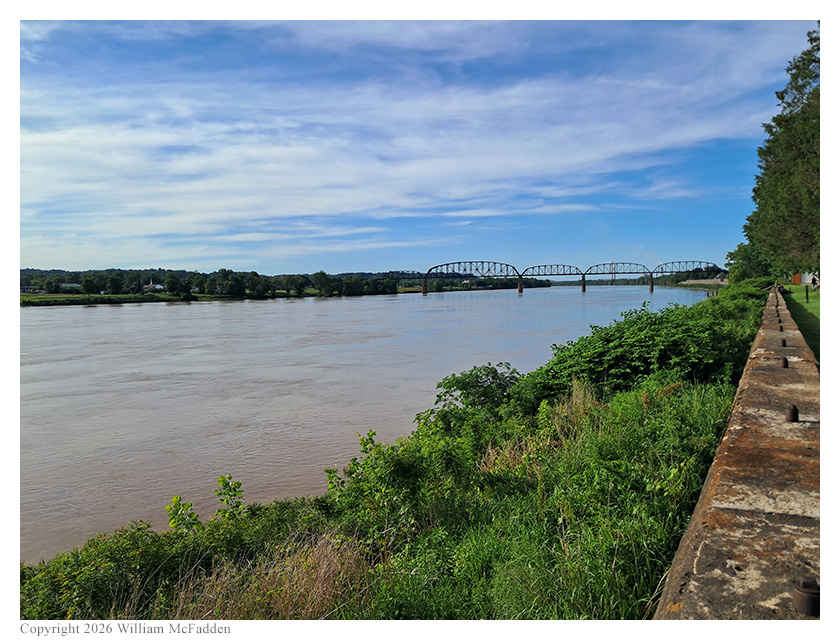
Looking north-east along the Ohio River.
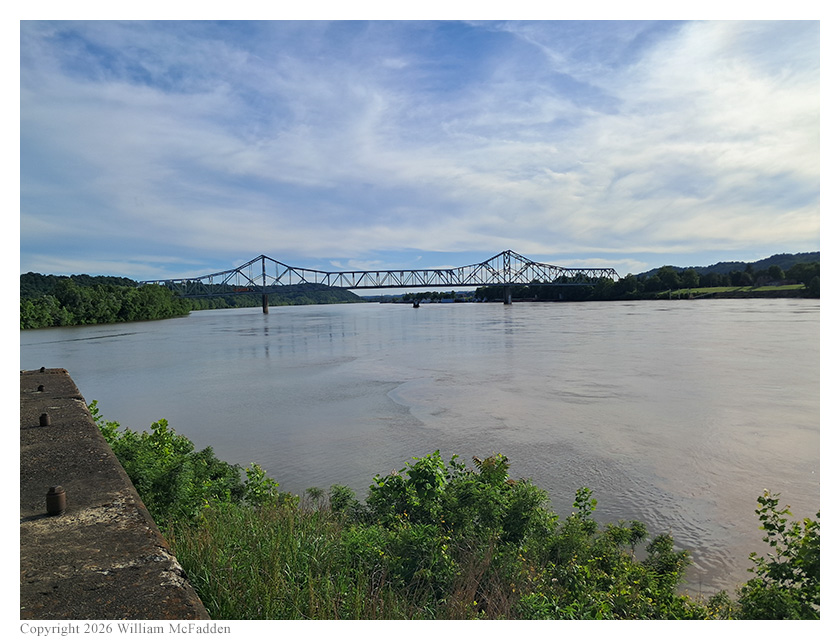
Looking south-west along the Ohio River.
After Eric had validated his activation, he texted his friend Thomas, K4SWL, to tell him Len's 40m frequency and to suggest that he try to work Len. By the time Thomas was able to get to his radio, Len had switched to hunter-mode so, of course, Thomas didn't hear him. His station not yet being torn down, Eric texted a 40m frequency to Thomas and at 2227 UTC he and Thomas were able to complete a QSO, Eric's sixteenth and final QSO of this operation.
In all, Eric made sixteen QSOs, including two P2P QSOs. All of Eric's QSOs were CW and were made at the 5-watt level. Len finished his operation with twelve QSOs, all of which were CW and were made at 5-watts or less.
Eric also submitted his log to the World Wide Flora and Fauna in Amateur Radio (WWFF; link) program for Tu-Endie-Wei State Park, KFF-1823.
(return)