by William Eric McFadden
From the park's website:
-
Located in the shadow of the Capitol in downtown Nashville, Bicentennial Capitol Mall gives visitors a taste of Tennessee’s history, natural wonders and serves as a lasting monument to Tennessee’s Bicentennial Celebration, which was June 1, 1996. With just a simple walk in the 11-acre park visitors can experience many facets of Tennessee’s history including a 200-foot granite map of the state, a World War II Memorial, a 95-Bell Carillon, a Pathway of History and the Rivers of Tennessee Fountains. The 11 planters along the Walkway of Counties show native plant species from different regions of the state.
Pictures
Description
On Wednesday, April 15, 2026, one member of the Southeast Ohio Radio Adventure Team performed a successful activation of Bicentennial Capitol Mall State Park (US-2928) in Tennessee as part of the Parks on the Air (POTA; link) program.
While driving home from northern Alabama, where he and his wife had found themselves for the adoption of a small dog the previous day, and following a successful activation of Radnor Lake State Park just a few minutes earlier, Eric McFadden, WD8RIF, stopped at Bicentennial Capitol Mall State Park in downtown Nashville for his second POTA activation within the state of Tennessee. Eric was accompanied by his wife Vickie and their two small dogs Theo and Gracie.
Hoping to find available parking, Eric let Google Maps navigate them to Nashville Farmers Market, and he, Vickie, and the two small dogs arrived there about 1815 UTC to find several available, two-hour-limit, parking spaces on Seventh Avenue between the Farmers Market and the Bicentennial Capitol Mall. Choosing a parking space beneath a shade tree, Eric parked the car. While Vickie checked out the Farmers Market, Eric and Theo found a shaded bench on the periphery of the Mall, near the Centennial Memorial, for Eric's operation. (Eric had originally also taken Gracie-dog with him to the bench, but she was too energetic, and not yet fully comfortable with her new people, so Eric took her back the car, ensuring that the sunroof and windows were open for her.)
Hoping to do a quick, super-low-profile urban activation, à la K4SWL, Eric set up his Elecraft KH1 on the bench and used a Tufteln (info) KH1 Right Angle Adapter to hold the KH1's 48" whip upright, placing the KH1's single 13' counterpoise wire directly on the ground. Eric was on the air at 1831 UTC.
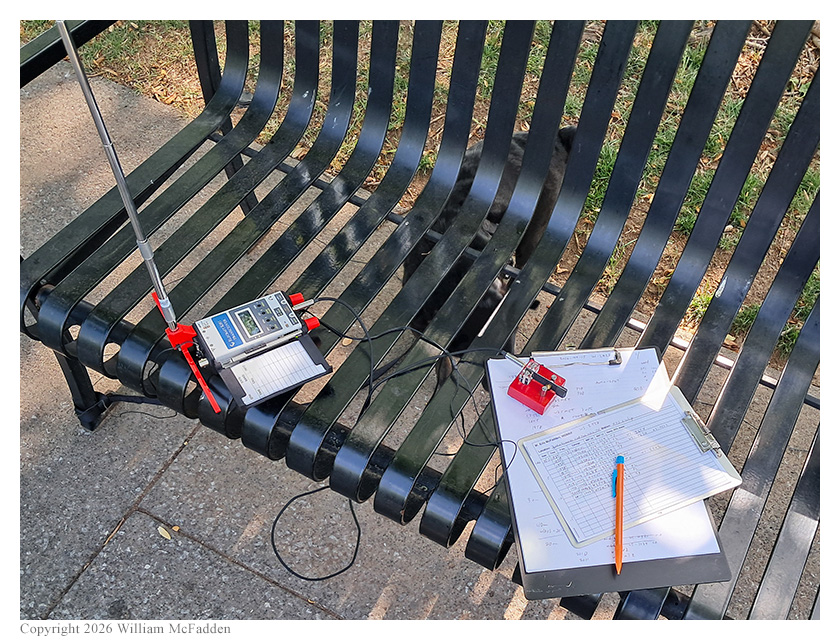
The KH1 station on the bench.
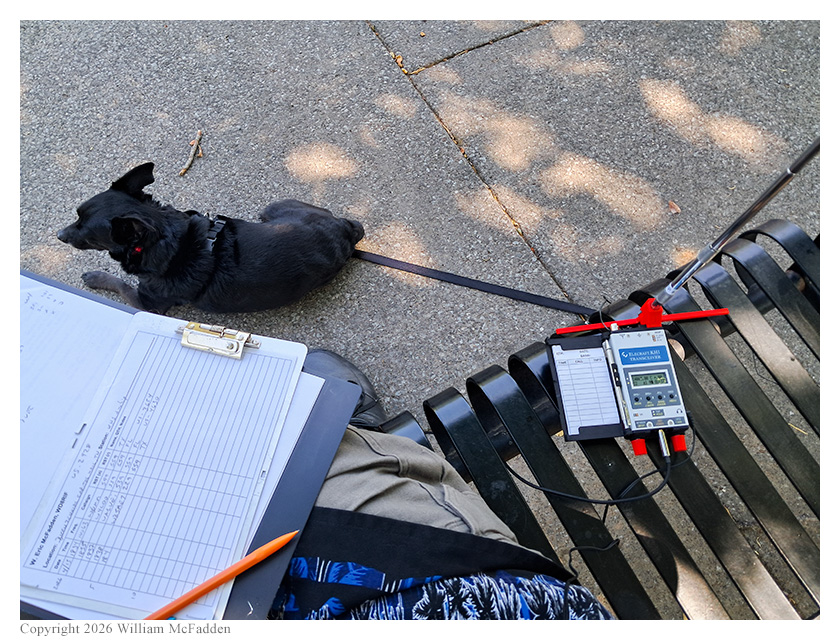
Eric operates while Theo maintains guard.
As he had expected, since he was in the middle of an urban location, Eric had good cell-signal and would be able to access POTA Spots to spot himself and to find Park-to-Park (P2P) QSO opportunities.
Eric started his operation on 20m. After finding himself a clear frequency to run, Eric began calling "CQ POTA" and was auto-spotted on POTA Spots. His first QSO came at 1834 UTC with W0MM in Texas. His second QSO came at 1835 UTC with W4LOO at Savannas Preserve State Park (US-3654) in Florida. His third QSO came at 1837 UTC with WA1VEI who was performing a two-fer activation of Little Big Econ State Forest (US-4630) and Florida Trail National Scenic Trail (US-4559) in Florida. His fourth QSO came at 1838 UTC with WB5MET who was performing a two-fer activation of McKinney Falls State Park (US-3038) and El Camino Real de los Tejas National Historic Trail (US-4568) in Texas. Things were looking very good, four QSOs with five P2Ps in just seven minutes. What could go wrong now? Well, plenty, it seems.
Many more minutes of calling "CQ POTA" failed to produce even a single QSO. Finally, at 1845 UTC, he just managed to pull IW2BNA in Italy out of the noise floor and was able to complete the QSO. Then, thirteen minutes later, at 1858 UTC, his CQ was answered by VE3TEF in Ontario.
Pausing to hunt for P2P QSOs, Eric found he could hear almost no other activators, but at 1907 UTC he was able to complete a P2P QSO on 20m with AL7T who was activating Lake Carlos State Park (US-2502) in Minnesota.
After returning to 20m to run a frequency, twelve minutes later, at 1919 UTC, Eric completed a QSO with ON4VT in Belgium. At 1927 UTC he completed a QSO with KB4VU in Florida. Then, nothing.
By this time, Eric's friend Thomas, K4SWL had arrived at Blue Ridge National Parkway (US-3378) in western North Carolina for his own activation, and he and Eric tried to work each other on 30 and 40m, but neither could hear the other. For 40m, Eric added the AXE1 loading coil to the KH1's standard 48" whip and swapped out the 13' counterpoise wire for the 33' wire. For 30m, Eric found the KH1's internal ATU found a better match with the AXE1 removed from the antenna, although the SWR was still higher than 3:1. In addition to not being able to work Thomas, no other stations came back to Eric's calls of CQ on either 30 or 40m.
At the time, Eric didn't know that he had worked two two-fer activators (WA1VEE and WB5MET), each of which could be logged as separate QSOs, so he thought he was still at nine QSOs, one shy of the ten required for a validated activation. (Had he known of the two two-fers, he could have ended his operation at this point with a validated activation.)
Returning to 20m, Eric first tried to hunt for P2P QSOs, but succeeded in working no one. Returning to run-mode, at 2010 UTC he was able to complete a QSO with K2PVB in Florida and, at 2011 UTC, he was able to complete a QSO with KF5UTZ in Texas.
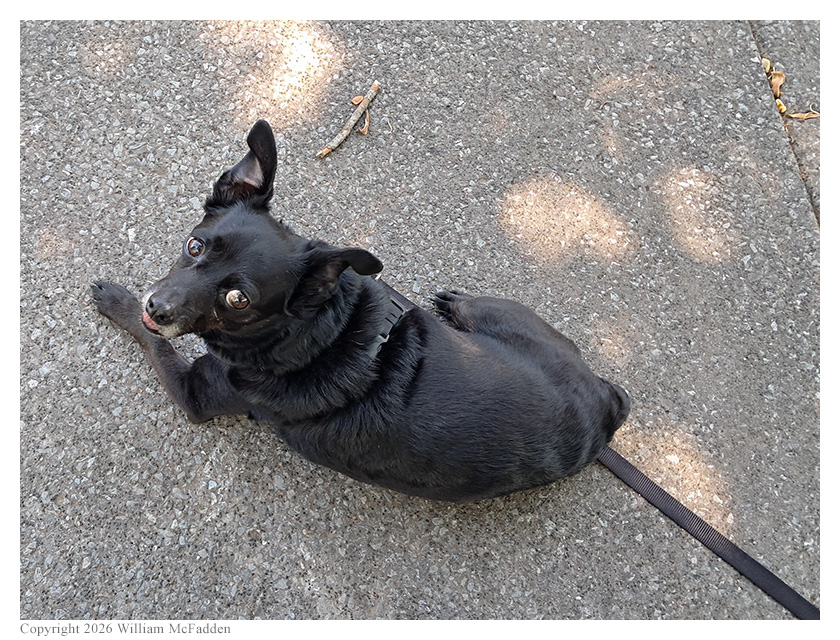
Theo asks, "Can we go home yet?"
With nearly ninety minutes spent at the key, and with eleven QSOs in the log to show for it, and with at least eight hours of driving ahead of them before he and his wife (and the dogs) would arrive at home in southeastern Ohio, Eric called the operation complete.
Eric snapped some photos, tore down his station, re-packed the car, and began the long drive back to Ohio.
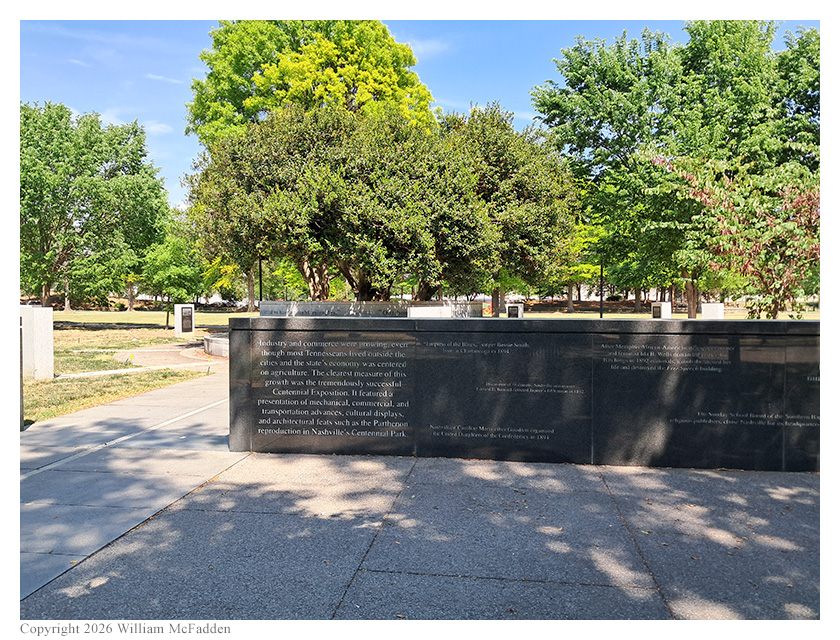
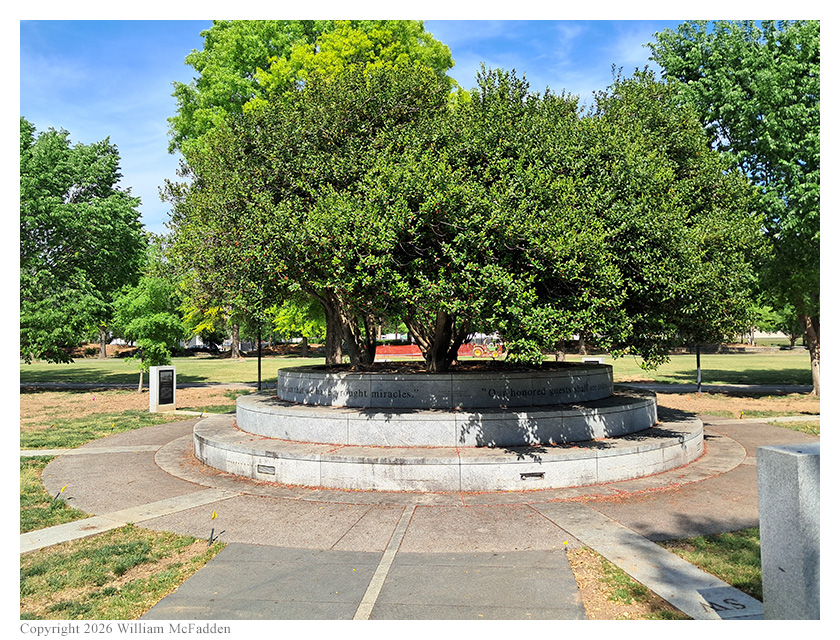
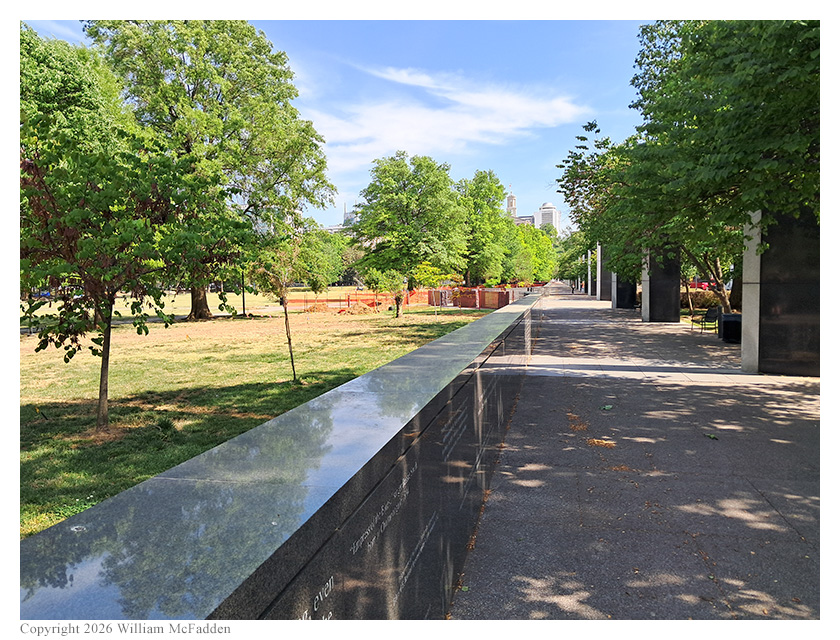
Scenes from Bicentennial Capital Mall State Park.
In all, Eric made eleven QSOs, including six P2P QSOs, in almost ninety minutes of on-air time. All of Eric's QSOs were CW and were made at five watts output.
Eric's first thought about his difficulty in making QSOs, of course, was that the 48" whip antenna on the KH1 was the problem, and he had briefly considered switching to his Tufteln 15' 4:1 EFRW supported on his Goture Red Fox Super Hard 720 carbon-fiber mast bungied to the park bench, but didn't think this slightly larger antenna would make all that much difference. He was confident his KH1 Micro Travel Kit's 35' ad hoc EFRW was big enough to make a difference but he really didn't want to try deploy this much larger antenna in this urban park. The KH1's 48" whip, while certainly being a comprised antenna, wasn't the cause of slow QSO-rate. After all, the 48" whip had delivered two cross-Atlantic QSOs. Despite solar numbers that didn't indicate a problem (SFI 101, SN 57, A-Index 4, K-Index 1), it was clear that propagation had simply gone away between the end of Eric's activation of Radnor Lake State Park and the beginning of this activation of Bicentennial Capitol Mall State Park.
For his part, Thomas, K4SWL, encountered similar difficulty performing his activation of Blue Ridge National Parkway (US-3378). While he used his KH1 and 48" whip to try to work Eric, for his activation he used a Mountain Topper MTR-3B Currahee transceiver and an N6ARA TinyGawant whip antenna with built in manual ATU. His report on this challenging operation can be read on QRPer.com.
Eric also submitted his log to the World Wide Flora and Fauna in Amateur Radio (WWFF; link) program for an operation at Bicentennial Capitol Mall State Park, KFF-2928.
(return)