
by William Eric McFadden
From the Tar Hollow State Park website:
-
Twisting park and forest roads pass through deep ravines and dense woodlands. Scattered shortleaf and pitch pines growing on the ridges were once a source of pine tar for early settlers, hence the name Tar Hollow. Dogwoods, redbuds and a variety of wildflowers color the hillsides in the springtime. Fall's pageant of color is spectacular.
From the Tar Hollow State Forest website:
-
Seventeen miles of paved forest roads and 14 miles of gravel forest roads provide a great opportunity for a scenic drive and allow good access to all areas of the forest.
From the North Country Trail Association website:
-
The North Country National Scenic Trail is the longest in the National Trails System, stretching 4,800 miles across eight states from North Dakota to Vermont, traversing forests and farmlands, remote terrain and nearby communities. Whether you’re looking to day-hike a few miles or plan a longer overnight backpacking trip, a multitude of diverse landscapes and hiking opportunities are waiting for you.
Pictures
Description
On Wednesday, May 13, 2026, two members of the Southeast Ohio Radio Adventure Team performed successful three-fer activations of Tar Hollow State Park, Tar Hollow State Forest, and North Country National Scenic Trail in Ohio as part of the Parks on the Air (POTA; link) program.
While driving from Athens in southeastern Ohio to Dayton for Four Days in May (FDIM, info) and Hamvention (info), Eric McFadden, WD8RIF, and Thomas Witherspoon, K4SWL, stopped at Tar Hollow State Forest to perform the three-fer activations. When the duo departed Athens, it was under gray skies and a forecast for rain most of the day, but as they neared Tar Hollow State Park, the skies magically cleared and the threat of rain disappeared.
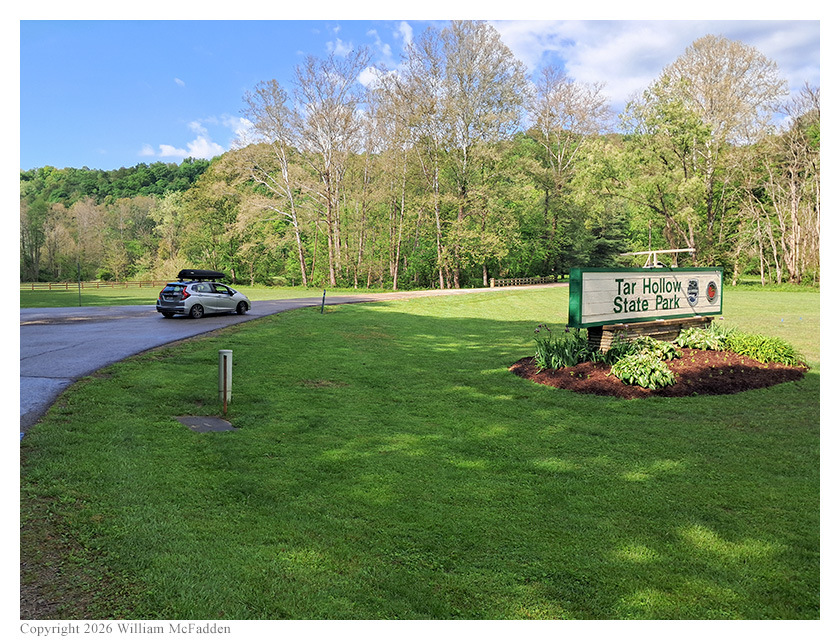
The Tar Hollow State Park sign, under blue skies.
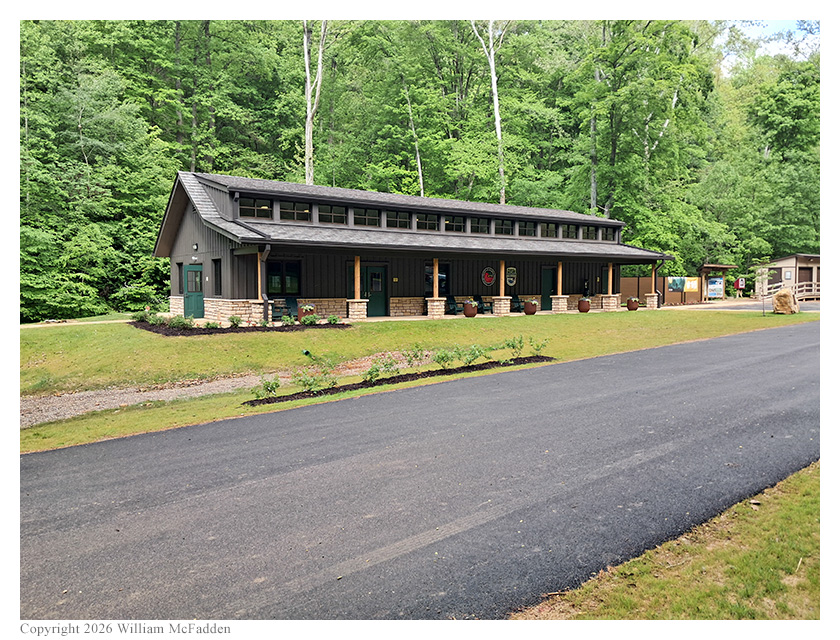
A brand-new education building, with nice bathroom facilities.
The three-fer is available at the Brush Ridge Fire Tower, a location Eric hadn't previously known was actually within Tar Hollow State Park. He had previously only a claimed a two-fer for Tar Hollow State Forest and North Country National Scenic Trail two-fer at the fire tower. Either he had earlier misread the maps, or Ohio Department of Natural Resources has published a new state park map, but the map available on the Tar Hollow State Park website clearly shows Brush Ridge Fire Tower to be within the state park as well as within the state forest. The map and trailhead markers at the fire tower show that North Country National Scenic Trail passes this location.
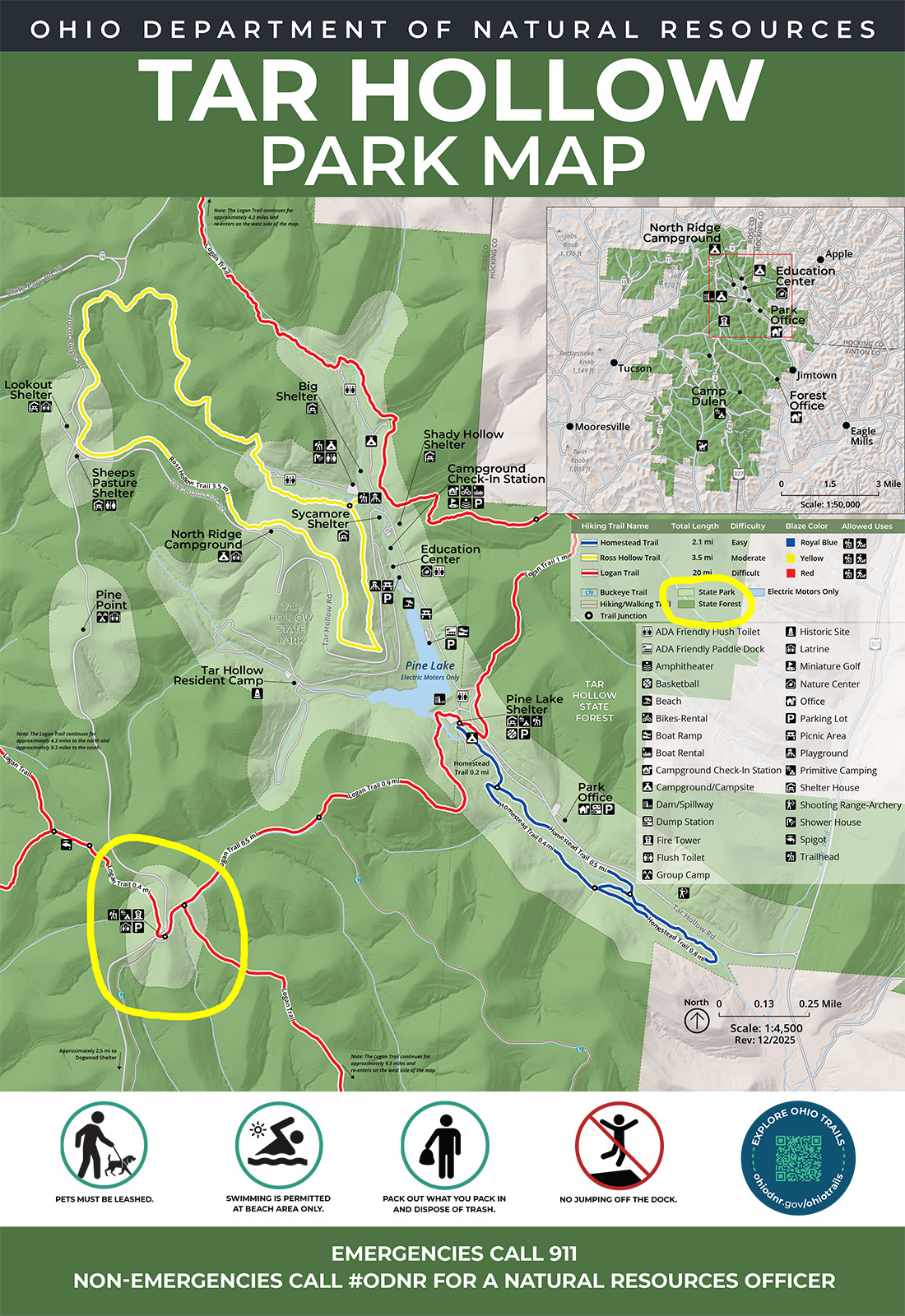
Proof-positive that Brush Ridge Fire
Tower is part of Tar Hollow State Park.
Tom and Eric arrived at Brush Ridge Fire Tower to find the entire area to be unoccupied. Tom wasted no time in scouting out the area for suitable antenna-support trees, while Eric confirmed the location of the North Country National Scenic Trail trailheads and found a level spot to set up his folding camp-chair.
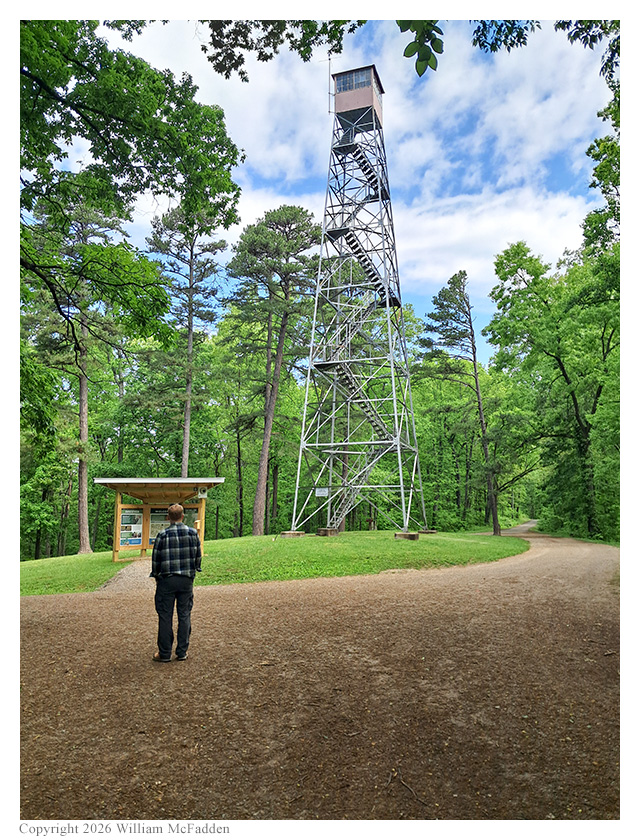
Tom scouts out the area for an operating location.
Having identified a suitable tree, Tom expertly threw an arborist's line through the tree and pulled up a 40m end-fed halfwave antenna. Hooking up his Elecraft KX2 to the antenna through a bandpass filter, he was on the air in no time.
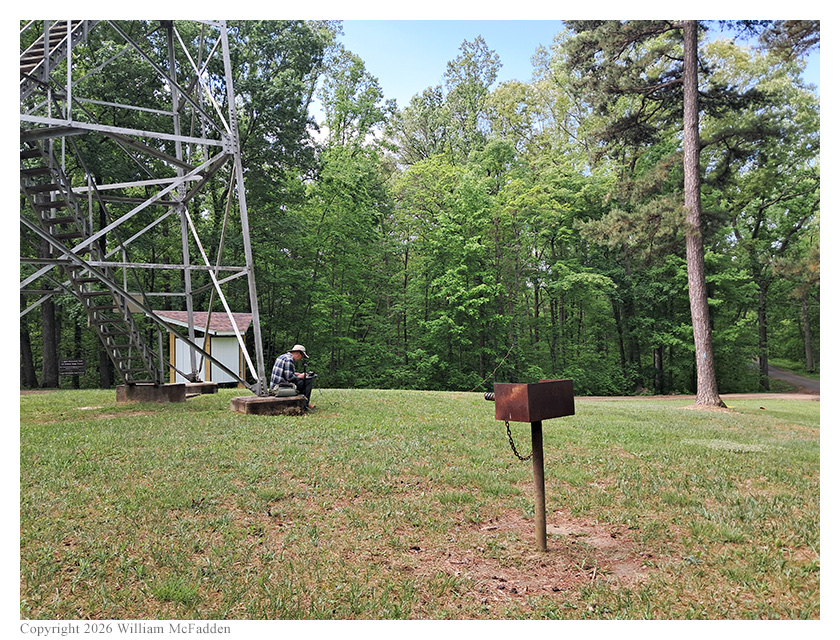
Tom operates his station at the base of the fire tower.
Having found a level space for his camp-chair at some distance from Tom's station, Eric bungied his 31' Jackite telescoping fiberglass mast to the chair and used it to support his Tufteln (link) end-fed random wire antenna as a 29' vertical, placing two 17' counterpoise wires directly on the ground. Placing his Elecraft KX2 on the chair's flip-up table, and connecting his Whiterook MK-33 paddle and Sony ear-buds, Eric was on the air at 1438 UTC.
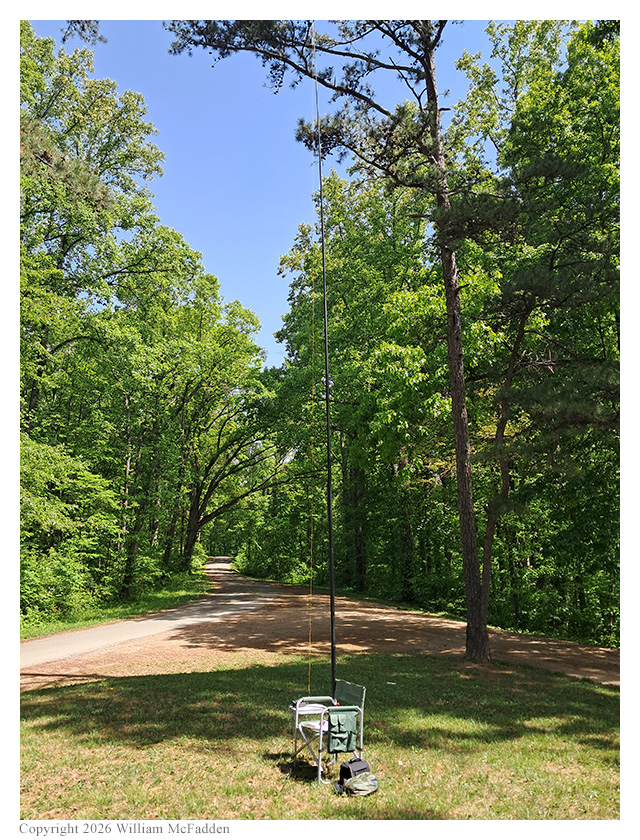
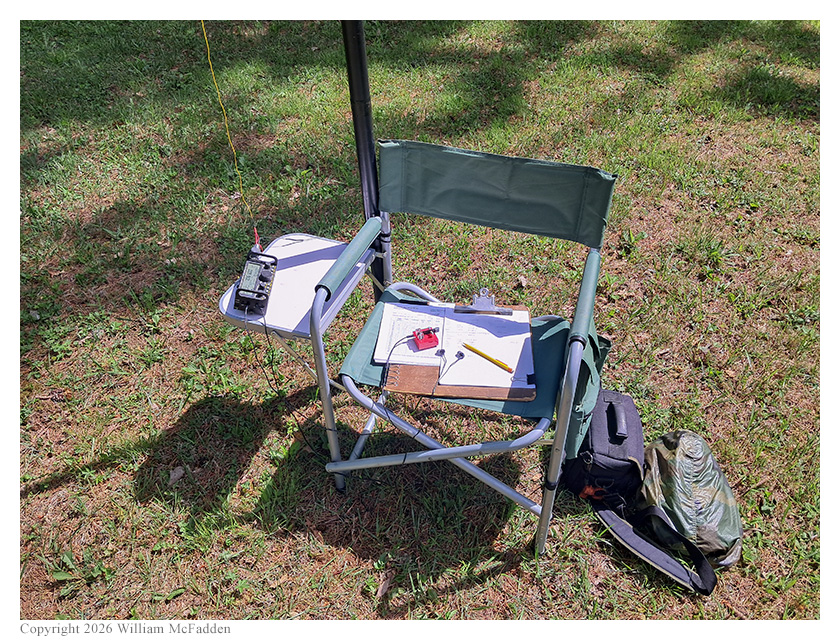
Eric's station.
As he had hoped, Eric had good cell-signal within the park, and he would be able to spot himself on POTA Spots (link) and to use POTA Spots to identify possible park-to-park (P2P) QSO opportunities.
Tom had begun his operation on 40m, so Eric decided to start his operation on 30m, a band not harmonically related to 40m. He found a clear frequency to run, began calling "CQ POTA", and was auto-spotted on POTA Spots. His first QSO came at 1441 UTC with W5KEB in Arkansas. Following this QSO, Eric paused to change to 40m and work Tom for a three-fer P2P QSO. Back on 30m, he refreshed his spot on POTA Spots and at 1448 UTC he worked N1RWJ at JL Curran State Park (US-6992) in Rhode Island. This was followed at 1450 UTC by a QSO with NK8O in Minnesota.
Switching to 20m, Eric found a clear frequency to run, began calling "CQ POTA", and was autospotted on POTA Spots. His first QSO in this run came at 1457 UTC with K1TH in Massachusetts. This was followed at 1504 UTC by a three-fer P2P QSO with Tom.
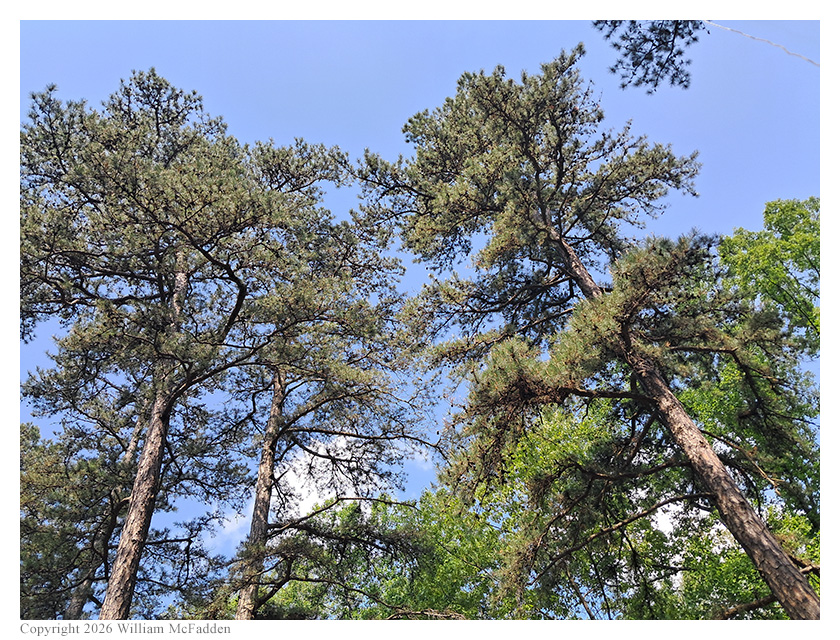
Blue skies viewed through trees.
By this time, Tom had moved off of 40m, so Eric found himself a clear frequency to run on that band and began calling "CQ POTA". His first QSO in this run came at 1506 UTC with N2QLV in New York. This was followed at 1509 UTC by a QSO with N3ZP in Pennsylvania. Following this QSO, Eric paused to change to 17m to work Tom for a third three-fer P2P QSO. Back on 40m, he worked K5KHK in New York at 1513 UTC, W8JWL in Michigan at 1515 UTC, and WD9F in Illinois at 1516 UTC.
In all, Eric made twelve QSOs in just under thirty minutes of on-air time. All of Eric's QSOs were CW and were made with five watts output.
Tom's full report can be viewed here: Ten Years Later! A Three-Fer at Tar Hollow with Eric (WD8RIF).
After they had both completed their operations, Tom and Eric tore down their stations, repacked the car, and began the short drive to Chillicothe for lunch and activations of Hopewell Culture National Historic Park.
Eric also submitted his log to the World Wide Flora and Fauna in Amateur Radio (WWFF; link) program for Tar Hollow State Park, KFF-1996.
(return)