
by William Eric McFadden
From the Strouds Run State Park website:
-
Strouds Run State Park is located in the scenic forested hills of Athens County, in the midst of the unglaciated Appalachian Plateau. Although untouched by the vast ice sheets that moved across portions of the state over 12,000 years ago, Strouds Run displays the effects of the glaciers -- in the deep ravines and high hills -- where the valleys served as outlets for torrents of glacial meltwaters. The erosive power of these waters carved the valleys and hillsides, creating the familiar topography Ohioans know today. Large deposits of glacial outwash, primarily sand and gravel, were deposited along these streams and strongly affected the type of biological communities present today.
Sandstone, the principal bedrock outcropping in the region, is very resistant to erosion and forms the uplands and steep sides of the valleys. Twisting roads and forest trails pass through these deep ravines and lead to dense stands of beech, hickory, oak, maple and tuliptree. Seasonal displays are offered by flowering dogwood, redbud and spring wildflowers -- with fall presenting a pageant of colorful foliage. These woods are home to white-tailed deer, fox, raccoon, opossum, squirrel, wild turkey and a variety of songbirds. Woodthrush, white-breasted nuthatch, scarlet tanager, pileated woodpecker and the rufous-sided towhee inhabit the forest canopy. These rugged hills and woodlands are truly reminiscent of the wilderness that characterized the Ohio country in the days of early settlers.
Pictures
- The Strouds Run State Park sign
- Eric's mast and antenna: 1 | 2
- Eric's KH1 station
- Eric's entire station
- Geese: 1 | 2 | 3
- Dow Lake: 1 | 2
- Baby barn swallows
Description
On Sunday, June 7, 2026, one member of the Southeast Ohio Radio Adventure Team performed a successful bicycle-portable activation of Strouds Run State Park (US-1994) as part of the Parks on the Air (POTA; link) program.
Taking advantage of a not-yet-too-hot morning, Eric McFadden, WD8RIF, performed a bicycle-portable POTA activation of Strouds Run State Park, riding his bicycle from his work-office's parking lot on the west side of Athens to Bulldog Shelter within Strouds Run State Park.
Eric started his ride at 1425 UTC, arriving at Bulldog shelter twenty-nine minutes later after a pleasant and uneventful ride.
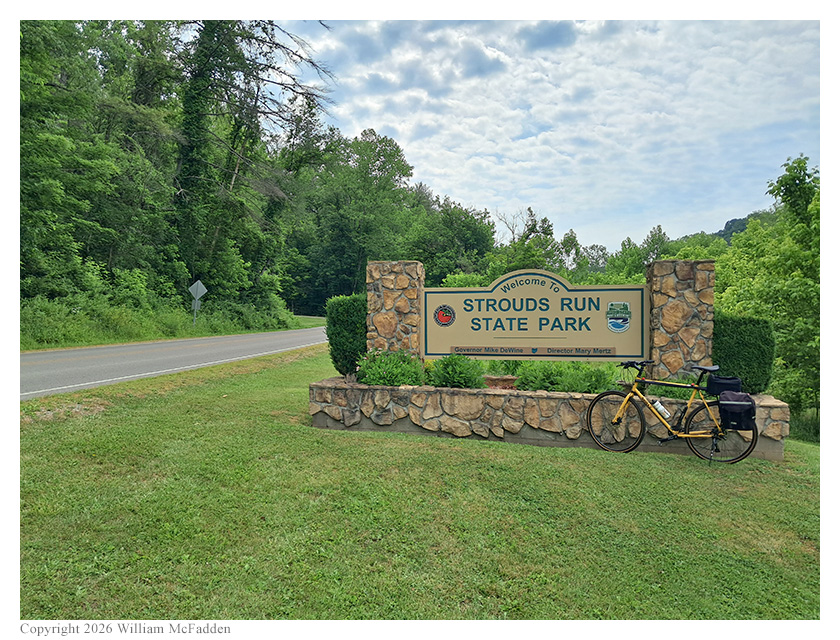
"Welcome to Strouds Run State Park".
At his arrival, Bulldog Shelter was unoccupied except for barn swallows in the rafters and Canada geese on the lawn, and Eric chose his regular picnic table. He had just begun unpacking his station from his bicycle's pannier when Paul Schulz, WD8SCV, arrived on his mountain bike. Minutes later, Ben Brewster, KF8DES, arrived in his Subaru Crosstrek, with his mountain bike hanging off the back. Paul and Ben had been riding some of the Strouds Run trails together, although they had started at different trailheads, and Paul was now riding back to his car at the Dow Lake Dam. During the ensuing "eyeball QSO ragchew", Eric deployed his KH1 Micro Travel Kit's 35' ad hoc end-fed random wire antenna as a sloper to the top of his Goture Red Fox Super Hard 720 carbon-fiber mast bungied vertically to his bicycle, placing a single 13' counterpoise wire directly on the ground. Placing his Elecraft KH1 on the table in "picnic table" mode, and hooking up his Whiterook MK-33 paddle and Sony earbuds, Eric was ready to begin his operation. Paul and and Ben left to go their separate ways a few minutes later, and Eric was on the air at 1510 UTC.
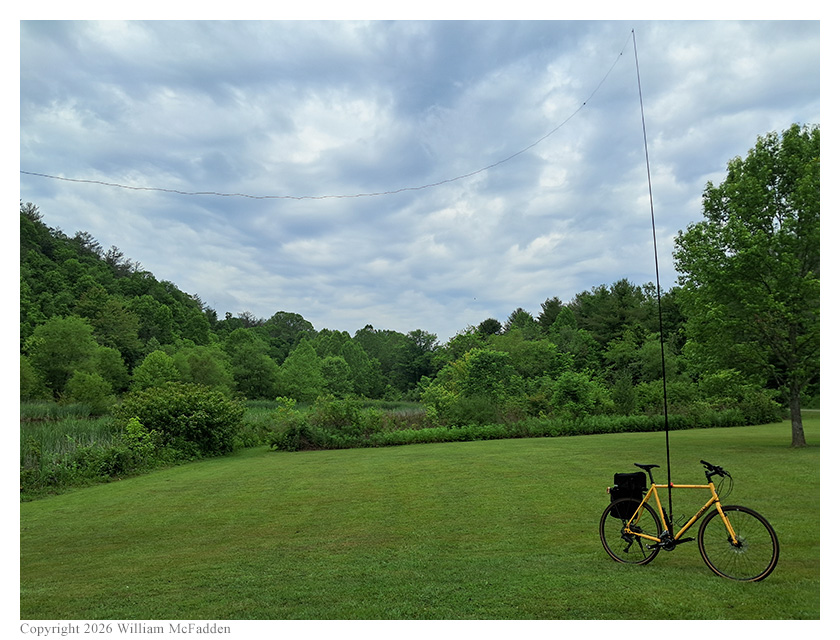
Eric's bicycle-supported mast and antenna
right after deployment, under cloudy skies...
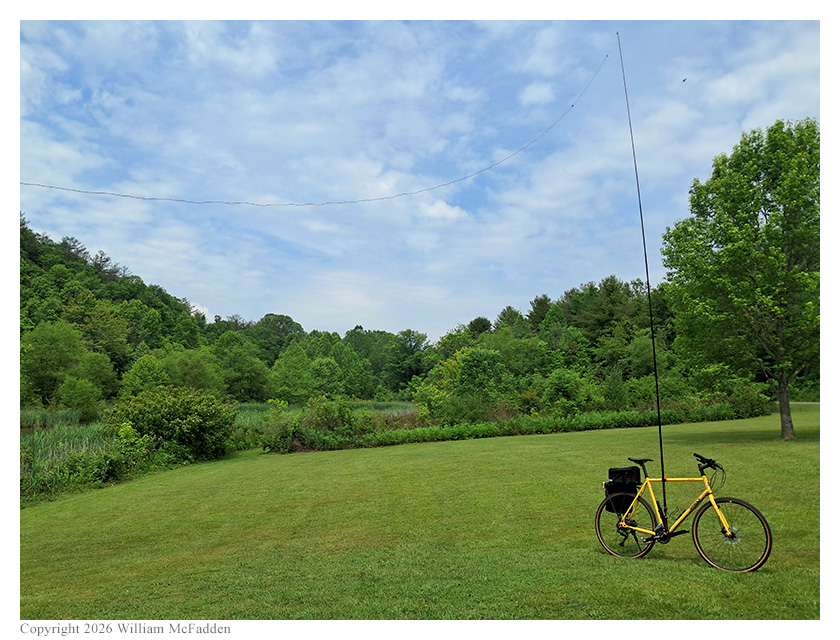
... and later, after the sun began peaking out.
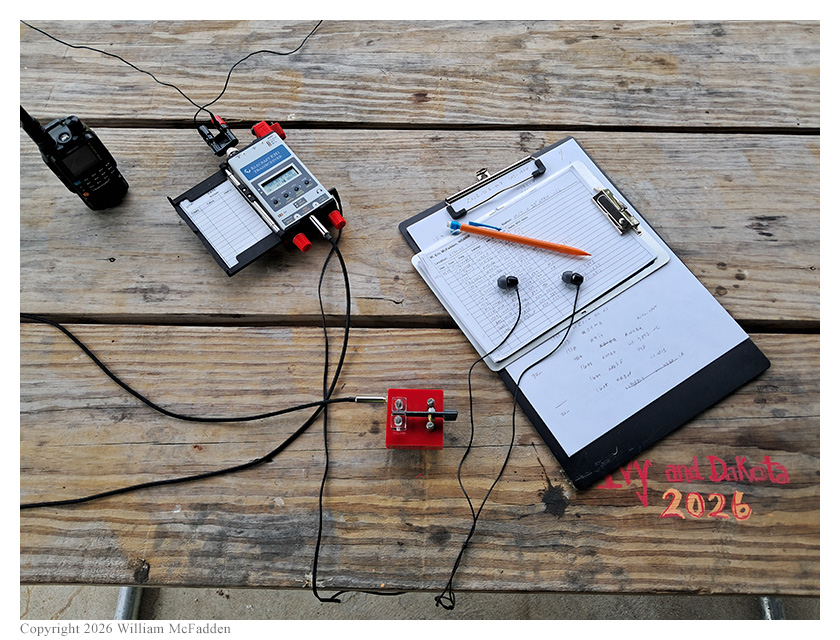
Eric's Elecraft KH1 station.
Cell-signal at the site was weak, but Eric had enough signal to access POTA Spots (link) to spot himself and to look for park-to-park (P2P) QSO opportunities.
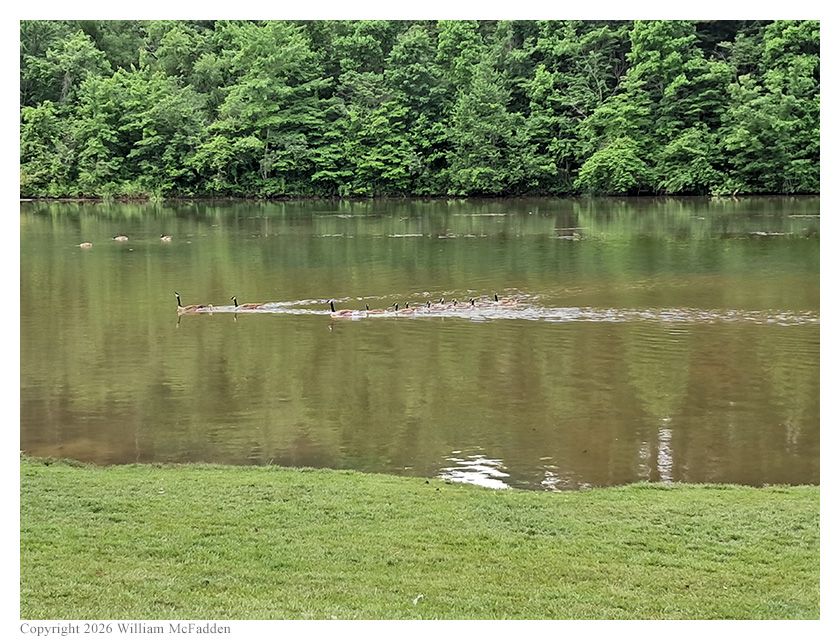
Two Canada geese parents and a large
number of goslings on Dow Lake.
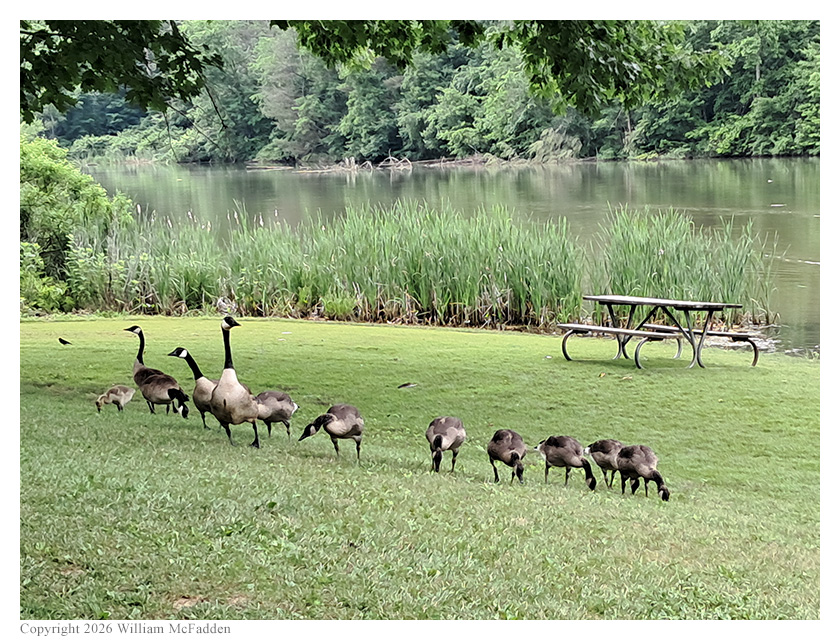
The same family of Canada geese, this time
on the lawn adjacent to the picnic shelter.
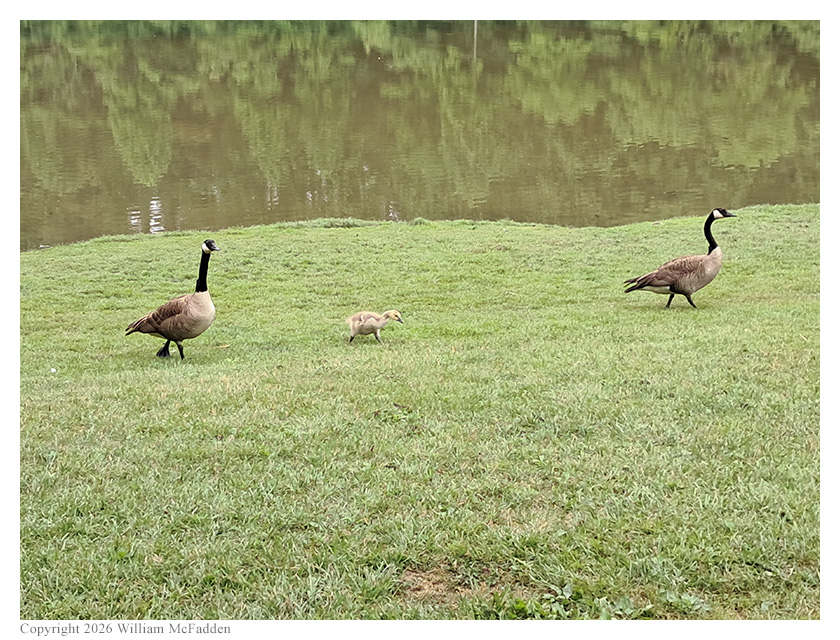
A different family: two parents and much younger
gosling march past the picnic shelter.
Eric began his operation on 20m by finding a clear frequency and calling "CQ POTA", and he was reassured to be auto-spotted on POTA Spots. His first QSO came at 1516 UTC with N4RS in Missouri. His second QSO came at 1518 UTC with WZ2H in New Jersey.
When 20m seemed to stop being productive, Eric switched to 40m. Finding himself a clear frequency and beginning to call "CQ POTA", he was again auto-spotted on POTA Spots. His first QSO in this run came at 1526 UTC with W4JL in North Carolina. This was followed at 1528 UTC by a QSO with his good friend Tom, K4SWL, in western North Carolina. His final QSO in this run came at 1531 UTC with K9VPL in Indiana.
When 40m seemed to stop being productive, Eric switched to "hunter mode", using POTA Spots to identify possible P2P QSO opportunities, but all the stations he tried to work were exceedingly weak and no P2P QSOs were made at this time.
Back on 20m, Eric verified that the frequency he had been running was still free, began to call "CQ POTA", and was auto-spotted on POTA Spots. This resulted in two QSOs: at 1540 UTC with KU4BB in Virginia, and at 1541 UTC with KE2BVB in New Jersey.
Returning to "hunter mode", at 1547 UTC Eric made a P2P QSO on 40m with W4TRA at Haw River at Iron Ore Access Belt State Park (US-3843) in North Carolina.
Returning 20m, Eric verified the frequency he had been running was still free, began to call "CQ POTA", and was auto-spotted on POTA Spots. This run produced three QSOs: at 1549 UTC with WB4JIM in Connecticut, at 1552 UTC with N2EIM in New Jersey, and at 1553 with KJ4MZ in Virginia.
With eleven QSOs in the log, Eric now had a validated POTA activation, but he wasn't yet ready to finish his operation. Switching to 30m, Eric found a clear frequency to run, began calling "CQ POTA", and was again auto-spotted on POTA Spots. His first QSO in this run came at 1558 UTC with stalwart hunter K9IS in Wisconsin. This was followed at 1559 UTC by a QSO with KN4ZQ in Virginia.
Returning to "hunter mode", at 1603 UTC, he was rewarded with a second P2P QSO with W4TRA at Haw River at Iron Ore Access Belt State Park (US-3843) in North Carolina, this time on 30m.
A return to running on 30m resulted in a P2P QSO at 1604 UTC with NQ1F at Wayne F. MacCallum Wildlife Management Area (US-11572) in Massachusetts.
Eric finished his operation by hunting for P2P QSOs, and at 1608 UTC, he made a P2P QSO on 20m with K0BUF at Block Island National Wildlife Refuge (US-0513) in Rhode Island.
In all, Eric made sixteen QSOs, including four P2P QSOs. All of Eric's QSOs were CW and were made with 5w or less of output power.
Eric snapped some more photos and then tore down his station and re-packed his bicycle.
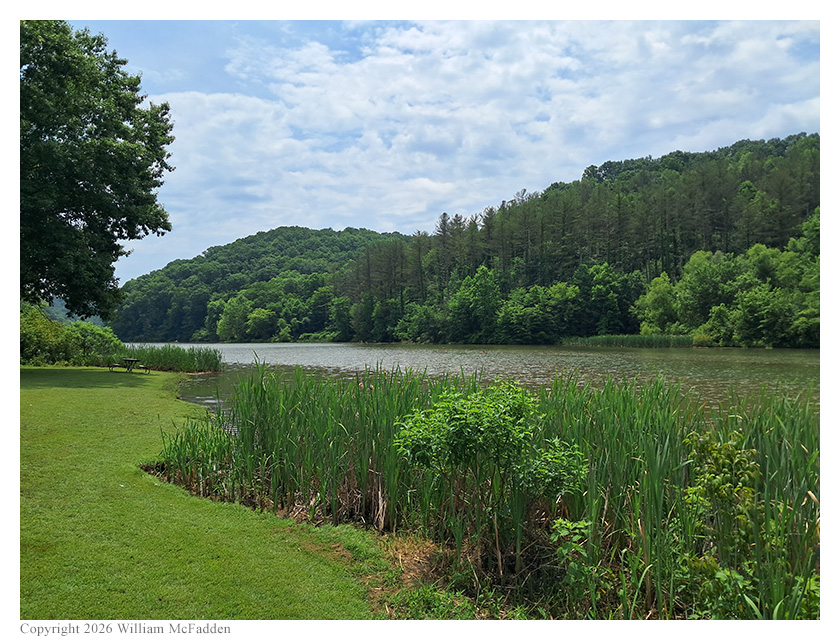
Dow Lake, looking south.
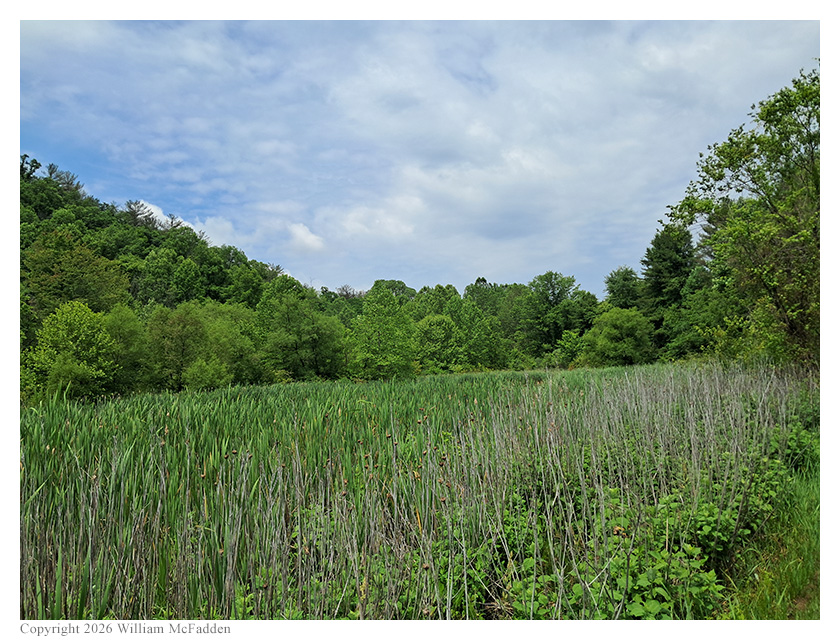
The "beginning" of Dow Lake, at its extreme
northern point, where it's more marsh than lake.
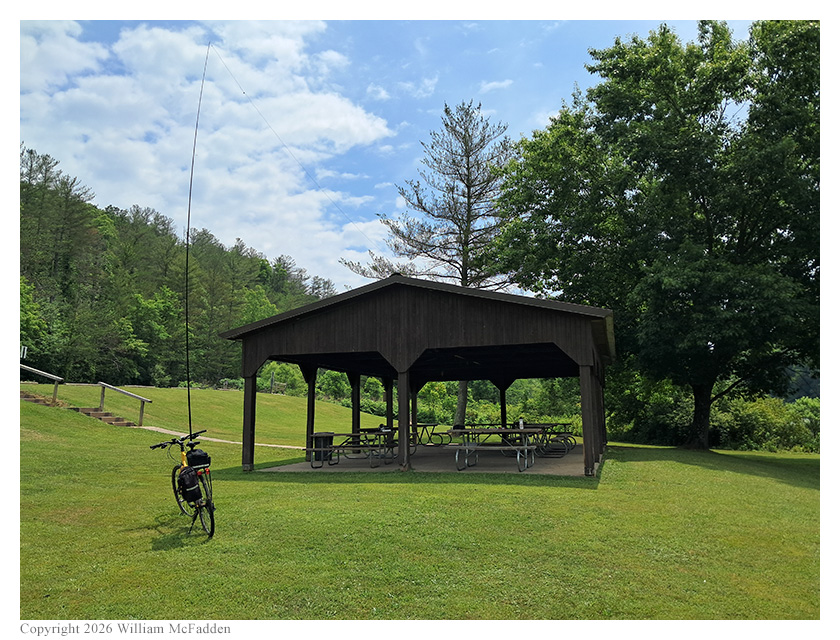
A final snap of Eric's station; his KH1 is set
up near the water bottle on the picnic table.
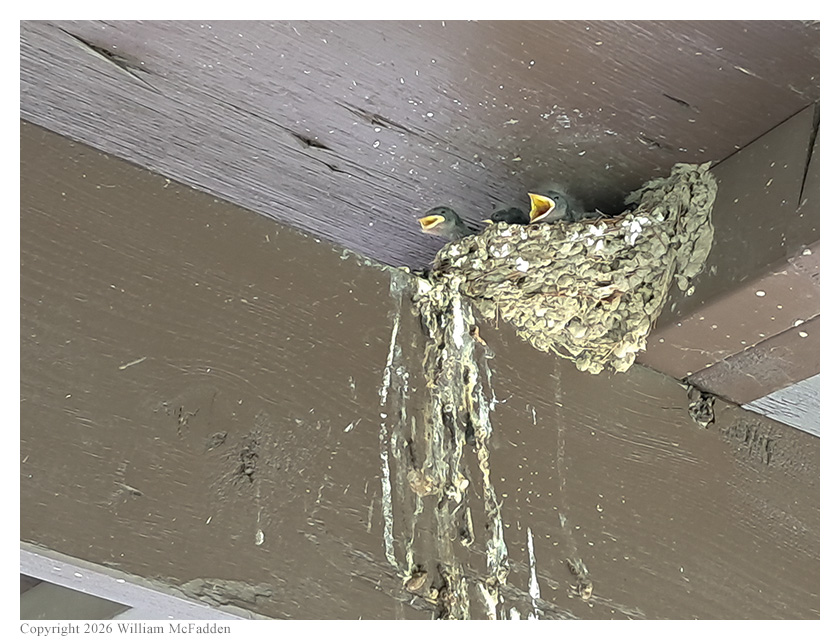
Hungry baby barn swallows in a nest in the roof
of Bulldog Shelter. (Mom or dad quickly returned
when Eric climbed down off the picnic table.)
Eric began his ride back to his car at 1638 UTC, arriving at his car unscathed, despite choosing to do the Cable Lane descent, some thirty-seven minutes later.
Eric also submitted his log to the World Wide Flora and Fauna in Amateur Radio (WWFF; link) program for an operation at Strouds Run State Park, KFF-1994.
(return)