
by William Eric McFadden
From the Strouds Run State Park website:
-
Strouds Run State Park is located in the scenic forested hills of Athens County, in the midst of the unglaciated Appalachian Plateau. Although untouched by the vast ice sheets that moved across portions of the state over 12,000 years ago, Strouds Run displays the effects of the glaciers — in the deep ravines and high hills — where the valleys served as outlets for torrents of glacial meltwaters. The erosive power of these waters carved the valleys and hillsides, creating the familiar topography Ohioans know today. Large deposits of glacial outwash, primarily sand and gravel, were deposited along these streams and strongly affected the type of biological communities present today.
Sandstone, the principal bedrock outcropping in the region, is very resistant to erosion and forms the uplands and steep sides of the valleys. Twisting roads and forest trails pass through these deep ravines and lead to dense stands of beech, hickory, oak, maple and tuliptree. Seasonal displays are offered by flowering dogwood, redbud and spring wildflowers — with fall presenting a pageant of colorful foliage. These woods are home to white-tailed deer, fox, raccoon, opossum, squirrel, wild turkey and a variety of songbirds. Woodthrush, white-breasted nuthatch, scarlet tanager, pileated woodpecker and the rufous-sided towhee inhabit the forest canopy. These rugged hills and woodlands are truly reminiscent of the wilderness that characterized the Ohio country in the days of early settlers.
Pictures
Description
On Friday, December 26, 2025, one member of the Southeast Ohio Radio Adventure Team performed an activation of Strouds Run State Park (US-1994) as part of the Parks on the Air (POTA; link) program.
On this 61° day-after-Christmas afternoon, Eric McFadden, WD8RIF, had hoped to perform a bicycle-portable activation of Strouds Run State Park but rain and other complications caused him to give up on the idea of bicycling and, instead, drove to Bulldog Shelther within the park for his activation.
Eric arrived at Bulldog Shelter at 2055 UTC, finding the shelter to be unoccupied. Because of the light rain that was falling, he chose to see how well his Elecraft AX1 antenna would work under the shelter's metal roof. He chose a conveniently-located picnic table, set up his Elecraft KX2, and deployed his Elecraft AX1 whip antenna using a Tufteln AX1 Antenna Stand (link), placing the single 13' counterpoise wire directly on the concrete floor of the shelterhouse. Hooking up the Whiterook MK-33 single-lever paddle and earbuds, Eric was on the air at 2103 UTC.
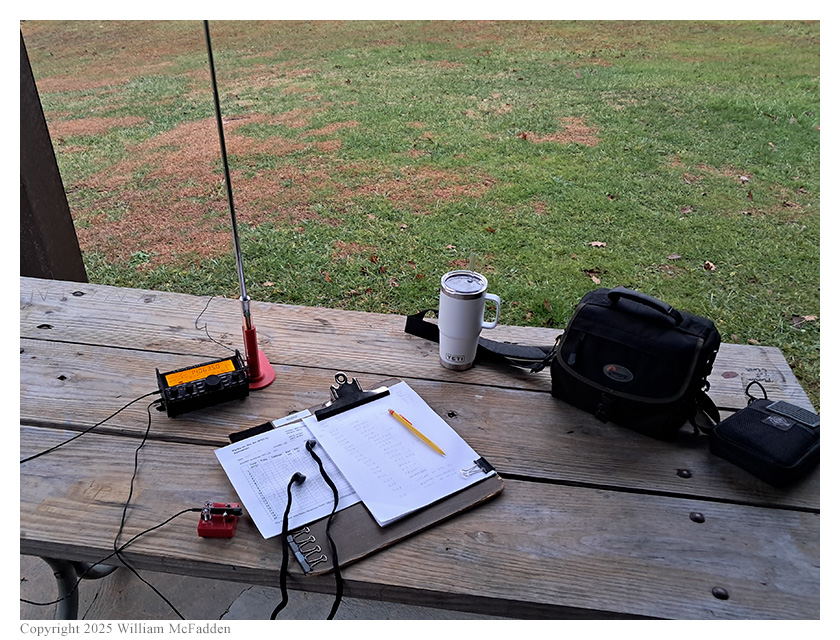
Eric's Elecraft KX2/AX1 station.
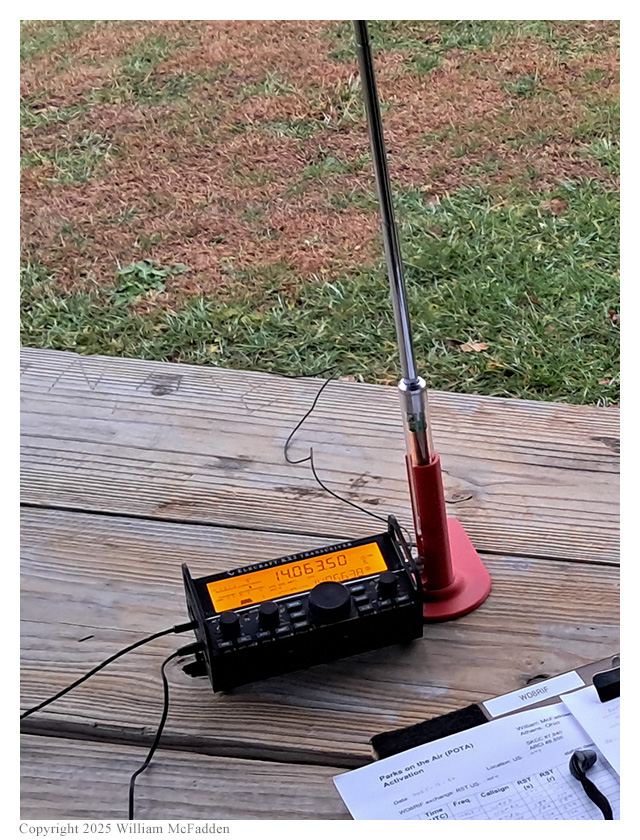
Close-up: The AX1 supported
in the Tufteln AX1 Antenna Stand.
As he has usually been the case at this location, Eric had cell-signal at Bulldog Shelter, and he would be able to access POTA Spots to spot himself and to find Park-to-Park (P2P) QSO opportunities.
Eric began his operation on 20m. Finding himself a clear frequency to run, he began calling "CQ POTA" and was quickly autospotted on POTA Spots. His first QSO came at 2105 UTC with W9OD in Wisconsin. QSOs came very quickly, with Eric's sixteenth QSO coming at 2122 UTC with K0JEM in Kansas. This run included a QSO with HI8JCD in the Dominican Republic, a P2P QSO with KC5F at Fort George Island Cultural State Park (US-1871) and Timucuan Preserve National Conservation Area (US-0658) in Florida, and QSOs with operators located in Colorado, Florida (2), Georgia (2), Kansas (2), Maine, Massachusetts, Missouri, New York, Rhode Island, Texas, Vermont, and Wisconsin.
Eric finished his operation by hunting P2P QSOs on 20m. At 2126 UTC he made a P2P QSO with W4LOO at Fort Pierce Inlet State Park (US-1872) in Florida and, at 2131 UTC he made a P2P QSO with W1WC at Monte Sano State Park (US-1048) in Alabama.
In all, Eric made eighteen QSOs, including three P2P QSOs, in thirty-six minutes of on-air time. All of Eric's QSOs were CW and were made at five watts of output.
Eric was very surprised by how easily he was able to make QSOs using the miniscule 48" whip under the metal roof of the picnic shelter. This activation using the KX2 and AX1 antenna was considerably easier than was his bicycle-portable activation at the same location on the 23rd when he used his KH1 and its identical 48' whip. It's hard to compare antenna performance over a period of days, but Eric has to wonder if the AX1 worked better due to its much, much larger matching inductor when compared to the matching inductor that's built into the KH1.
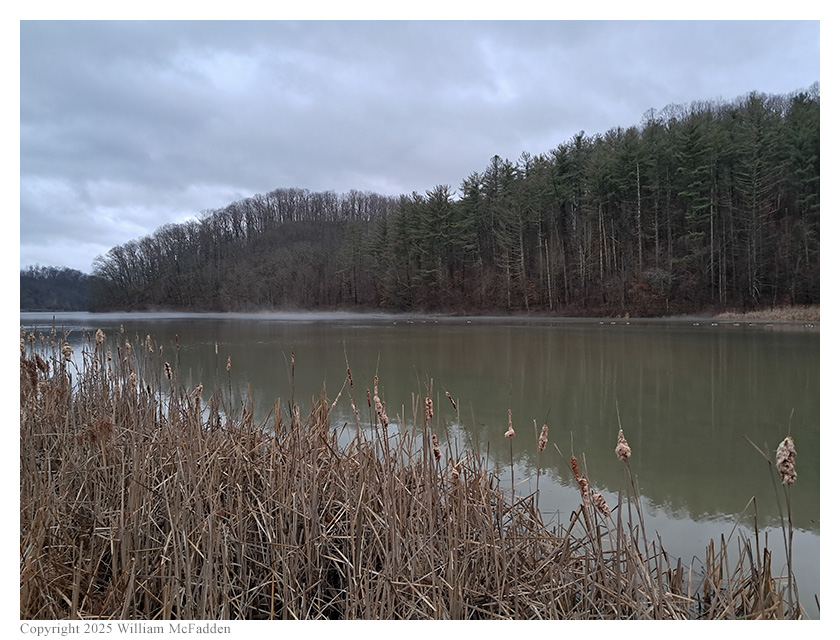
Smoke Fog on the Water: Dow Lake, looking south...
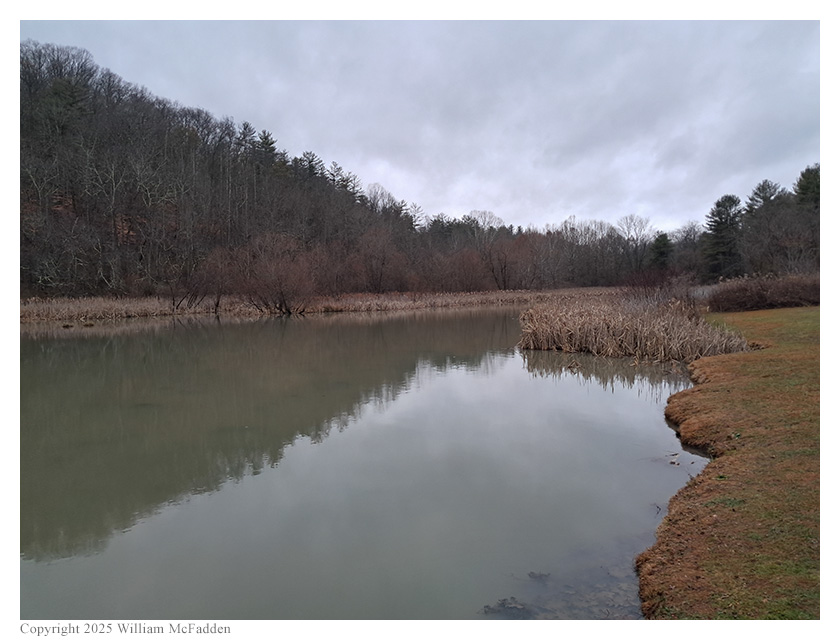
... and looking north.
Eric also submitted his log to the World Wide Flora and Fauna in Amateur Radio (WWFF; link) program for an operation at Strouds Run State Park, KFF-1994.
(return)