
by William Eric McFadden
From the Strouds Run State Park website:
-
Strouds Run State Park is located in the scenic forested hills of Athens County, in the midst of the unglaciated Appalachian Plateau. Although untouched by the vast ice sheets that moved across portions of the state over 12,000 years ago, Strouds Run displays the effects of the glaciers — in the deep ravines and high hills — where the valleys served as outlets for torrents of glacial meltwaters. The erosive power of these waters carved the valleys and hillsides, creating the familiar topography Ohioans know today. Large deposits of glacial outwash, primarily sand and gravel, were deposited along these streams and strongly affected the type of biological communities present today.
Sandstone, the principal bedrock outcropping in the region, is very resistant to erosion and forms the uplands and steep sides of the valleys. Twisting roads and forest trails pass through these deep ravines and lead to dense stands of beech, hickory, oak, maple and tuliptree. Seasonal displays are offered by flowering dogwood, redbud and spring wildflowers — with fall presenting a pageant of colorful foliage. These woods are home to white-tailed deer, fox, raccoon, opossum, squirrel, wild turkey and a variety of songbirds. Woodthrush, white-breasted nuthatch, scarlet tanager, pileated woodpecker and the rufous-sided towhee inhabit the forest canopy. These rugged hills and woodlands are truly reminiscent of the wilderness that characterized the Ohio country in the days of early settlers.
Pictures
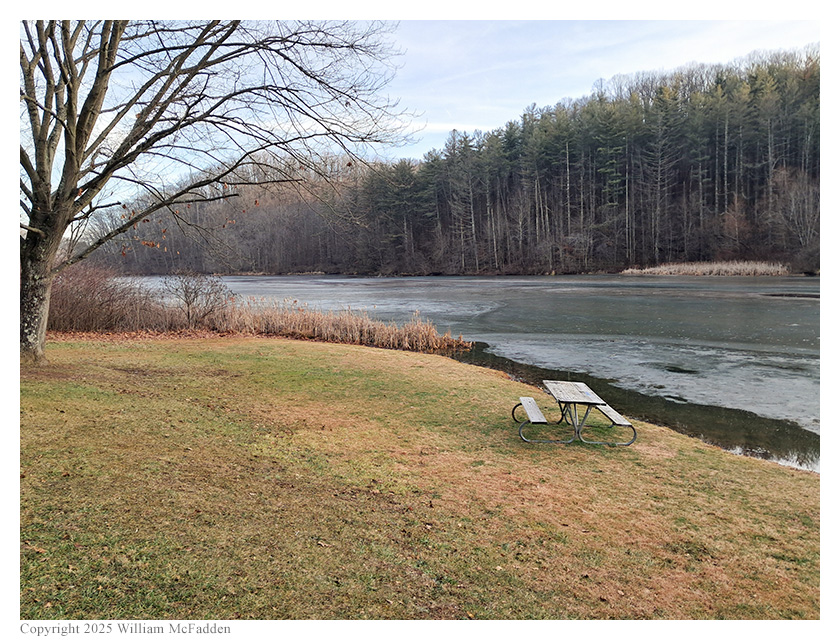
Description
On Wednesday, December 24, 2025, one member of the Southeast Ohio Radio Adventure Team performed an activation of Strouds Run State Park (US-1994) as part of the Parks on the Air (POTA; link) program.
On this 58° Christmas Eve afternoon, Eric McFadden, WD8RIF, had hoped to perform a bicycle-portable activation of Strouds Run State Park but family activities combined with a lingering general lack of energy from a recent COVID-19 immunization, caused him to give up on the idea of bicycling and, instead, drove to Bulldog Shelther within the park for his activation. Eric was accompanied by little dog Theo.
Eric arrived at Bulldog Shelter at 2008 UTC, finding the shelter to be unoccupied. Eric chose a conveniently-located picnic table and deployed his Tufteln (link) 35' EFRW as a sloper supported on a Goture Red Fox Super Hard 720 carbon-fiber mast on a spike, placing three 17' counterpoise wires directly on the ground. Placing his Elecraft KX2 on the picnic table and hooking up the Whiterook MK-33 single-lever paddle and earbuds, Eric was on the air at about 2017 UTC.
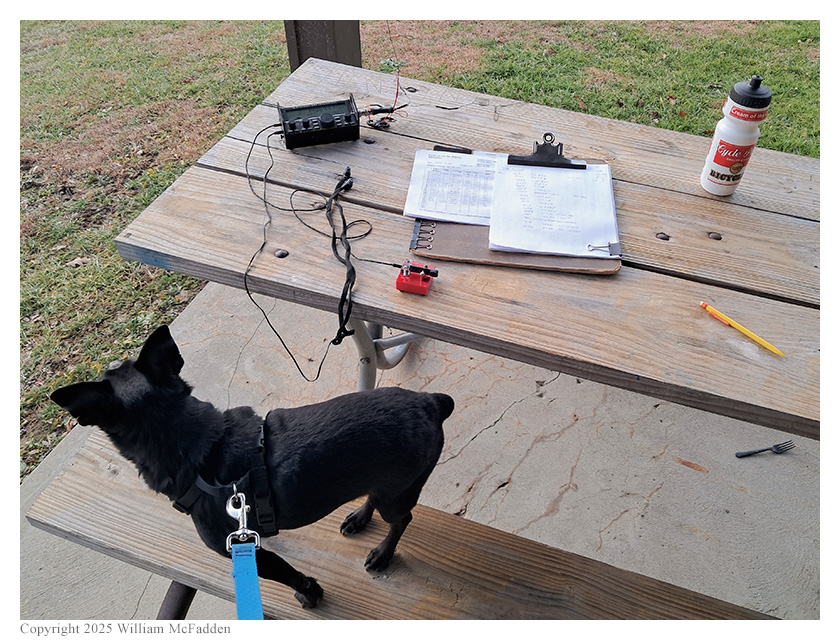
Eric's Elecraft KX2 station, with Theo-dog.
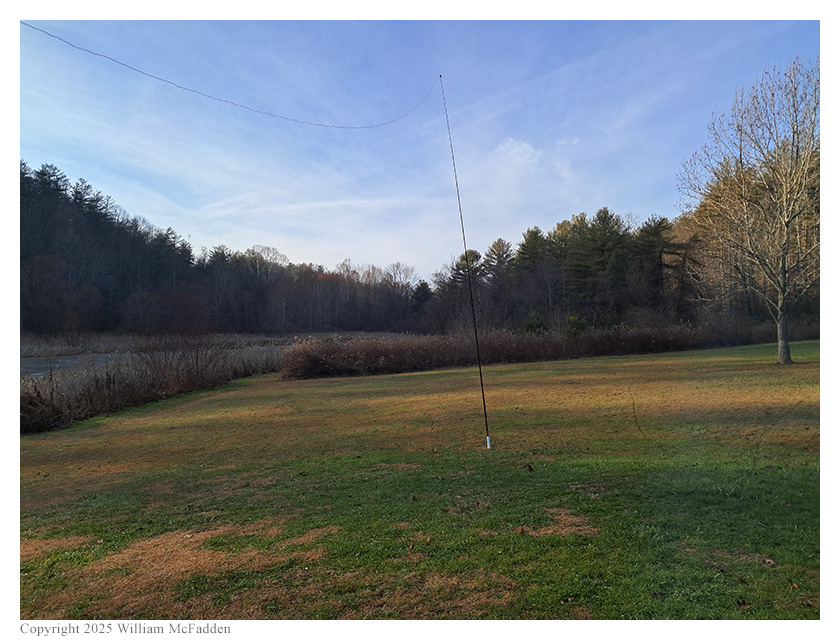
Eric's mast and antenna.
As he has come to expect at this location, Eric had cell-signal at Bulldog Shelter, and he would be able to access POTA Spots to spot himself and to find Park-to-Park (P2P) QSO opportunities.
Eric began his operation on 20m. Finding himself a clear frequency to run, he began calling "CQ POTA" and was autospotted on POTA Spots. His first QSO came at 2019 UTC with AC0DK in Wisconsin. QSOs came steadily, with Eric's sixth QSO coming at 2028 with N4UCM in Wisconsin. This run included QSOs with operators located in Georgia, Iowa, Louisiana, Texas, and Wisconsin (2).
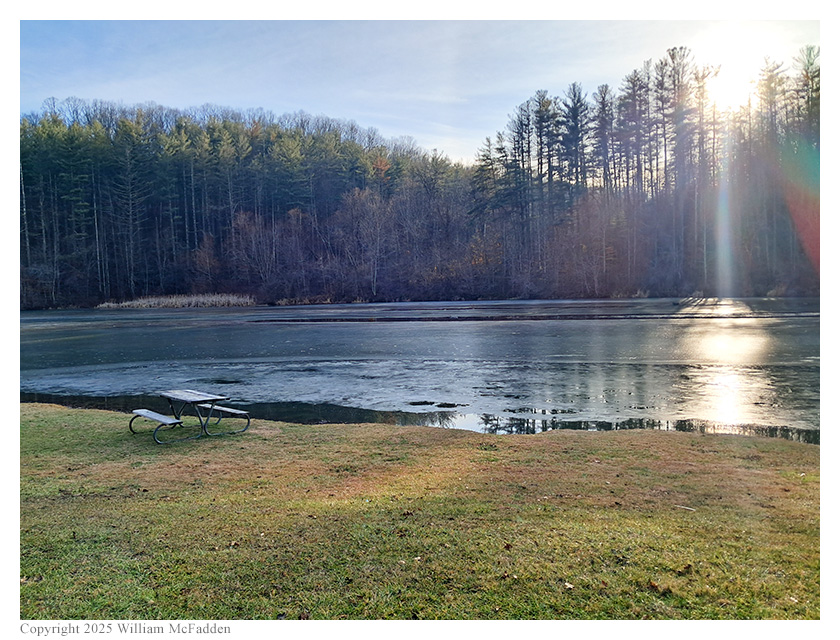
Eric's view of thawing Dow Lake from his operation position.
Pausing to hunt P2P QSOs, at 2029 UTC Eric made a P2P QSO on 20m with W4LOO at Avalon State Park (US-1833) in Florida.
Returning to run a frequency on 20m, Eric refreshed his spot on POTA Spots and his first QSO in this run came at 2032 UTC with WA2SPL in Vermont. QSOs came quickly, with Eric's fifth QSO in this run coming at 2038 UTC with N5DUX in Texas. This run included QSOs with operators located in Alabama, Connecticut, Minnesota, Texas, and Vermont.
Eric finished his operation by hunting P2P QSOs on 20m. At 2042 UTC, he had a P2P QSO with W1ND at Gulf State Park (US-1042) in Alabama. At 2025 UTC, he had a P2P QSO with WC1D at National Key Deer National Wildlife Refuge (US-0250) in Florida. At 2049 UTC, he had a P2P QSO with W8BMO at Sawhill Ponds State Wildlife Area (US-9669) in Colorado. Finally, at 2052 UTC, he had a P2P QSO with AK0A at Perry State Park (US-2347) in Kansas.
In all, Eric made sixteen QSOs, including five P2P QSOs, in about thirty-five minutes of on-air time. All of Eric's QSOs were CW and were made at five watts of output.
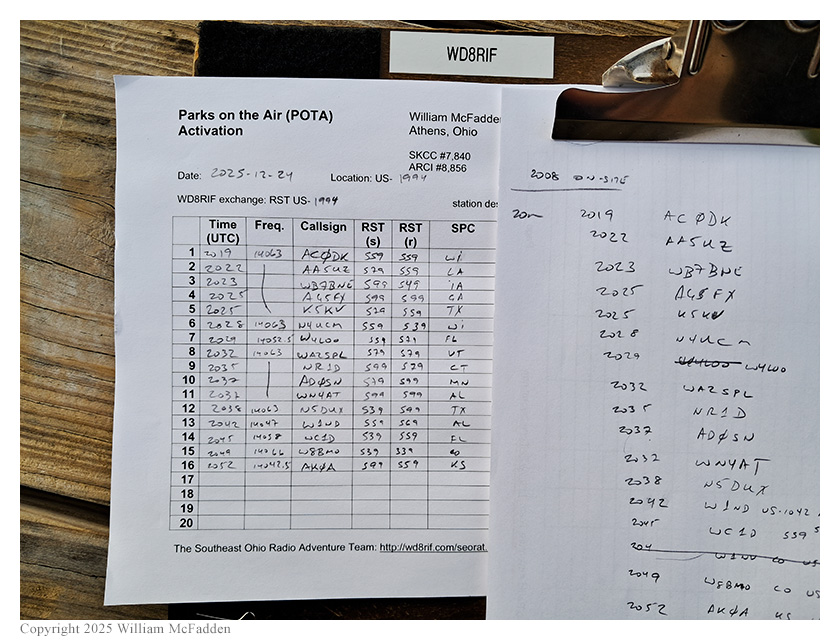
Eric's logsheet.
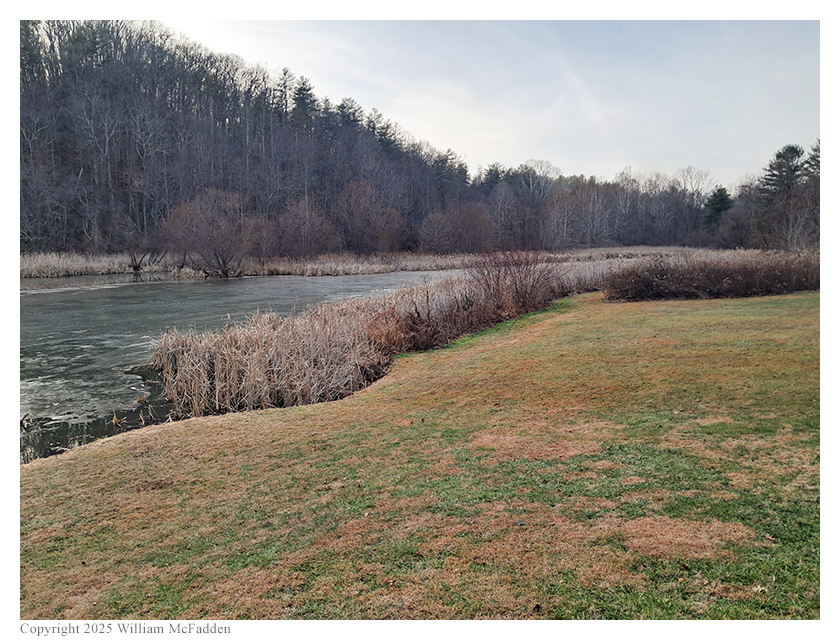
Dow Lake, looking north...
and south.
Eric also submitted his log to the World Wide Flora and Fauna in Amateur Radio (WWFF; link) program for an operation at Strouds Run State Park, KFF-1994.
(return)