
by William Eric McFadden
From the Strouds Run State Park website:
-
Strouds Run State Park is located in the scenic forested hills of Athens County, in the midst of the unglaciated Appalachian Plateau. Although untouched by the vast ice sheets that moved across portions of the state over 12,000 years ago, Strouds Run displays the effects of the glaciers — in the deep ravines and high hills — where the valleys served as outlets for torrents of glacial meltwaters. The erosive power of these waters carved the valleys and hillsides, creating the familiar topography Ohioans know today. Large deposits of glacial outwash, primarily sand and gravel, were deposited along these streams and strongly affected the type of biological communities present today.
Sandstone, the principal bedrock outcropping in the region, is very resistant to erosion and forms the uplands and steep sides of the valleys. Twisting roads and forest trails pass through these deep ravines and lead to dense stands of beech, hickory, oak, maple and tuliptree. Seasonal displays are offered by flowering dogwood, redbud and spring wildflowers — with fall presenting a pageant of colorful foliage. These woods are home to white-tailed deer, fox, raccoon, opossum, squirrel, wild turkey and a variety of songbirds. Woodthrush, white-breasted nuthatch, scarlet tanager, pileated woodpecker and the rufous-sided towhee inhabit the forest canopy. These rugged hills and woodlands are truly reminiscent of the wilderness that characterized the Ohio country in the days of early settlers.
Pictures
Description
On Sunday, October 26, 2025, one member of the Southeast Ohio Radio Adventure Team performed an activation of Strouds Run State Park (US-1994) as part of the Parks on the Air (POTA; link) program.
Taking advantage of a sudden early-afternoon opportunity for some much-needed radio therapy, after dropping his wife and young grandchildren off at church, Eric McFadden, WD8RIF, visited Bulldog Shelter within Strouds Run State Park to play radio. He was accompanied by his little dog, Theo.
For this operation, Eric chose to return to a favorite rig from wayback: his Elecraft K2. This transceiver had been Eric's primary field radio from late 2008 until he built his KX3 in late 2013. Once Eric had built his KX3, the once-favored K2 was relegated to hamshack and backup-rig status. Indeed, during 2016's ARRL National Parks on the Air, Eric carried his K2 as the backup radio to nearly all of his 183 activations, but it didn't get used on even one of them. It was time to give this excellent radio some time afield again! Because he had built his FT-817 Travel Kit to allow the FT-817ND, Z-11 ATU, and microphone to swapped out and the K2 swapped in, this was a good opportunity to see if the FT-817 Travel Kit included everything necessary to support an operation with the K2.
Eric arrived at Bulldog Shelter at 1605 UTC, finding the shelter to be unoccupied. Since the early afternoon temperature was cool (~55°F), and there was blustery wind, Eric selected a corner picnic table and moved it into the direct sun. He placed his K2 on the picnic table and grabbed the LDG 4:1 UNUN and discovered that the FT-817 Travel Kit lacked an SO259-to-BNC adapter to allow the transformer to be connected to the K2's BNC antenna jack. For just this sort of situation, Eric had brought both his Enhanced KX3 Travel Kit and his KX2 Mini Travel Kit, but he was surprised to find that neither of these kits contained the necessary adapter. (Actually, Eric later realized that his Enhanced KX3 Travel Kit does contain the necessary adapter, but it's mounted on that kit's homebrew 4:1 UNUN and Eric had overlooked it in the heat of the moment.) Finding himself unable to use the LDG UNUN, Eric decided to borrow the antenna from the KX2 Mini Travel Kit, and he deployed a 58' EFRW as a sloper up to the top of his Goture Red Fox Super Hard 720 carbon-fiber mast held upright on a spike, with two 17' counterpoise wires placed directly on the ground. (Eric would have preferred to place three counterpoise wires, but he was concerned that Theo-dog would get tangled in the third wire.) Connecting the American Morse Equipment Mini-B single-lever paddle and the Bioenno 4.5Ahr LiFePO4 battery from the FT-817 Travel Kit to the K2, Eric was on the air at 1620 UTC.
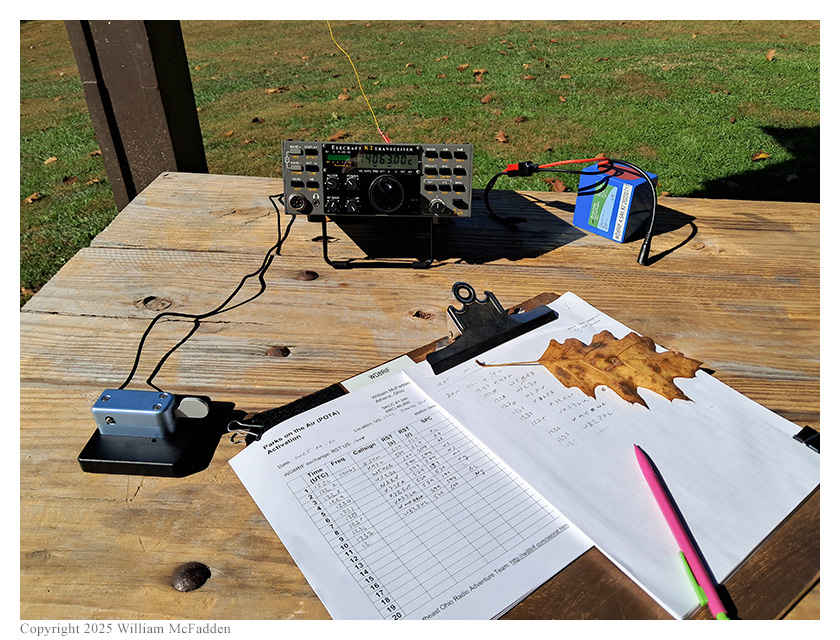
Eric's Elecraft K2 station.
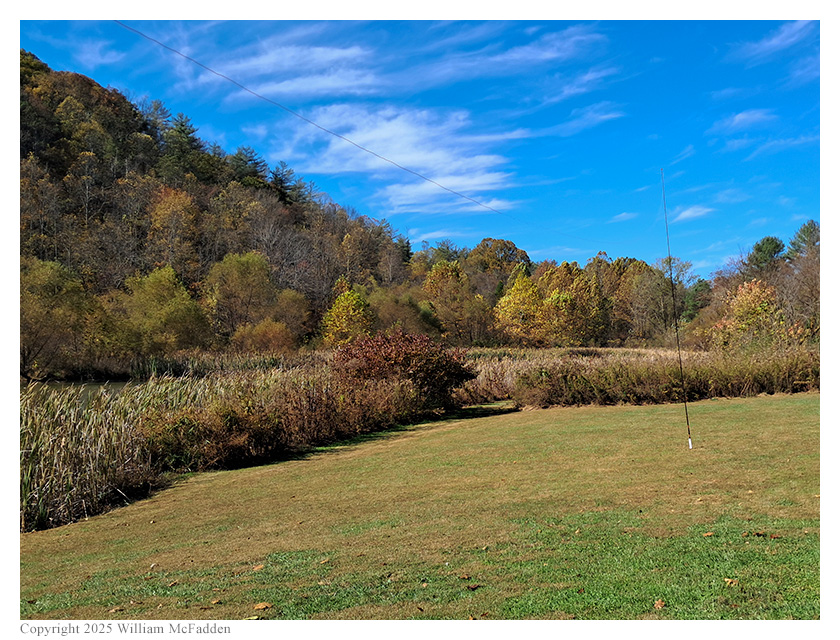
Eric's mast and 58' EFRW antenna.
Because the last time Eric had used his K2, he had been primarily a cootie-operator, the K2 was configured to treat the paddle as a hand key, and it took Eric a minute or two to remember how to tell the K2 he wanted to use his key as a keyer paddle, but he got it figured out eventually.
As he has come to expect at this location, Eric had cell-signal at Bulldog Shelter, and he would be able to access POTA Spots to spot himself and to find Park-to-Park (P2P) QSO opportunities.
Eric began his operation on 20m, and he was happy to see that the K2's internal ATU very quickly found a match on this band for the 58' EFRW antenna. Eric found himself a clear frequency to run and began calling "CQ POTA". Since he had neglected to announce his activation on POTA Spots, Eric self-spotted himself on POTA Spots. His first QSO came at 1626 UTC with KJ4M in Alabama. QSOs came steadily, with Eric's twenty-second QSO coming at 1654 UTC with W7CVI in Washington. This run included a P2P QSO with KD2GUT at Edgewood Oak Brush Plains State Forest (US-12166) in New York, a P2P QSO with N1TJC at John Boyd Thacher State Park (US-2085) in New York, a P2P N1BS at Black Hut Wildlife Management Area (US-6984) in Rhode Island, and QSOs with operators located in Alabama (2), Arizona, Arkansas (2), California, Georgia, Illinois, Minnesota, Montana, New Jersey (2), New York (5), Ontario, Rhode Island, Tennessee, Texas, and Washington.
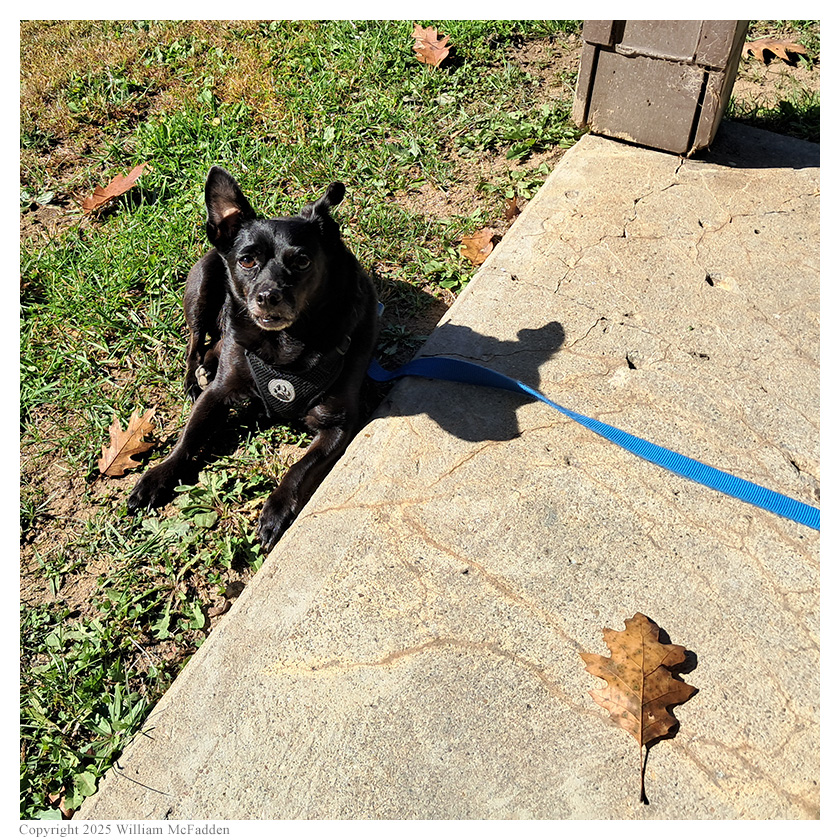
Theo-dog enjoys the sunshine.
Switching to 40m, Eric found himself a clear frequency to run, began calling "CQ POTA", and self-spotted himself on POTA Spots. His first QSO in this run came at 1702 UTC with KC8LA in Ohio. QSOs came quickly, with Eric's seventh QSO in this run coming at 1711 UTC with AA4HI in North Carolina. This run included a P2P QSO with WB8YYY at Medoc Mountain State Park (US-2744) in North Carolina and QSOs with operators located in Michigan, North Carolina (3), Ohio, Ontario, Pennsylvania, and Tennessee.
Switching to "hunting mode", at 1718 UTC Eric completed a P2P QSO on 15m with N7BBQ at Sea Rim State Park (US-3054) in Texas.
Recognizing that 15m might actually be hot, Eric found himself a clear frequency to run, began calling "CQ POTA", and self-spotted himself on POTA Spots. After several minutes of calling with no responses, Eric received a text from his wife that she was ready to be picked up, so Eric stopped calling CQ and sent that he was QRT. Of course, this meant someone called wanting a QSO, and at 1722 UTC, Eric made his final QSO, with K4NYX in Florida.
In all, Eric made thirty-two QSOs, including five P2P QSOs, in just over an hour of on-air time. All of Eric's QSOs were CW and were made at five watts of output.
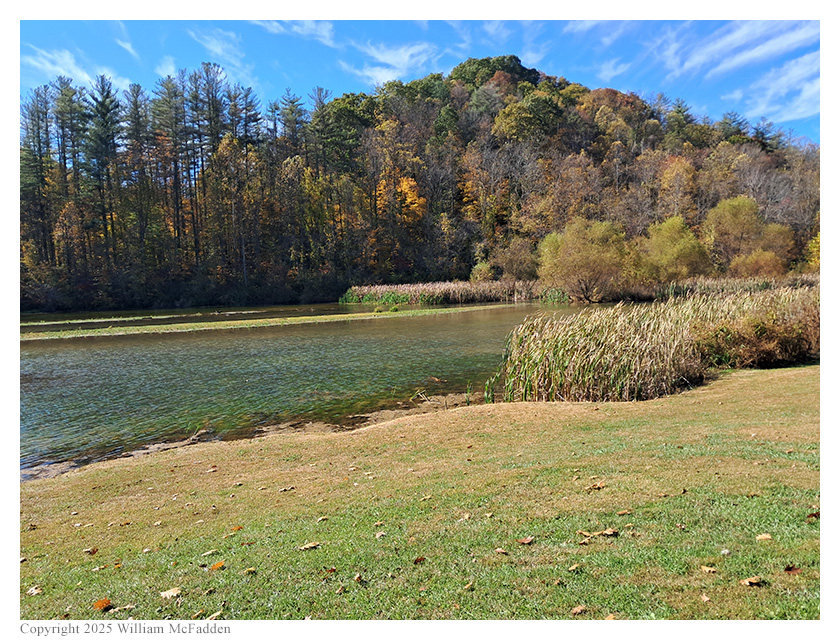
Fall colors!
Since Eric hadn't operated his K2 in several years, he had pleasantly surprised by the the superhet's lovely receive audio.
This operation demonstrated to Eric that the FT-817 Travel Kit is almost ready to support operation with the Elecraft K2. Eric now knows he needs to add an SO239-to-BNC adapter to the kit and, because he had forgotten how to do some things on the K2, he needs to print a small-format version of the K2 manual for the kit. (Since Eric's K2 is an early model using the Rev A board, and since the Elecraft website provides only the manual for the newer Rev B units, he'll need to reach out to Elecraft for a PDF of the older manual.)
Eric also submitted his log to the World Wide Flora and Fauna in Amateur Radio (WWFF; link) program for an operation at Strouds Run State Park, KFF-1994.
(return)