
by William Eric McFadden
From the Strouds Run State Park website:
-
Strouds Run State Park is located in the scenic forested hills of Athens County, in the midst of the unglaciated Appalachian Plateau. Although untouched by the vast ice sheets that moved across portions of the state over 12,000 years ago, Strouds Run displays the effects of the glaciers — in the deep ravines and high hills — where the valleys served as outlets for torrents of glacial meltwaters. The erosive power of these waters carved the valleys and hillsides, creating the familiar topography Ohioans know today. Large deposits of glacial outwash, primarily sand and gravel, were deposited along these streams and strongly affected the type of biological communities present today.
Sandstone, the principal bedrock outcropping in the region, is very resistant to erosion and forms the uplands and steep sides of the valleys. Twisting roads and forest trails pass through these deep ravines and lead to dense stands of beech, hickory, oak, maple and tuliptree. Seasonal displays are offered by flowering dogwood, redbud and spring wildflowers — with fall presenting a pageant of colorful foliage. These woods are home to white-tailed deer, fox, raccoon, opossum, squirrel, wild turkey and a variety of songbirds. Woodthrush, white-breasted nuthatch, scarlet tanager, pileated woodpecker and the rufous-sided towhee inhabit the forest canopy. These rugged hills and woodlands are truly reminiscent of the wilderness that characterized the Ohio country in the days of early settlers.
Pictures
Description
On Wednesday, October 15, 2025, one member of the Southeast Ohio Radio Adventure Team performed an activation of Strouds Run State Park (US-1994) as part of the Parks on the Air (POTA; link) program.
Taking advantage of a sudden evening opportunity to play radio while his wife participated in her book club, Eric McFadden, WD8RIF, visited Bulldog Shelter within Strouds Run State Park to play radio. He was accompanied by his little dog, Theo.
After driving his wife to the book club meeting, Eric arrived at (the unoccupied) Bulldog Shelter at 2230 UTC, just as daylight was beginning to fade. After giving Theo a quick walk, Eric took some photos of Dow Lake in the evening light and then set up his station inside Bulldog Shelter.
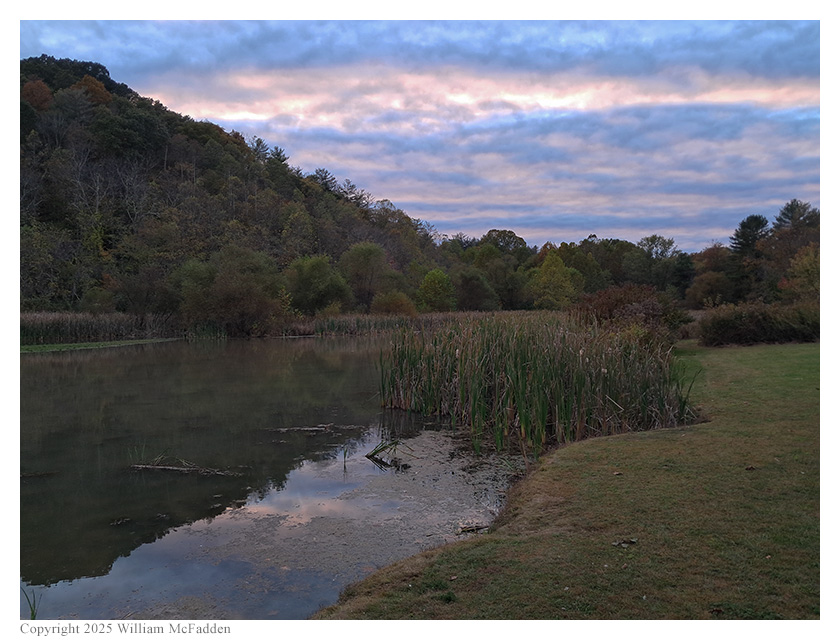
Evening falls over Dow Lake, looking north...
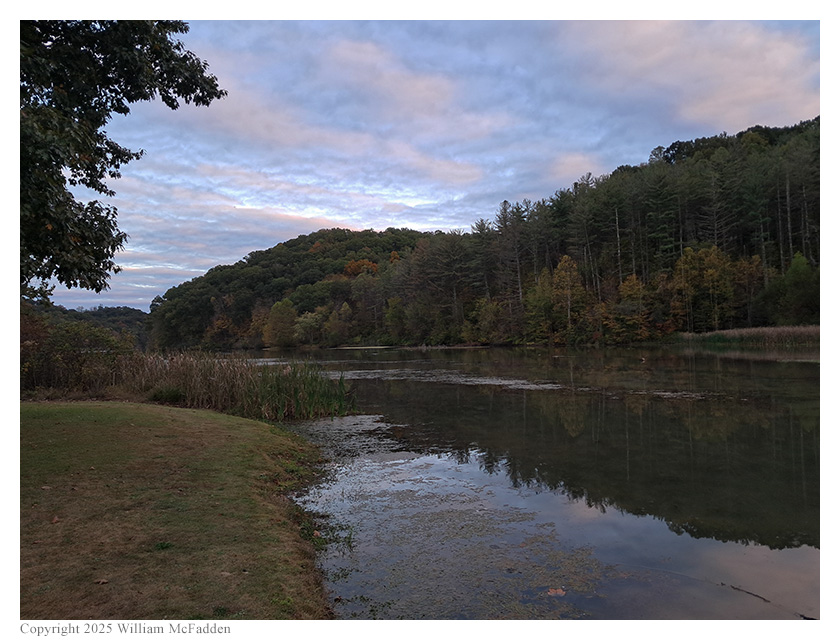
... and looking south.
After choosing a suitable picnic table, Eric deployed his Tufteln (link) 35' EFRW antenna as a vertical on a 31' Jackite telescoping mast carefully leaned into a tree, and he placed a single 17' counterpoise wire directly on the ground. For this operation, Eric chose to operate his Elecraft four-band K1, which he powered with an Elecraft KXBT2 lithium-ion battery and which he keyed with a Whiterook MK-33 single-lever paddle. Eric was on the air at 2247 UTC.
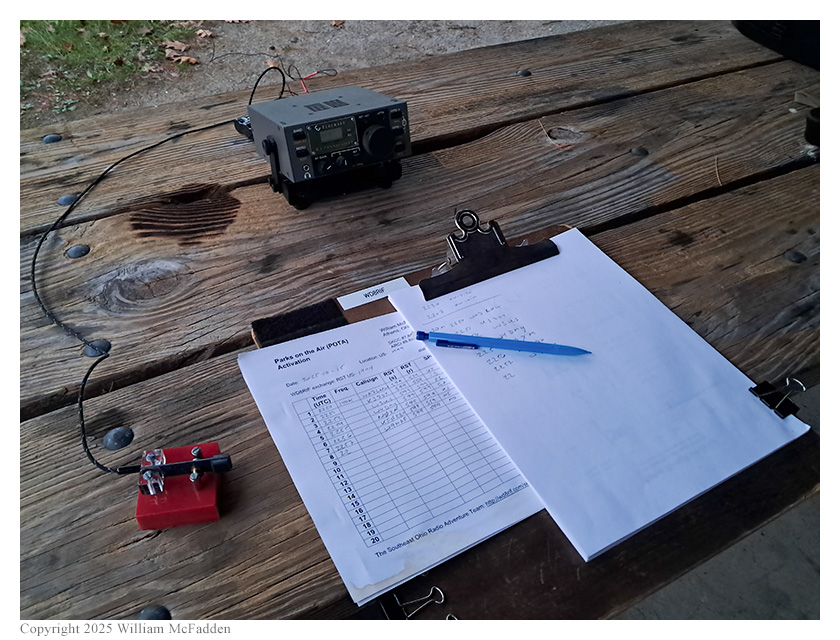
Eric's K1 station, before full darkness fell.
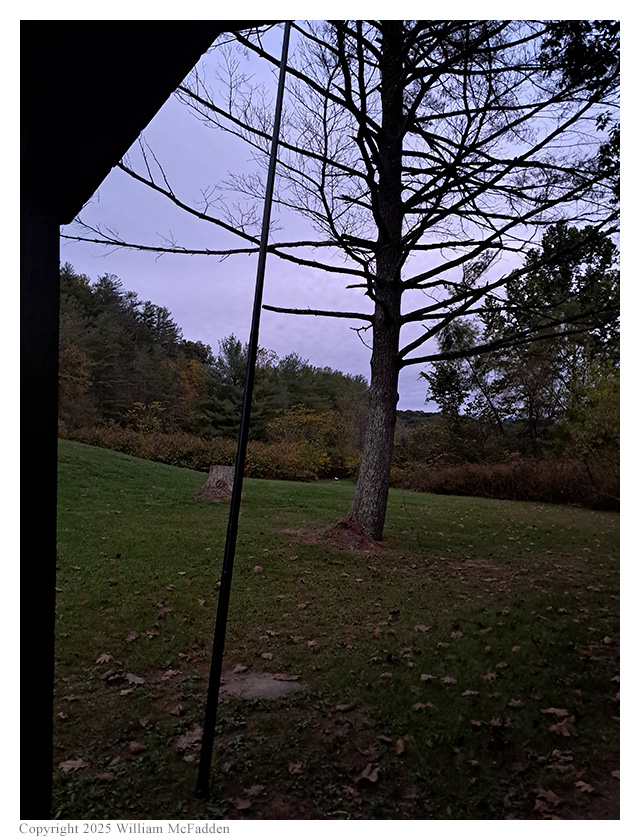
Eric's mast and antenna.
As he has come to expect at this location, Eric had cell-signal at Bulldog Shelter, and he would be able to access POTA Spots to spot himself and to find Park-to-Park (P2P) QSO opportunities.
Just as Eric finished his station set up, he was visited by Ben, KF8DES, and his (female) friend Alex, who arrived on bicycles as they neared the end of their ride on the state park's mountain bike trails. As Eric began his operation, Ben and Alex heaped love onto Theo, and Theo, as is his modus operandi, reciprocated by heaping love onto Ben and Alex.
Eric started his operation on 20m. When he commanded the K1's internal KAT1 automatic antenna tuner to find a match, the tuner made the usual clicking noises and seemed to find a good match, but finished the tuning cycle with the message, "PLo" and, on transmit, the K1 display showed only three bars, indicating the K1 had dialed itself back to about 3w of output power. Eric had with him the K1 manual, but not the separate KAT1 manual, so he was unable to determine what "PLo" meant. Throwing caution to the winds, Eric forged ahead with his operation. Finding himself a clear frequency to run, he began to call "CQ POTA" and spotted himself on POTA Spots. His first QSO came at 2250 UTC with WA7LNW in Utah. QSOs came quickly, with Eric's thirteenth QSO coming at 2309 UTC with KM9R in Nevada. This run included QSOs with operators located in Colorado, Florida (3), Georgia, Idaho, Kansas, Missouri (2), Nebraska, Nevada, Texas, and Utah.
Having successfully validated his activation by making ten QSOs, Eric switched to hunting-mode, using POTA Spots to identify possible P2P QSO opportunities. At 2311 UTC, he made a P2P QSO on 20m with N1CCC who was performing a three-fer activation of California National Historic Trail (US-4566), Oregon National Historic Trail (US-4576), and Santa Fe National Historic Trail (US-4579) in Missouri. At 2316 UTC, he made a P2P QSO on 20m with WN7JT who was activating Rasar State Park (US-3255) in Washington. Finally, at 2319 UTC, he made a P2P QSO on 20m with WB0RLJ who was performing his 1,045th (!) activation of Chalco Hills State Recreation Area (US-4011) in Nebraska.
Although, by this time full darkness had arrived, Eric had time left before he had to pick his wife up, so he switched to 40m to try a run. This time, when he engaged the K1's internal ATU, it quickly found a match and didn't display "PLo", and when he transmitted, the K1's display showed five bars, indicating approximately 5w output. Eric found himself a clear frequency to run, began calling "CQ POTA", and was auto-spotted on POTA Spots. His first QSO in this run came at 2324 UTC with KE2AXX in New York. QSOs again came quickly, with Eric's eighth QSO in this run coming at 2331 UTC with KA0REN. This run included QSOs with operators located in Colorado, Connecticut Georgia, Mississippi, Missouri, New York (2), and Ontario.
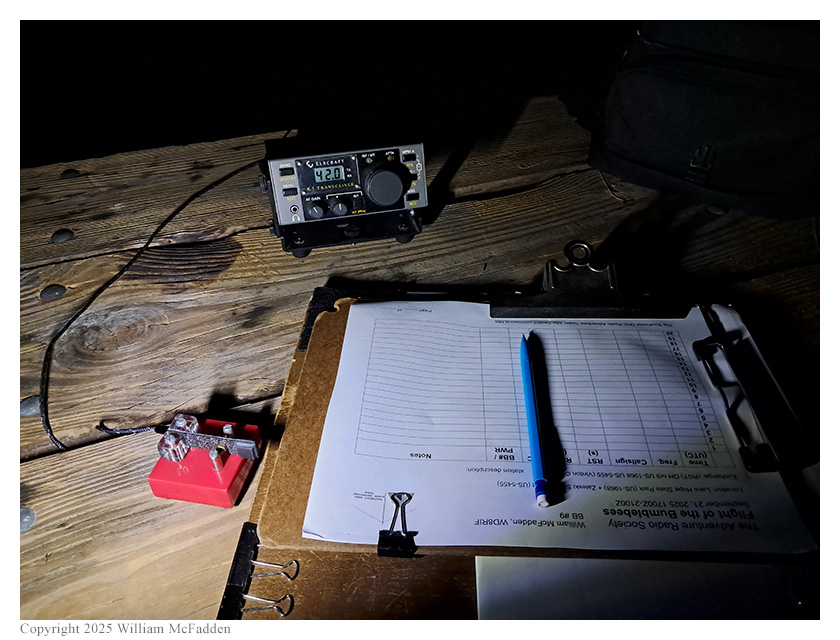
Eric's K1 station, after full darkness fell,
with a flashlight for a light-source.
In all, Eric made twenty-six QSOs (counting N1CCC's three-fer as three QSOs), including five P2P QSOs, in just about one hour of on-air time. All of Eric's QSOs were CW and were made at three watts (on 20m) or five watts (on 40m) of output.
Since Eric hadn't operated his K1 since 2022, he had completely forgotten just how lovely the K1's receive audio is. He hopes to take the K1 into the field more often in the future, but first he needs to print a reduced-size copy of the KAT1 manual and he needs to play with the K1 in his home hamshack to determine what "PLo" means and what caused it to be displayed.
Eric also submitted his log to the World Wide Flora and Fauna in Amateur Radio (WWFF; link) program for an operation at Strouds Run State Park, KFF-1994.
(return)