by William Eric McFadden
From the Salt Fork State Park website:
-
Located in eastern Ohio, Salt Fork State Park encompasses a stunning landscape featuring forested hills, open meadows, and misty valleys decorated with winding streams. With thousands and thousands of acres of land and water, the park has something for every outdoor enthusiast. Boaters will appreciate the park's two marinas and eight launch ramps; hikers will be challenged by a trail system that offers a variety of lengths and levels of difficulty; history buffs can visit the historic Kennedy Stone House; and golfers will enjoy the top-rated 18-hole golf course. Overnight accommodations include a full-service resort lodge, deluxe vacation cabins, and a large campground.
From the Salt Fork Wildlife Area website:
-
Situated in the hills of southeastern Ohio, the Salt Fork Wildlife Area and the Salt Fork State Park have a steep to rolling terrain that is dissected by numerous small streams. The largest of these, Salt Fork Creek, has been impounded to create the 2,952-acre Salt Fork Lake. The area is administered by the Division of Wildlife and the Division of Parks and Recreation, respectively, of the Ohio Department of Natural Resources. The Division of Wildlife is responsible for fish and wildlife management and public hunting and fishing activities on the area. The Division of Parks and Recreation is responsible for development and maintenance of the general recreational facilities of the park area.
Pictures
- The Salt Fork State Park sign
- Eric's KX2 station, with Thia and Theo
- Granddaughter Thia
- Theo-dog
- W8EOG operates: 1 | 2
- W8EOG's IC-705 station
- The Eco-Discovery Center
- Inside the Eco-Discovery Center: 1 | 2 | 3 | 4 | 5
Description
On Saturday, October 18, 2025, one member of the Southeast Ohio Radio Adventure Team performed successful simultaneous activations of Salt Fork State Park and Salt Fork Wildlife Area in Ohio as part of the Parks on the Air (POTA; link) program. Eric McFadden, WD8RIF, performed the two-fer activation at the state park's Eco-Discovery Center. Eric was accompanied by his wife, Vickie, grandchildren Archer and Thia, and Theo-dog. They were met at the state park by Eric's father Tom, W8EOG, and his mother Hanne.
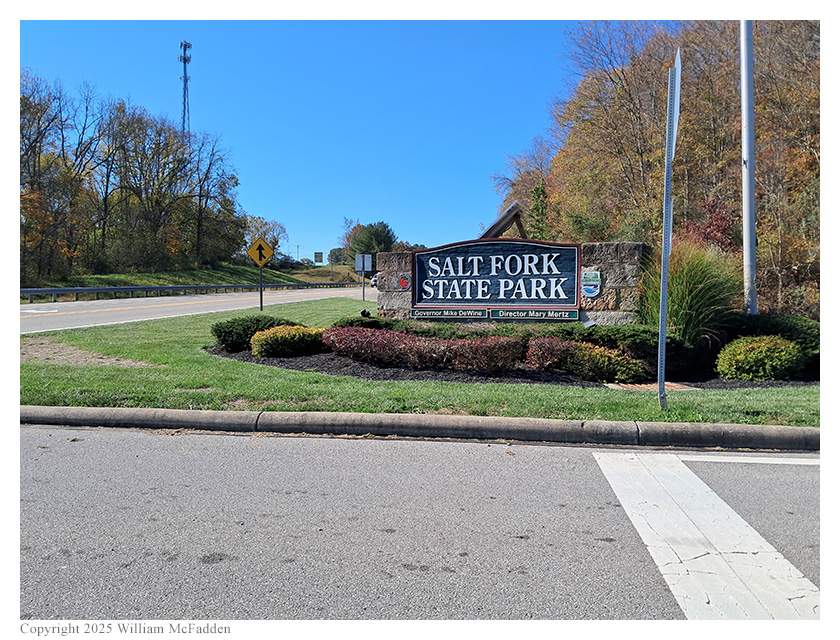
The Salt Fork State Park sign.
Eric, Vickie, the grandchildren, and the dog arrived at the Salt Fork State Park Lodge at just about lunchtime, and Eric's parents arrived a few minutes later. After taking advantage of the facilities and enjoying a picnic lunch under a Honey Locust tree, the group went to the state park's swim-beach and playground—Eric and Tom hoping to be able to play radio while Archer played in the playground—only to find the swim-beach area closed for re-construction and the playground completely gone. Undeterred, the group went then to the state park's Eco-Discovery Center so that Vickie could take Archer through the museum while Eric and Tom performed their two-fer activations.
Both of them wanting shade, Eric and Tom chose locations within a small grove of trees overlooking the Eco-Discovery Center.
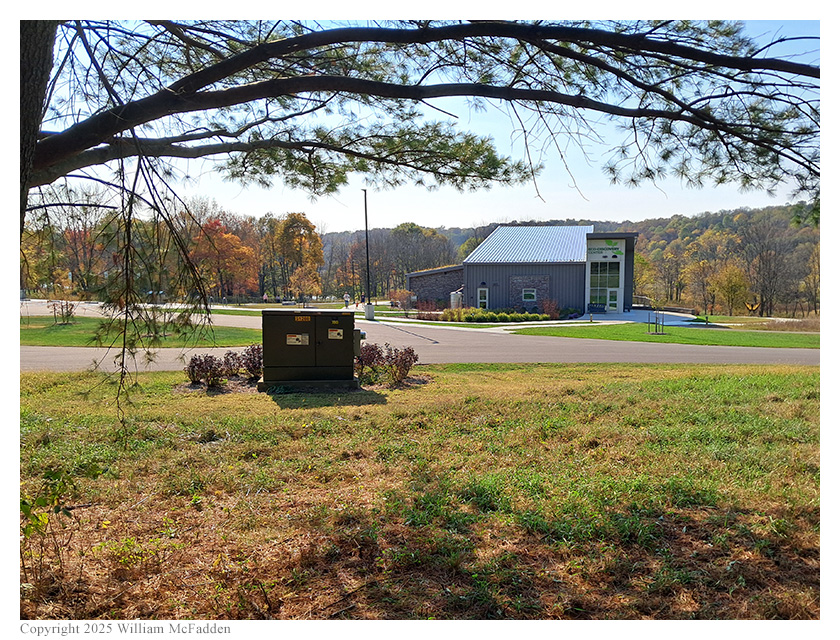
The Eco-Discovery Center, as viewed form the grove.
Eric set up his KX2 Mini Travel Kit, deploying his 29' end-fed random wire as a vertical supported on his 31' Jackite telescoping fiberglass mast bungied to his folding camp-chair, and laying two 17' counterpoise wires directly on the ground. Placing his KX2 transceiver on his camp-chair's flip-up table, connecting his Whiterook MK-33 single-lever paddle and a pair of earbuds, Eric was on the air at 1816 UTC.
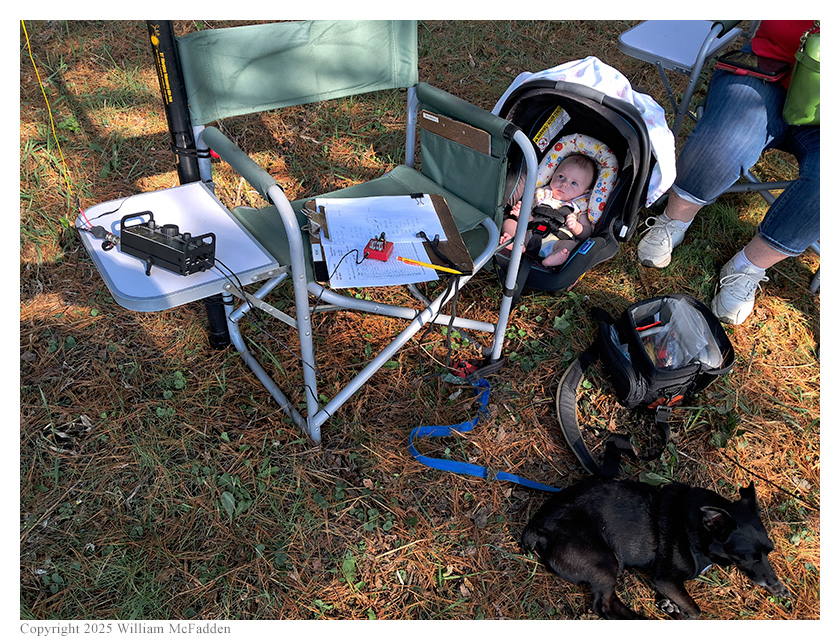
Eric's KX2 station, with granddaughter Thia and Theo-dog.
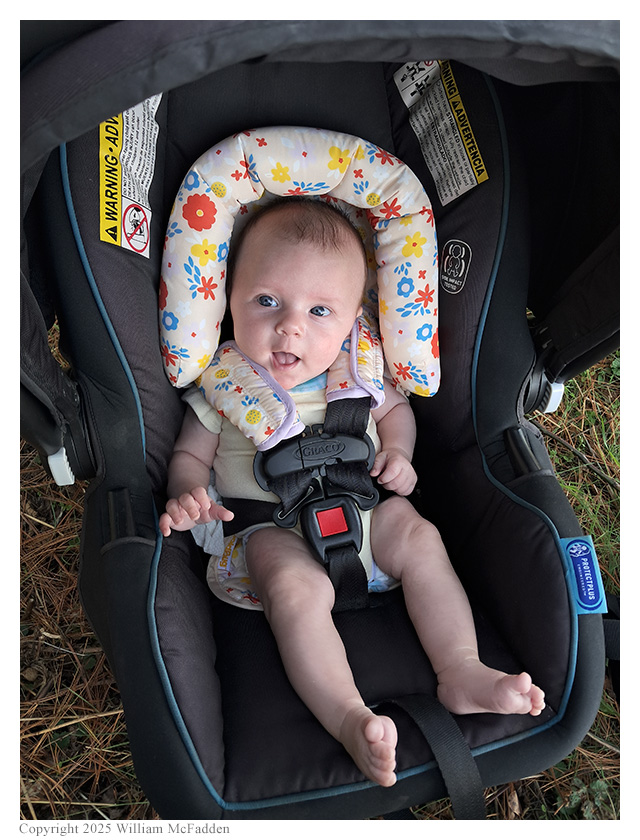
Infant Thia, learning CW?
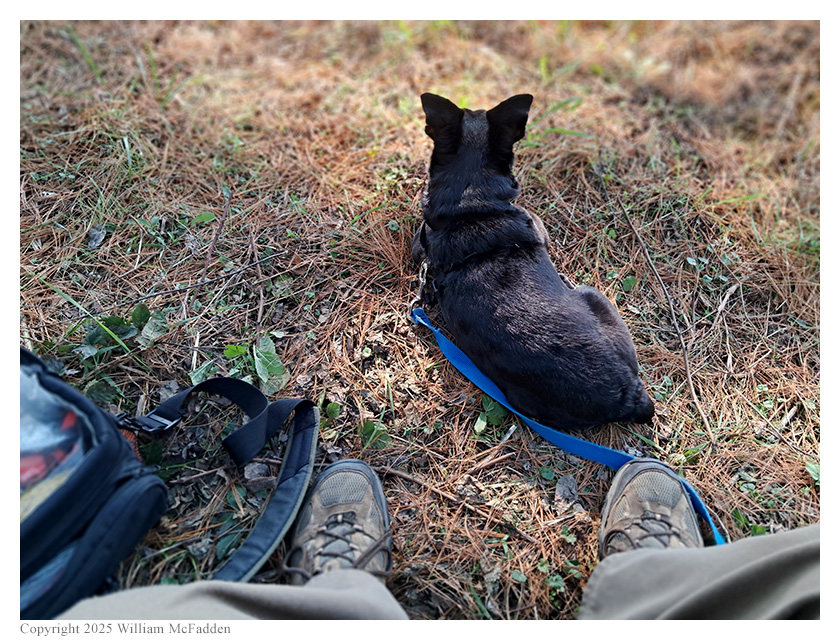
Theo-dog guards his pack from all threats.
Tom set up his IC-705 station about 100' away from Eric, deploying his JPC-12 portable HF vertical on a small tripod, and placing his IC-705, Vibroplex Vibrokeyer single-lever paddle, and logging computer on a 4' folding table.
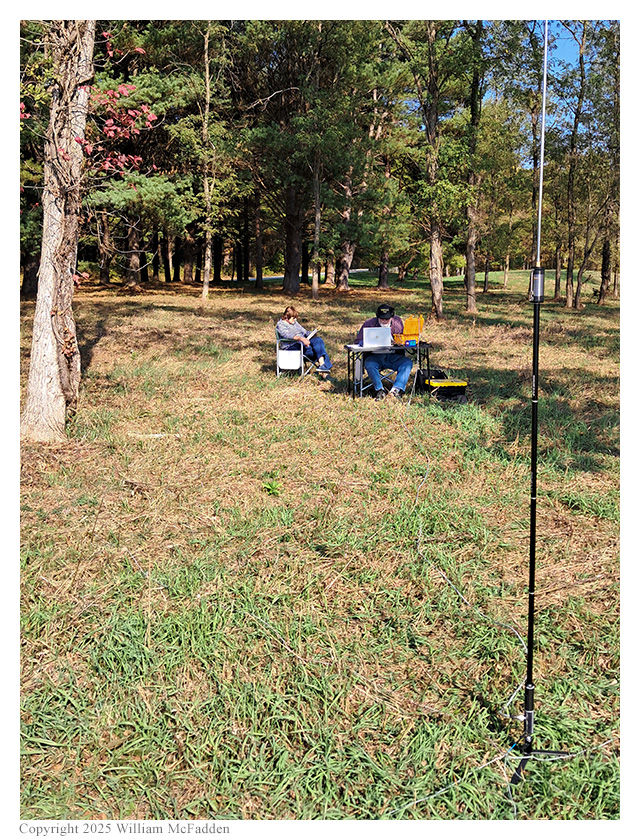
Tom's antenna and station.
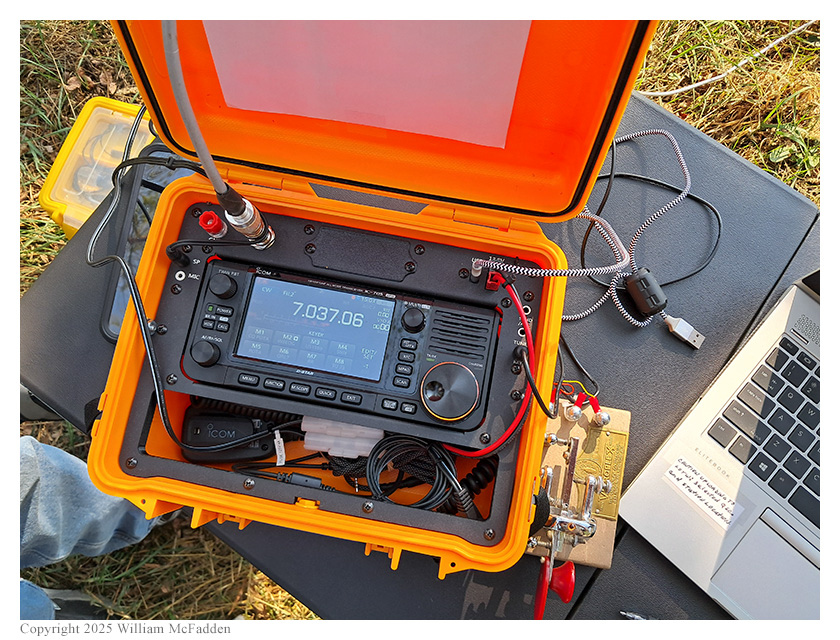
Tom's IC-705 station.
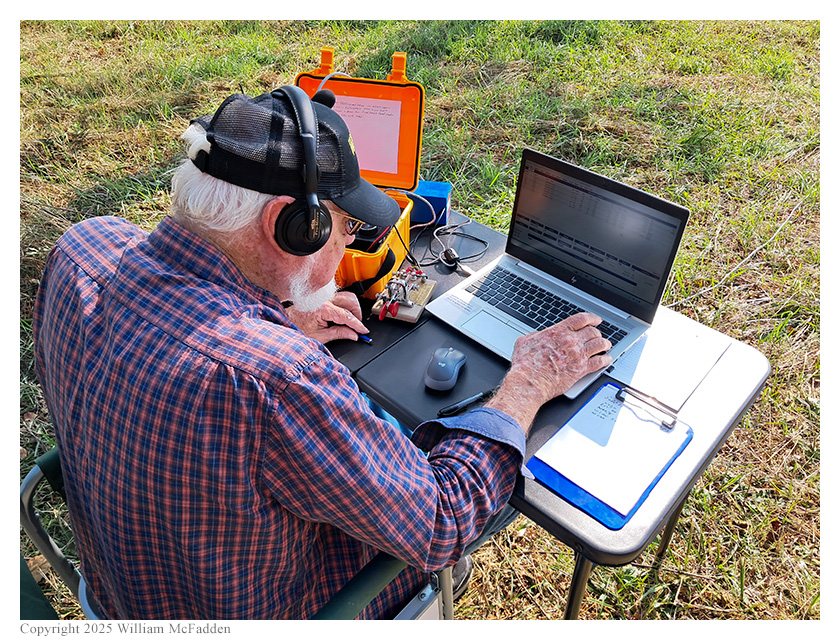
Tom operates.
As he had hoped, given the close proximity to I-77, Eric found he had good cell-signal and would be able to spot himself on POTA Spots (link) and to use POTA Spots to identify possible park-to-park (P2P) QSO opportunities.
Eric started his operation on 30m so that his father could start on 20m. While looking for a clear frequency to run, Eric found K3ES running a frequency, and at 1822 UTC Eric completed a P2P QSO with K3ES who was activating Cornplanter State Forest (US-5465) in Pennsylvania.
After finding himself a clear frequency to run, Eric began calling "CQ POTA" and was auto-spotted on POTA Spots. His first QSO in this run came at 1824 UTC with VA3UZ in Ontario. This was followed at 1826 UTC by a QSO with K9HIM in Illinois, and at 1827 UTC by a QSO with KQ1O in Virginia.
After noticing that his father was operating on 40m, Eric moved to 20m and, while trying to find himself a clear frequency, found KU8T running. At 1834 UTC, Eric completed a P2P QSO with KU8T who was activating Footville State Wildlife Area (US-9842) in Illinois.
Finding himself a clear frequency to run, Eric began calling "CQ POTA" and self-spotted himself on POTA Spots. His first QSO in this run came at 1837 UTC with K3KWB in Maryland. QSOs came quickly, with Eric's tenth QSO in this run coming at 1851 UTC with KC1VAS who, Eric learned later, was performing a two-fer activation of Taylor Saw Mill State Historic Site (US-8024) and Ballard State Forest (US-4872) in New Hampshire. This run included QSOs with operators located in Florida (2), Indiana, Maryland, Massachusetts, New Hampshire, North Carolina (2), Pennsylvania, and Ontario.
Eric finished his operation by coordinating with his father to make two-fer P2P QSOs on 40m and on 20m.
In all, Eric made twenty QSOs (if one considers the P2P two-fer QSOs), with eight P2P QSOs. All of his QSOs were made with CW and 5w of transmitter output.
Eric learned later that his transmissions on 20m wiped out his dad's reception on 40m. Nevertheless, Tom managed to complete his activation with twelve QSOs, not counting two-fer P2P QSOs as multiples.
After tearing down his station, and after saying his good-byes to his parents, Eric let grandson Archer show him the highlights of the Eco-Discovery Center while Vickie watched over granddaughter Thia and Theo-dog.
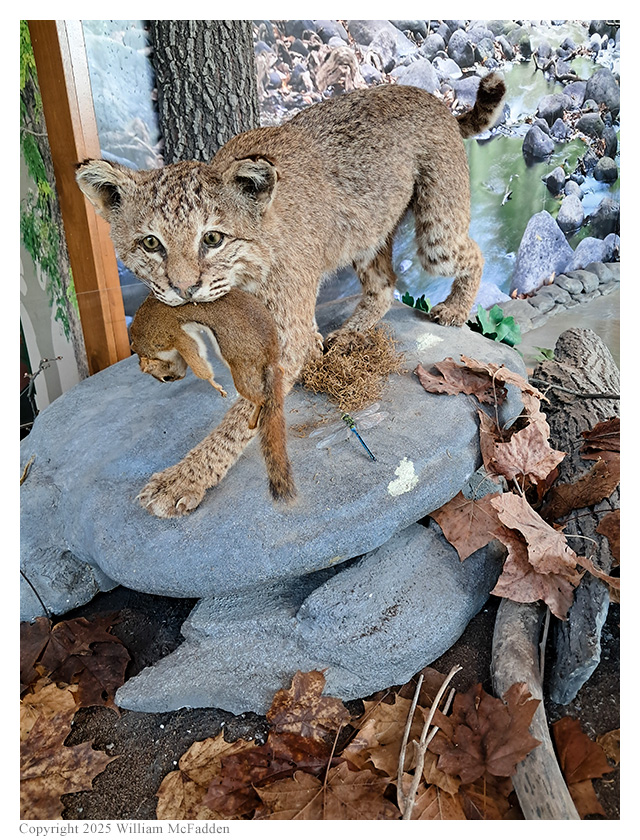
A (taxidermy) bobcat, with a (taxidermy) squirrel.
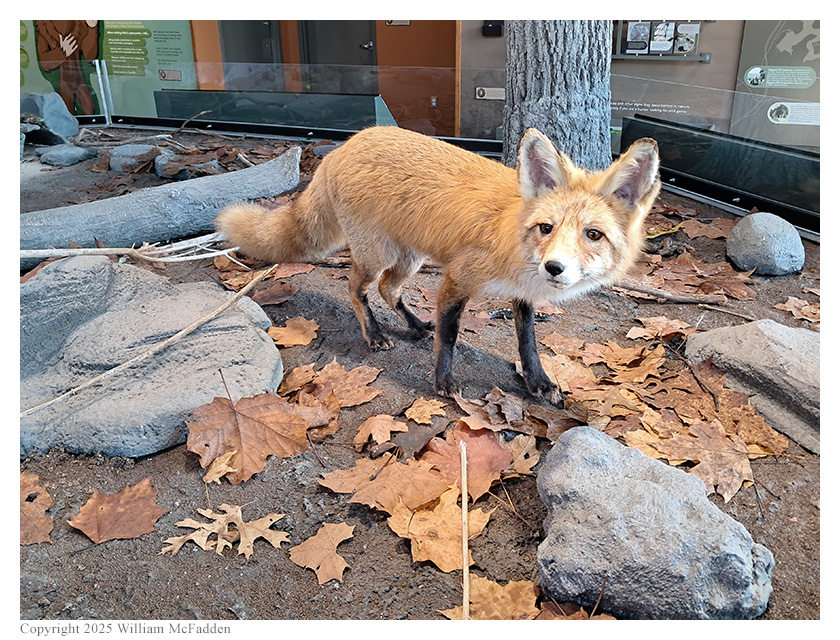
A (taxidermy) red fox.
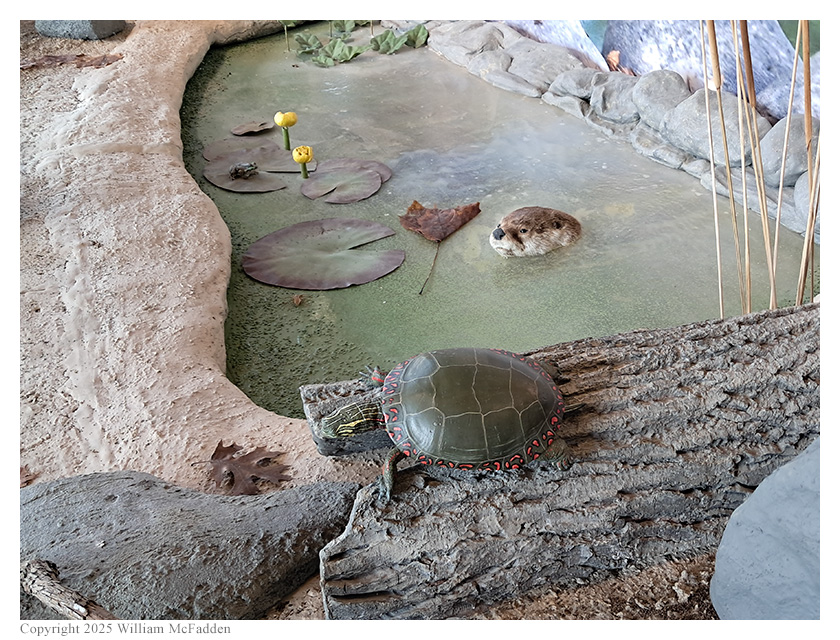
A (taxidermy) turtle, a (taxidermy) river otter, and a (taxidermy) frog.
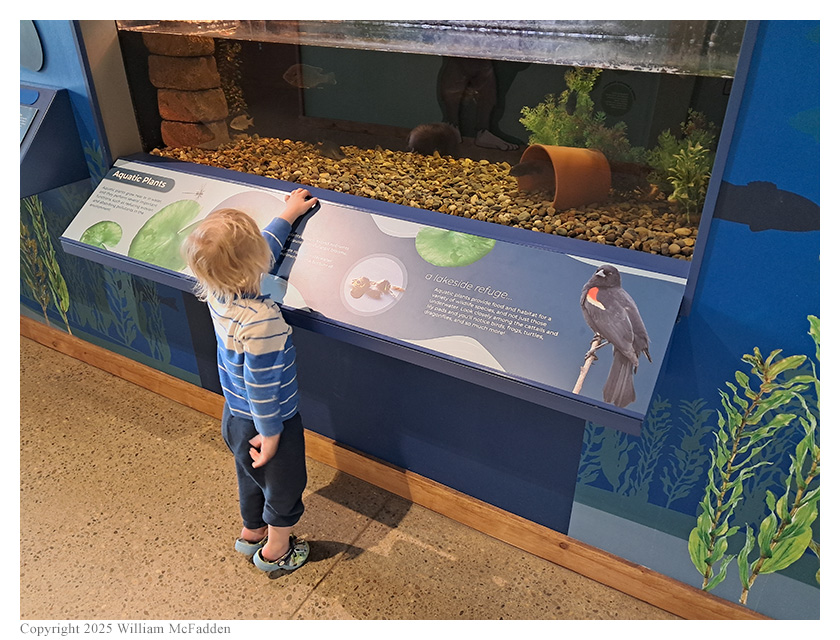
Archer enjoys one of several aquariums.
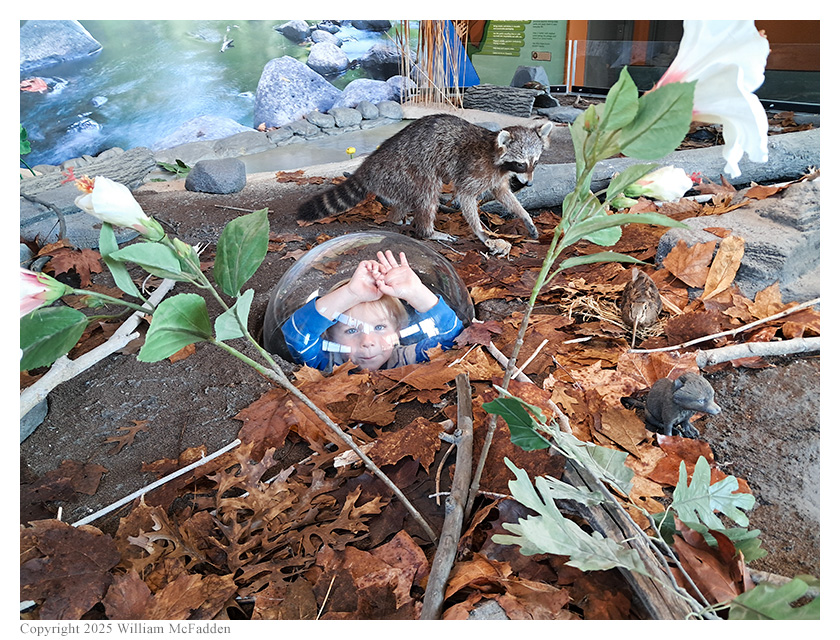
Archer pops his head up from underneath the large diorama.
After leaving Salt Fork State Park, Eric, Vickie, the grandkids and Theo-dog diverted to Zanesville for dinner and ice cream at Tom's Ice Cream Bowl (link). (Well, Theo-dog didn't have dinner or ice cream, and granddaughter Thia had to be content with just a bottle.) Upon leaving Tom's Ice Cream Bowl, Eric navigated to the northern terminus of Ohio State Route 555—the famous Triple Nickel—and followed the first 38 miles of the twisty, hilly state route before reaching Chesterhill and turning for home.
Eric also submitted his log to the World Wide Flora and Fauna in Amateur Radio (WWFF; link) program for Salt Fork State Park, KFF-1989.
(return)