
by William Eric McFadden
From the Quail Hollow State Park website:
-
Quail Hollow State Park is a 701-acre landscape of rolling meadows, marshes, and pine and deciduous woods surrounding a 40-room historic manor. Scenic woodland trails, gardens and the house offer a variety of natural and cultural experiences for visitors.
Pictures
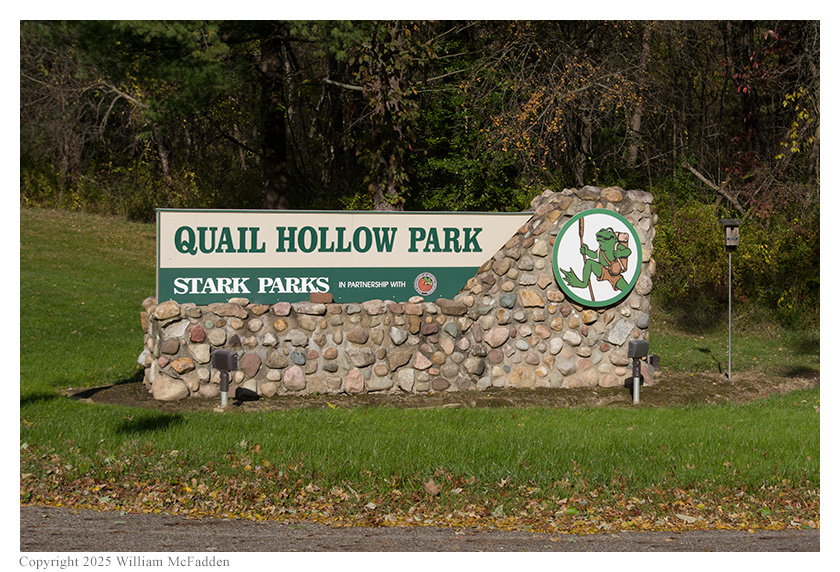
- The Quail Hollow State Park sign
- Eric's KX2 station
- Eric's mast and antenna
- Miles operating: 1 | 2 | 3
- Miles's mast and antenna
- The pond
Description
On Saturday, November 1, 2025, two members of the Southeast Ohio Radio Adventure Team performed activations of Quail Hollow State Park (US-1987) as part of the Parks on the Air (POTA; link) program.
While in the northeastern corner of Ohio for the MARC Hamfest at MAPS Aviation Museum the following day, Eric McFadden, WD8RIF, and Miles McFadden, KD8KNC, each performed activations of Quail Hollow State Park. This was the first of three parks Eric and Miles planned to visit before finding dinner and their motel room.
Eric and Miles arrived at Quail Hollow State Park and did a bit of exploring before deciding to set up their stations at the playground/trailhead/pond area within the state park. Each operator chose a picnic table from several available picnic tables.
WD8RIF
After selecting a suitable picnic table, Eric deployed a Tufteln (link 35' EFRW antenna as a sloper to the top of a Goture Red Fox Super Hard 720 carbon-fiber mast held upright on a spike, oriented at a right-angle with Miles's antenna, laying three 17' counterpoise wires directly on the ground. Placing his Elecraft KX2 on the picnic table, and connecting earphones and a paddle, Eric was on the air at about 1945 UTC.
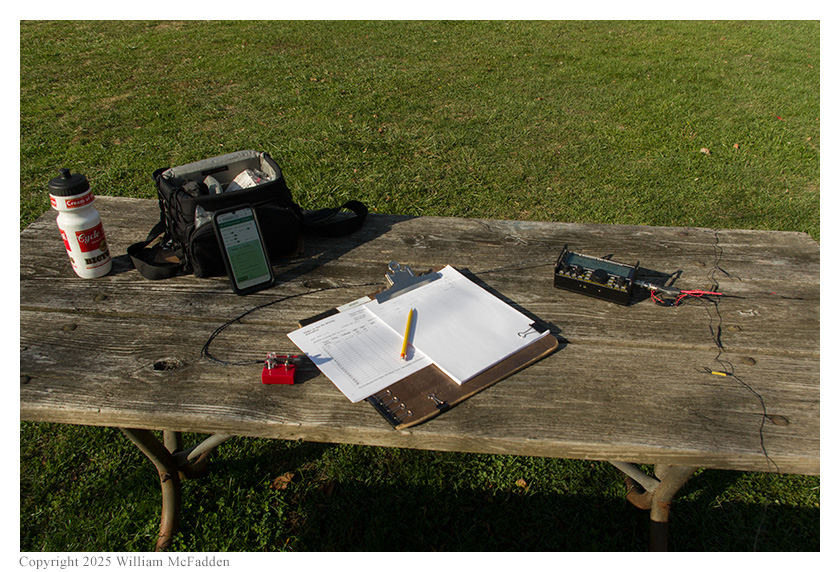
Eric's Elecraft K2 station.
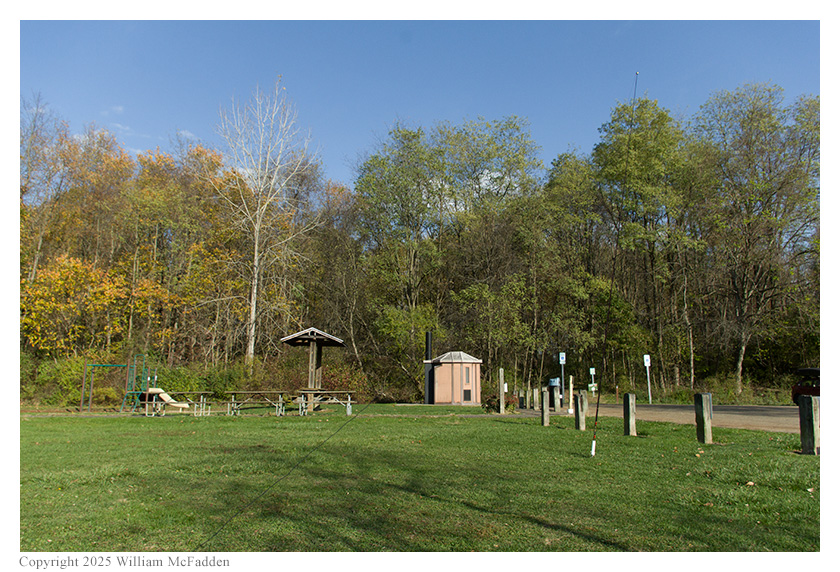
Barely visible: Eric's mast and antenna.
As he had expected, Eric found he had cell-signal at this location, and he would be able to access POTA Spots to spot himself and to find Park-to-Park (P2P) QSO opportunities.
Wanting to give Miles the opportunity to use 20m first, Eric chose to begin his operation on 17m, a band not harmonically related to 20m, to minimize interference between the two stations. After finding himself a clear frequency to run, Eric self-spotted himself on both the POTA and World Wide Flora and Fauna in Amateur Radio (WWFF; link) spotting pages, and began to call "CQ POTA". His first QSO came at 1951 UTC with stalwart hunter KJ7DT in Idaho. This was followed at 1953 UTC by a QSO with HI8JCD in the Dominican Republic. QSOs came surprisingly quickly, with Eric's fifth QSO coming at 1959 UTC with K7MSO in Montana. This run included the aforementioned DX QSO and QSOs with operators located in Idaho, Maine, Montana, and Texas.
Switching to 30m, another band not harmonically related to 20m, Eric found a clear frequency to run, spotted himself on POTA Spots and WWFF, and began calling "CQ POTA". His first QSO in this run came at 2005 UTC with WT3C in Maryland. QSOs came steadily on 30m, with Eric's tenth QSO in this run coming at 2016 UTC with AC5K in Missouri. This run included QSOs with operators located in Connecticut, Indiana, Maryland (3), Missouri, New York (2), Pennsylvania, and Wisconsin.
In all, Eric made fifteen QSOs in just about half an hour of on-air time. All of Eric's QSOs were CW and were made at five watts of output.
KD8KNC
Miles had chosen a scenic picnic table located under a tree displaying Fall color. He deployed his PacTenna (link) EFRW as a sloper to the top of a mast in a weighted base, relying on his coax's outer shield to serve as a single counterpoise wire. Miles placed his Yaesu FT-891 transceiver on the picnic table, connected it to his 2m go-box's DC distribution-bus for power, and connected the antenna through an LDG Z-100A auto-tuner. After he set his transceiver to about 20w of output power, Miles was on the air at about 1950 UTC.
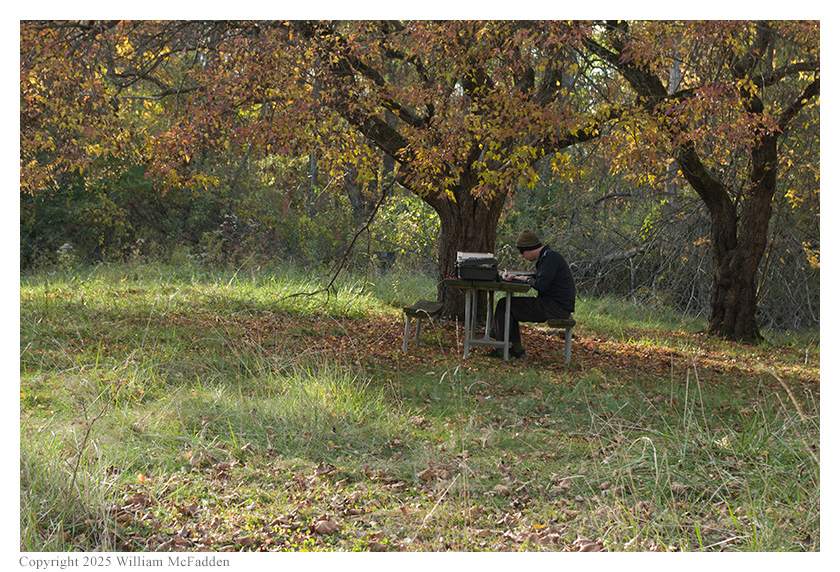
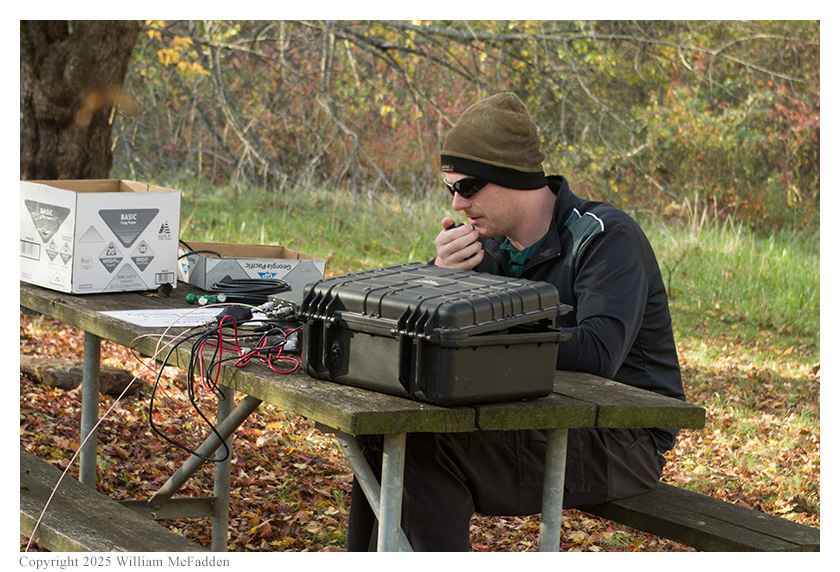
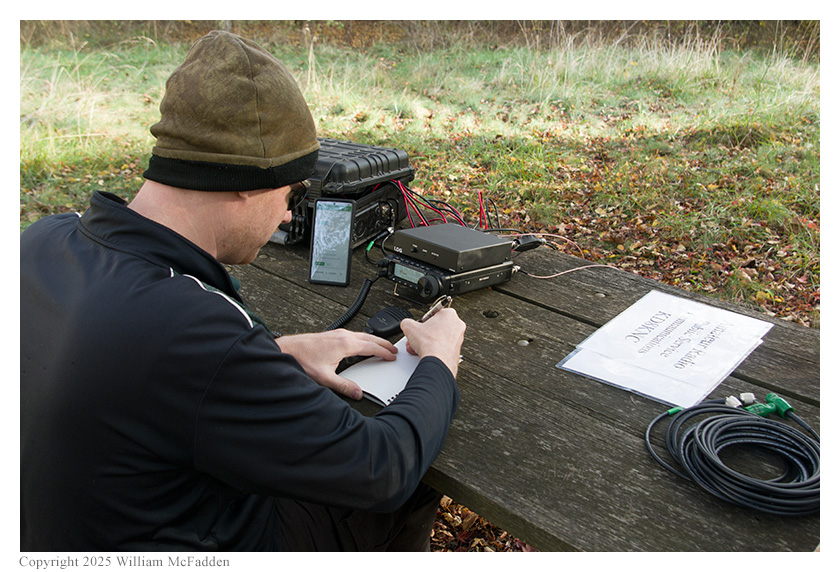
Miles operating.
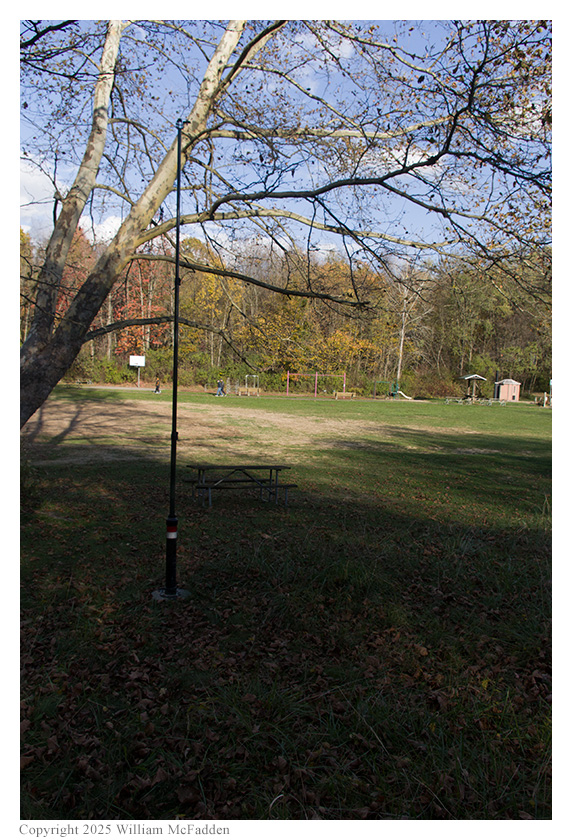
Miles's mast and (not-quite-visible) antenna.
Miles started his operation on 20m and confined himself to only hunting for P2P QSOs. By the time Eric had finished his operation, Miles had five or six P2P QSOs in the log. When Eric was able to join Miles, he noticed that Miles's transceiver was indicating high SWR, so he helped Miles figure out how to put the FT-891 into transmit in CW mode and to tell the ATU to initiate a tuning cycle, and the ATU was able to quickly find a good match. After this, Miles found it a bit easier to bust the pileups and log QSOs more quickly. (During tear-down, Miles found that he had plugged the ATU control-cable key line into the wrong socket on the back of the transceiver; this error prevented the ATU from commanding the transceiver to key and to initiate a tuning cycle.)
After validating his activation with ten QSOs, Miles switched to 40m and made two more P2P QSOs.
Post-activation Conclusion
After their respective operations were complete, Eric and Miles agreed that neither of them had heard any interference from the other station. Choosing non-related bands and orienting the antennas at right-angles to each other seemed to enough to prevent the sort of interference Eric had experienced with more haphazard two-op operations.
After a few more photos, a quick tear-down of both stations, and packing everything into the car, it was time to drive the short distance to the day's second park, Wingfoot Lake State Park.
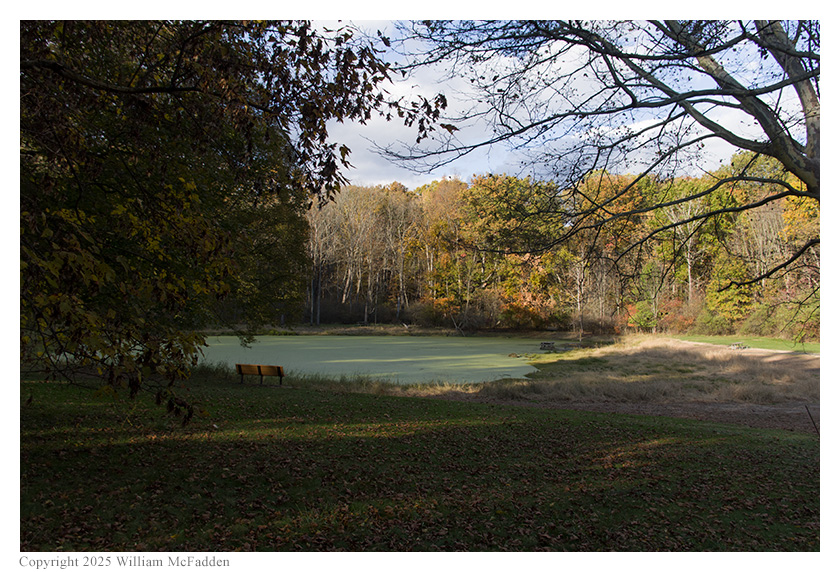
The pond at the playground and trailhead area.
Eric also submitted his log to the World Wide Flora and Fauna in Amateur Radio (WWFF; link) program for an operation at Quail Hollow State Park, KFF-1987.
(return)