by William Eric McFadden
From the Lake Hope State Park website:
-
Lake Hope State Park offers a truly relaxing, yet rustic getaway from the high speed of modern life. The entire 2,983-acre park lies within the Zaleski State Forest in the valley of Big Sandy Run. The park's heavily forested region is marked by steep gorges and narrow ridges with remnants of abandoned mining and iron-producing industries.
The park surrounds the lake and boasts a wooded family campground and a variety of year-round cabins for families and gatherings of all sizes, including the roomy Laurel Lodge. No visit to the park is complete without a stop in the dining lodge for a hearty meal.
From the Zaleski State Forest website:
-
The 27,822-acre Zaleski State Forest is the second largest forest in Ohio's system of state forests.
Zaleski State Forest operates the only state-owned sawmill in Ohio. The mill produces rough sawn lumber for use by Ohio’s state forests and state parks as well as other government agencies.
Historic Moonville Tunnel is located within Zaleski State Forest on the Moonville Rail Trail right-of-way.
Pictures
- Iron Furnace Trail Runs "King Hollow Aid Station"
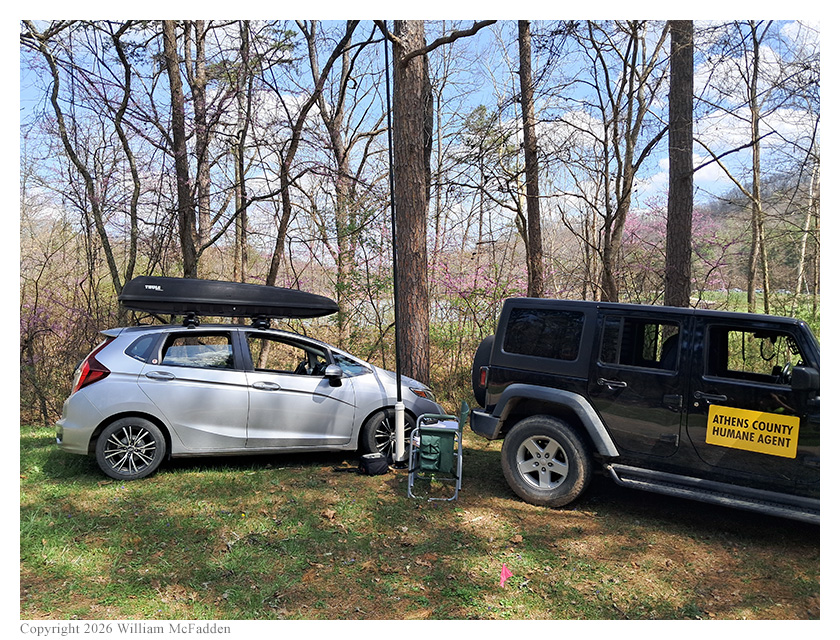
- Eric's POTA station: 1 | 1
- Eric's mast and antenna
Description
On Saturday, April 4, 2026, one member of the Southeast Ohio Radio Adventure Team performed successful simultaneous activations of Lake Hope State Park (US-1968) and Zaleski State Forest (US-5455) in Ohio as part of the Parks on the Air (POTA; link).
After providing communications-support to the Iron Furnace Trail Runs (info) at the King Hollow Aid Station, Eric joined Andy McDonald, K8FO, at his location near the finish of the half-marathon to perform the two-fer activation.
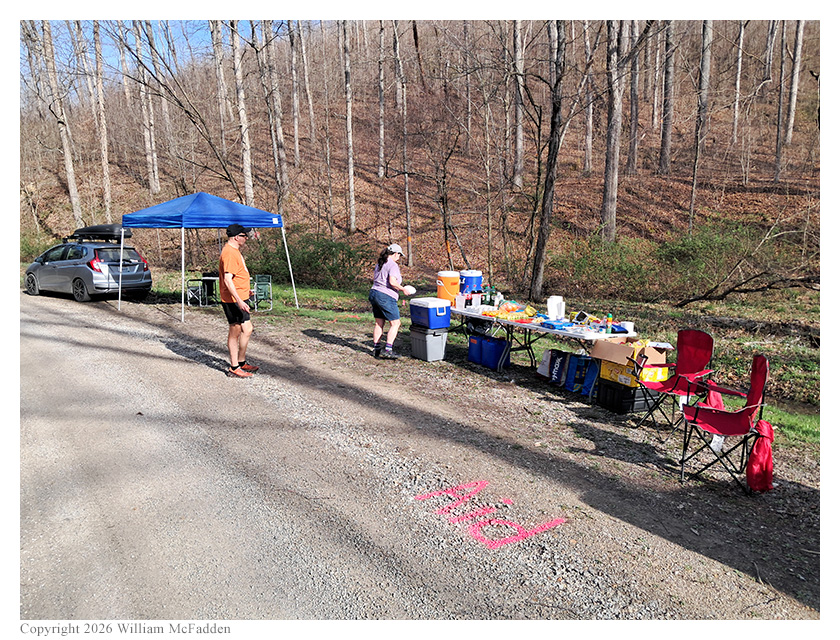
The King Hollow Aid Station prior to the arrival of the
first runners; Eric's 2m station is under the blue canopy.
After verifying that Eric's activity wouldn't interfere with Andy's ability to support the half-marathon, Eric set up his station, deploying his Tufteln (info) EFRW as a 29' vertical supported on a 31' telescoping fiberglass mast in a drive-on base, and placing two 17' counterpoise wires directly on the ground. Placing his folding camp-chair at the base of the mast, and placing his Elecraft KX2 on the camp-chair's flip-up table, Eric was on the air at 1651 UTC.
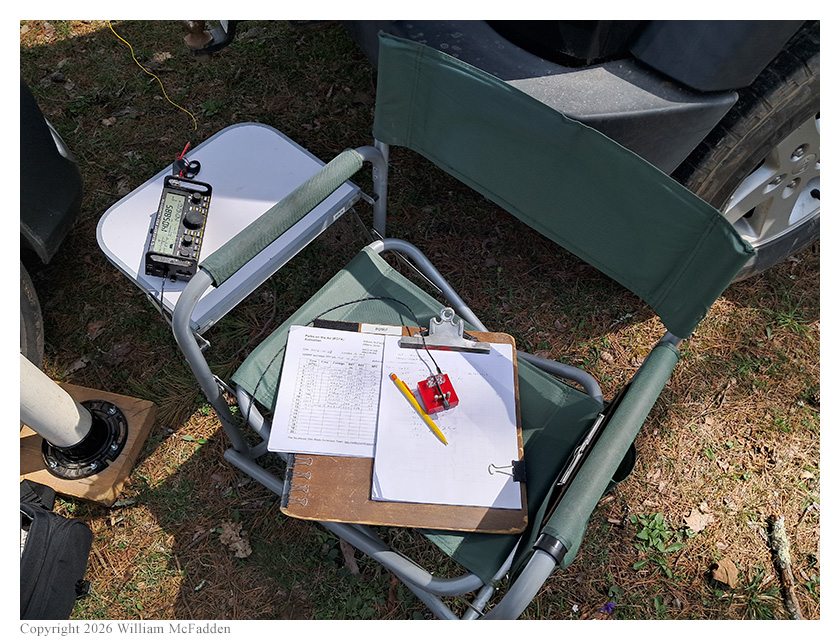
Eric's KX2 station.
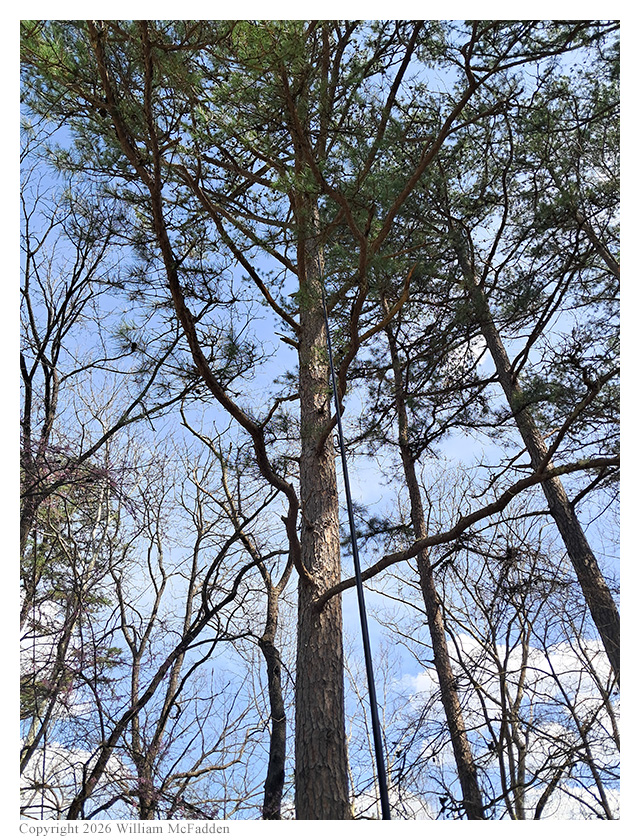
Having parked beneath a fir tree to take
advantage of the shade, but having failed
to look up before placing his drive-on
base, Eric was lucky his 29' radiator
didn't tangle irretrievably in the fir tree.
Eric was able to operate so near to the lake because the new cell-tower was operational and strong cell-signal is now available throughout most of the state park. (Previously, he would have needed to go high up on a ridgetop in order to find any cell-signal at all.) The availability of cell-signal meant Eric would be able to spot himself, if needed, on the POTA Spots website (link), and he would be able to use POTA Spots to identify possible Park-to-Park (P2P) QSOs.
Eric began his operation on 20m. Finding himself a clear frequency to run, Eric began calling "CQ POTA" and was auto-spotted on POTA Spots. His first QSO came at 1653 UTC with WA1VEI who was operating mobile in Massachusetts. QSOs came steadily, with Eric's twelfth QSO coming at 1711 UTC with KY4LV in Missouri. This run included QSOs with operators located in Colorado, Florida (2), Georgia (3), Massachusetts, Minnesota, Missouri, New York (2), and Vermont.
In all, Eric made twelve QSOs in twenty minutes of on-air time. All of Eric's QSOs were CW and were made with a power output of five watts.
Following station tear-down, Eric drove to nearby Turkey Ridge Wildlife Area (US-9509) to see if cell-signal was now available there. However, upon arriving at Turkey Ridge Wildlife Area on Bolster Hollow Road, he was disappointed to find that Verizon cell-signal still remains weak to non-existent.
Eric also submitted his log to the World Wide Flora and Fauna in Amateur Radio (WWFF; link) program for an operation at Lake Hope State Park, KFF-1968.
(return)