by William Eric McFadden
From the Lake Hope State Park website:
-
Lake Hope State Park offers a truly relaxing, yet rustic getaway from the high speed of modern life. The entire 2,983-acre park lies within the Zaleski State Forest in the valley of Big Sandy Run. The park's heavily forested region is marked by steep gorges and narrow ridges with remnants of abandoned mining and iron-producing industries.
The park surrounds the lake and boasts a wooded family campground and a variety of year-round cabins for families and gatherings of all sizes, including the roomy Laurel Lodge. No visit to the park is complete without a stop in the dining lodge for a hearty meal.
From the Zaleski State Forest website:
-
The 27,822-acre Zaleski State Forest is the second largest forest in Ohio's system of state forests.
Zaleski State Forest operates the only state-owned sawmill in Ohio. The mill produces rough sawn lumber for use by Ohio’s state forests and state parks as well as other government agencies.
Historic Moonville Tunnel is located within Zaleski State Forest on the Moonville Rail Trail right-of-way.
Pictures
Description
On Sunday, February 1, 2026, one member of the Southeast Ohio Radio Adventure Team performed successful simultaneous activations of Lake Hope State Park (US-1968) and Zaleski State Forest (US-5455) in Ohio as part of the Parks on the Air (POTA; link).
While the region was stuck in a deep-freeze following a significant snow-event the previous weekend, roads had (mostly) been cleared and Eric McFadden, WD8RIF, needed some "radio therapy" and he chose to visit Lake Hope State Park and Zaleski State Forest for the two-fer activation.
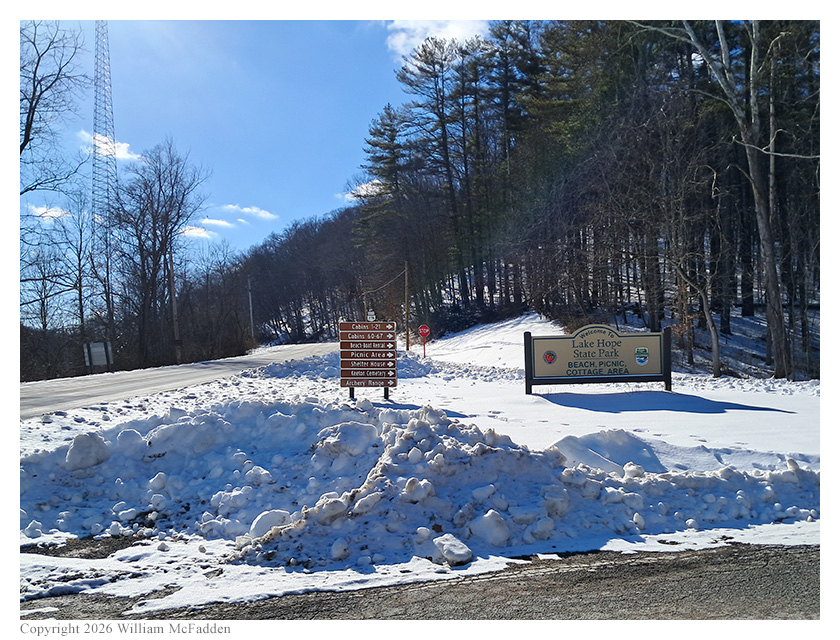
"Welcome to Lake Hope State Park"
Eric arrived at Keeton Cemetery within the state park and state forest at 1937 UTC to find the parking lot to be unoccupied. Parking his car, he deployed his Tufteln (link) EFRW as a 29' vertical supported on a 31' Jackite telescoping fiberglass mast in a drive-on base, laying two 17' counterpoise wires directly on the ground. Placing his Elecraft KX2 on the car's passenger-side dashboard, Eric was on the air at 1945 UTC.
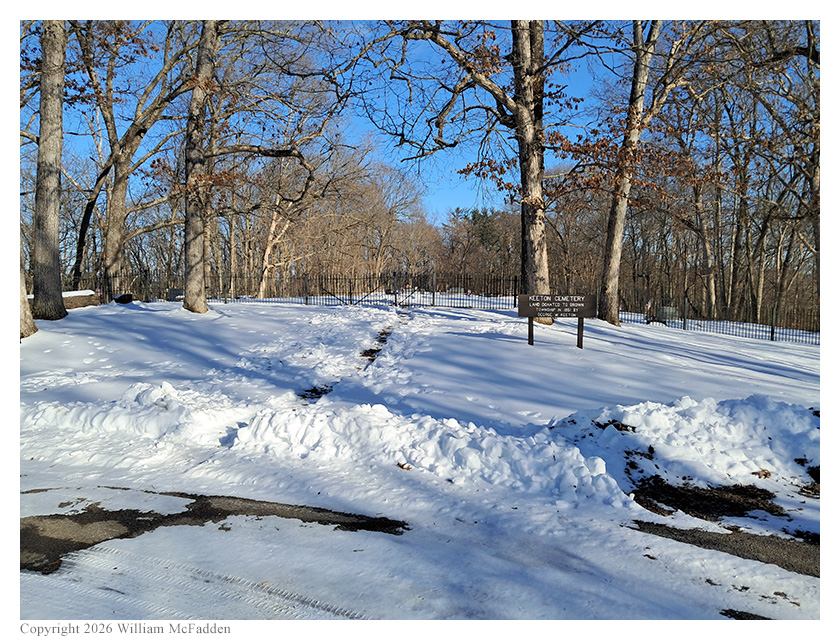
Keeton Cemetery; someone was nice
enough to shovel a path into the cemetery.
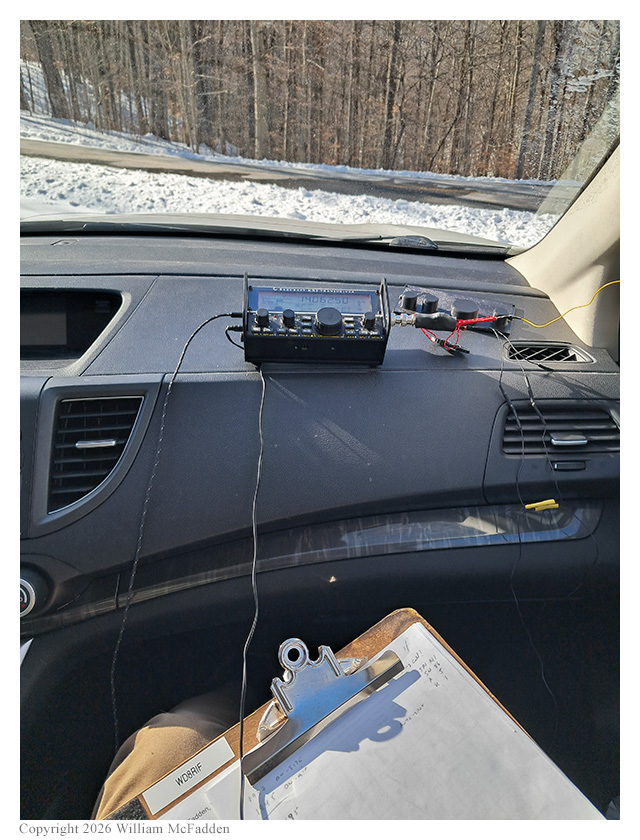
Eric's KX2 station inside the car.
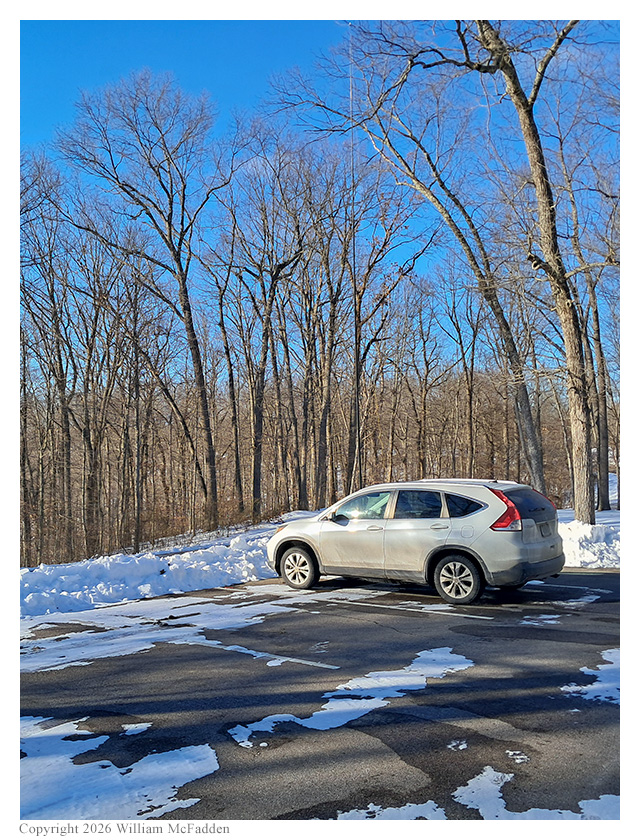
Eric's mast, just barely visible.
Eric had selected Keeton Cemetery because, during previous operations, this was one of only a few locations within the park that had any sort of cell-signal, and it had previously been very weak. On this visit, however, Eric was very pleased to see that everywhere he went within the park had strong cell-signal, an indication that the cell-tower that had been under construction for nearly a year was finally operational. The availability of cell-signal meant Eric would be able to spot himself, if needed, on the POTA Spots website (link), and he would be able to use POTA Spots to identify possible Park-to-Park (P2P) QSOs.
Eric began his operation on 20m. Finding himself a clear frequency, Eric began calling "CQ POTA" and was auto-spotted on POTA Spots. His first QSO came at 1953 UTC with AD0DB in Minnesota. QSOs came steadily, with his tenth QSO coming at 2011 UTC with W9MAF in Missouri. This run included a P2P QSO with KJ7XJ at Penrose Point State Park (US-3248) in Washington and QSOs with operators located in Florida, Kansas, Maine, Massachusetts, Minnesota, Missouri, New York, Texas, Utah, and Washington.
Having successfully validated his activation by completing ten QSOs, Eric switched to 30m in order to make a QSO at 2016 UTC with K3ES at Cornplanter State Forest (US-5465) in Pennsylvania.
Switching to 40m, Eric found himself a clear frequency to run, began calling "CQ POTA", and was auto-spotted on POTA Spots. His first QSO in this run came at 2021 UTC with KB6NU in Michigan. QSOs on 40m came quickly, with his fifth QSO in this run coming at 2024 UTC with K3NCE in Maryland. This run included QSOs with operators located in Indiana (2), Maryland, Michigan, and Pennsylvania.
Eric finished his operation by hunting for P2P QSOs. He was disappointed to be unable to hear KL7EC in Alaska on 10m, but at 2030 UTC he made a P2P QSO on 20m with WR7B at Featherstonhaugh State Forest (US-5015) in New York.
In all, Eric completed seventeen QSOs, including three P2P QSOs, in forty-five minutes of on-air time. All of Eric's QSOs were CW and were made with a power output of five watts.
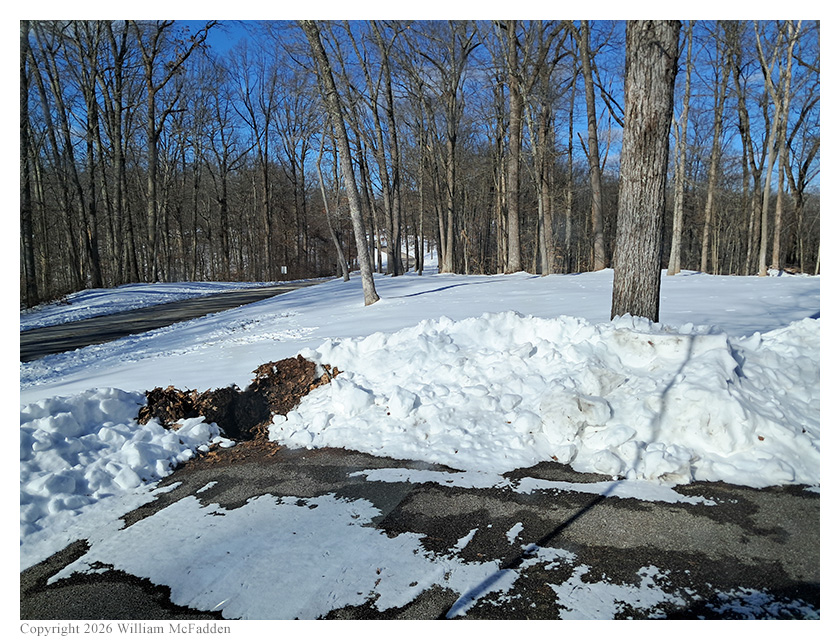
Snow surrounding the Keeton Cemetery parking lot.
Following station tear-down, Eric thought to drive to nearby Turkey Ridge Wildlife Area (US-9509) to see if cell-signal was now available there. However, upon arriving at Bolster Hollow Road, the access road into the wildlife area, he found that ODNR hadn't plowed that road. (It appeared that ODNR had failed to plow any of the other forestry roads in Turkey Ridge Wildlife Area or Zaleski State Forest.) Even though the car Eric was driving was equipped with all-wheel drive and Blizzak snow tires, Eric was fairly certain it wouldn't have been up to the task of negotiating the 6" or more of snow on the unplowed road, so another trip will be required to determine if cell-signal is available.
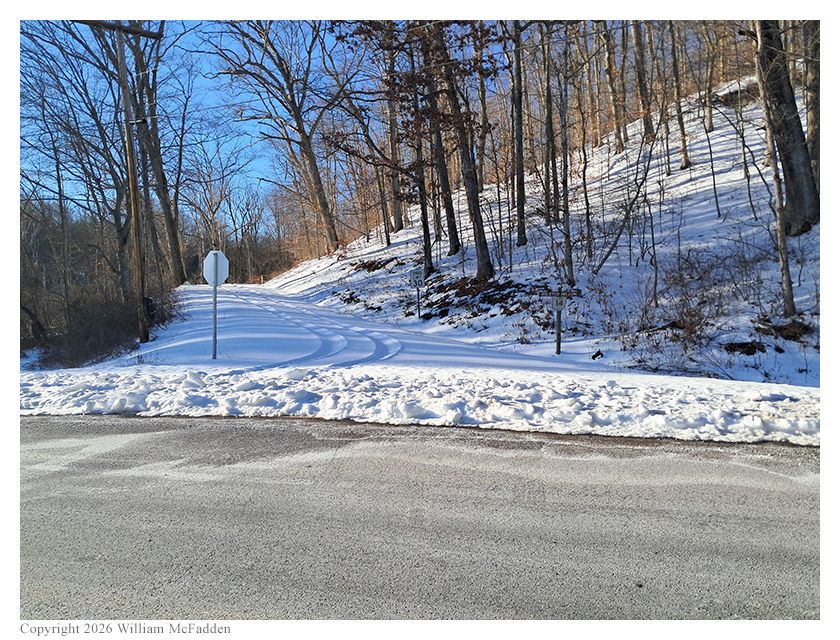
Bolster Hollow Road, unplowed and inaccessible
except, perhaps, to high-clearance 4WD trucks.
Eric also submitted his log to the World Wide Flora and Fauna in Amateur Radio (WWFF; link) program for an operation at Lake Hope State Park, KFF-1968.
(return)