by William Eric McFadden
From the Burr Oak State Park website:
-
As one of Ohio's resort parks, Burr Oak State Park blends modern convenience with Ohio's wilderness spirit. Miles of forested ridges and hollows can be found here. The park offers a rustic full-service lodge with family suites and a cozy campground with easy access to the lake. A substantial trail system ranges from moderate to difficult with portions intersecting the statewide Buckeye Trail.
From the North Country Trail Association website:
-
The North Country National Scenic Trail is the longest in the National Trails System, stretching 4,800 miles across eight states from North Dakota to Vermont, traversing forests and farmlands, remote terrain and nearby communities. Whether you’re looking to day-hike a few miles or plan a longer overnight backpacking trip, a multitude of diverse landscapes and hiking opportunities are waiting for you.
Pictures
Description
On Saturday, January 17, 2026, two members of the Southeast Ohio Radio Adventure Team performed a successful two-fer activation of Burr Oak State Park (US-1939) and North Country National Scenic Trail (US-4239) in Ohio as part of the Parks on the Air (POTA; link) program.
It being POTA Support Your Parks, Winter weekend, Eric McFadden, WD8RIF, wanted to perform an activation. When his son Miles McFadden, KD8KNC, volunteered to go with him, Eric chose to visit Burr Oak State Park because it is relatively close to Miles' house. In order to be able to take advantage of the North Country National Scenic Trail two-fer, Eric and Miles decided to perform their operations at Burr Oak State Park's Dock 3, where NCNST passes over the parking lot. After verifying availability of cell-signal, Eric and Miles set up their respective stations well within 100' of NCNST. The pair were accompanied by Eric's small dog, Theo.
Despite the regions having received about 2" of snow the previous night, the temperature had risen to about 39° and, when the sun wasn't behind clouds, the conditions for outdoor operating were comfortable.
Because they had cell-signal, Eric and Miles would be able to use POTA Spots (link) for spotting themselves and to look for park-to-park (P2P) QSO opportunities.
Eric, Miles, and Theo arrived at Dock 3 at about 1930 UTC to find the parking area empty and still covered in fresh snow. Miles, who was driving his AWD Subaru Impreza, chose a sunlit picnic table on the edge of the lake for his operating location. After clearing the table of snow, he began to set up his station, deploying his PackTenna (link) EFRW antenna on a telescoping mast supported on a heavy weighted base and placing his Yaesu FT-891 on the picnic table. When Miles discovered he was missing an adapter and wouldn't be able to use a coaxial feedline to connect the antenna to his LDG ATU, he connected the EFRW's matching unit directly to his ATU and Eric loaned him a 17' counterpoise wire to take the place of the counterpoise that would have been provided by the missing coaxial cable's outer shield. It took Miles a few minutes to figure out which of the three unlabeled mini-sockets to plug his ATU's interface cable into, but once that was done, Miles was able to get a 1:1 match on 20m and he was on the air at about 1945 UTC. Miles began his operation by hunting for P2P QSOs.
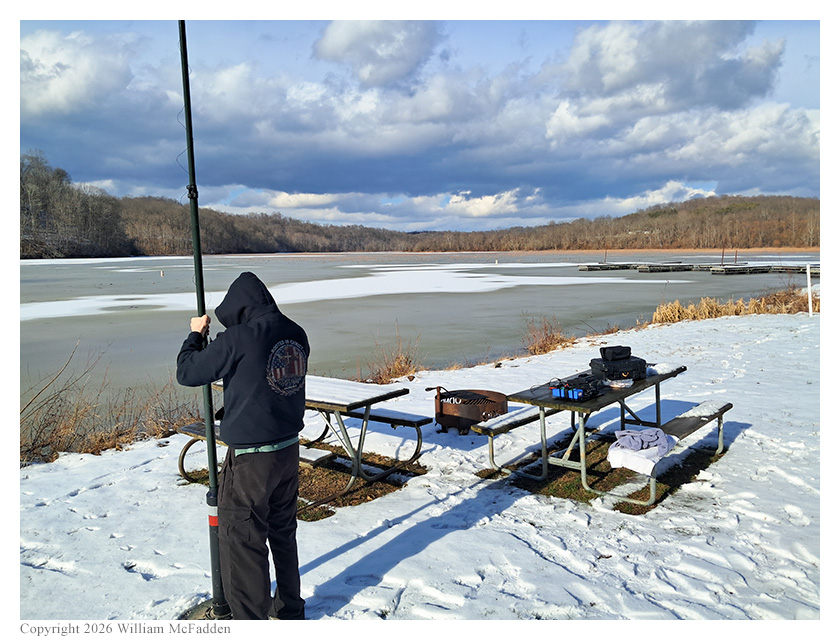
Miles deploys his antenna.
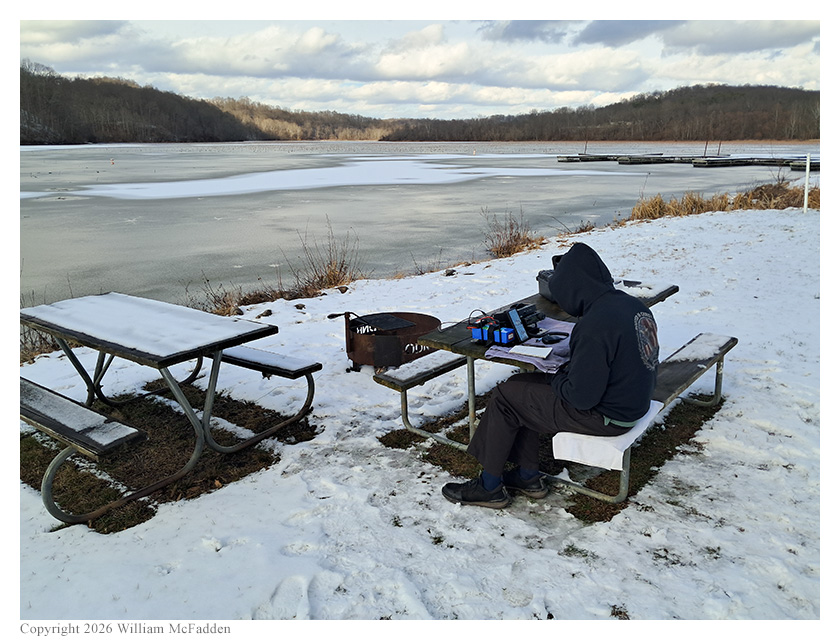
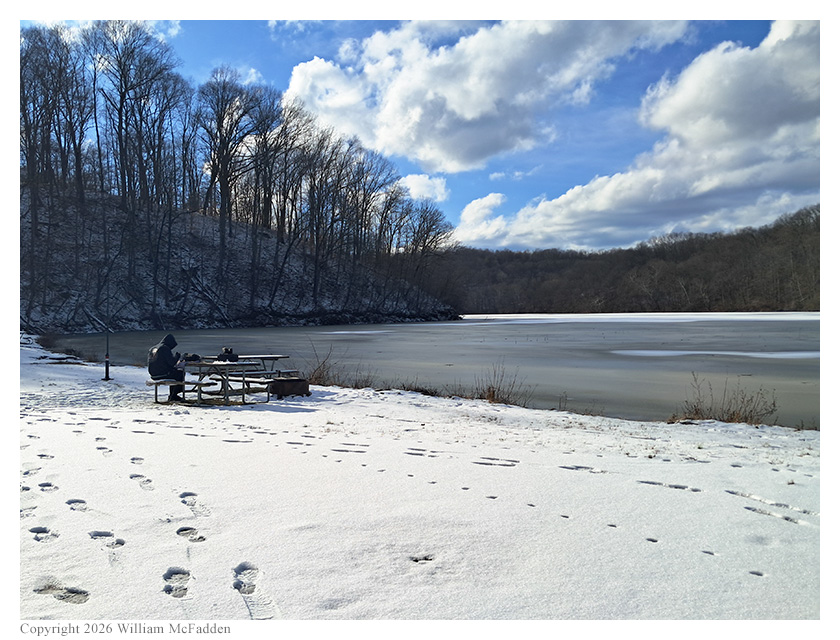
Miles operates.
While Miles hunted P2P stations, Eric took Theo-dog for a quick walk and then set up his own station. Placing his folding camp-chair about 50' away from Miles, he bungied his 31' Jackite telescoping fiberglass mast to his chair, pulled his Tufteln (link) 29' EFRW up, placed two 17' counterpoise wires directly on the ground, and placed his Elecraft KX2 on the camp-chair's flip-up table. Eric was on the air at 1955 UTC.
In order to minimize interference with Miles's station, Eric chose to begin his operation on 30m, a band not harmonically-related to 20m. Finding himself a clear frequency to run, Eric began calling "CQ POTA" and was auto-spotted on POTA Spots. His first QSO came at 1959 UTC with WW4VA in Virginia. QSOs came very quickly, with Eric's tenth QSO (and a validated activation) coming at 2007 UTC and his sixteenth QSO coming at 2014 UTC. Upon completing his sixteenth QSO, Eric sent that he was going off the air (QRT) but ended up working an additional three more stations in quick succession, his final QSO coming at 2018 UTC. This run included a P2P QSO with WG8Y who was performing a two-fer activation of Yadkin River State Game Land (US-6877) and Yadkin River State Trail (US-12320) in North Carolina and QSOs with operators located in Arkansas, Illinois, Kentucky, Maryland, Mississippi, Missouri, New Jersey, New York, North Carolina (3), South Carolina (2), Texas, Vermont, Virginia (2), West Virginia, and Wisconsin.
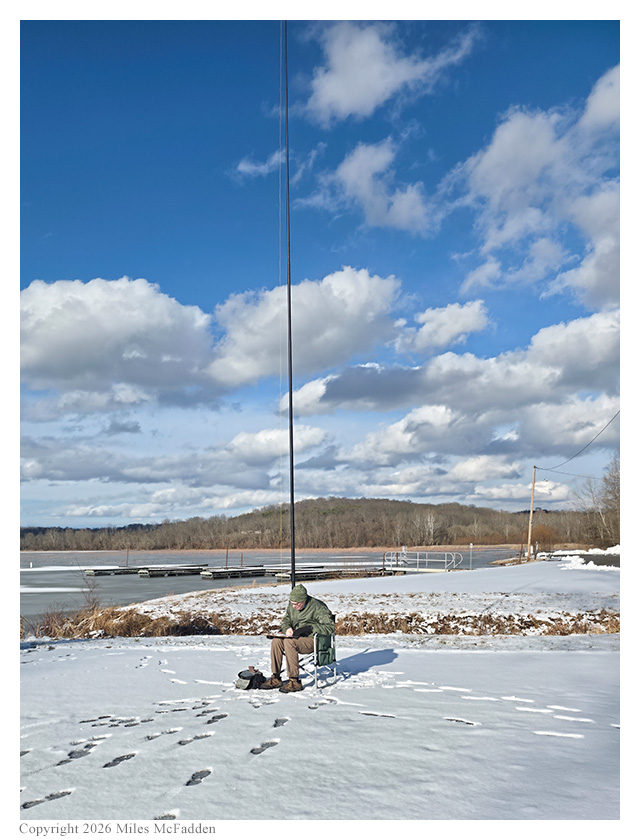
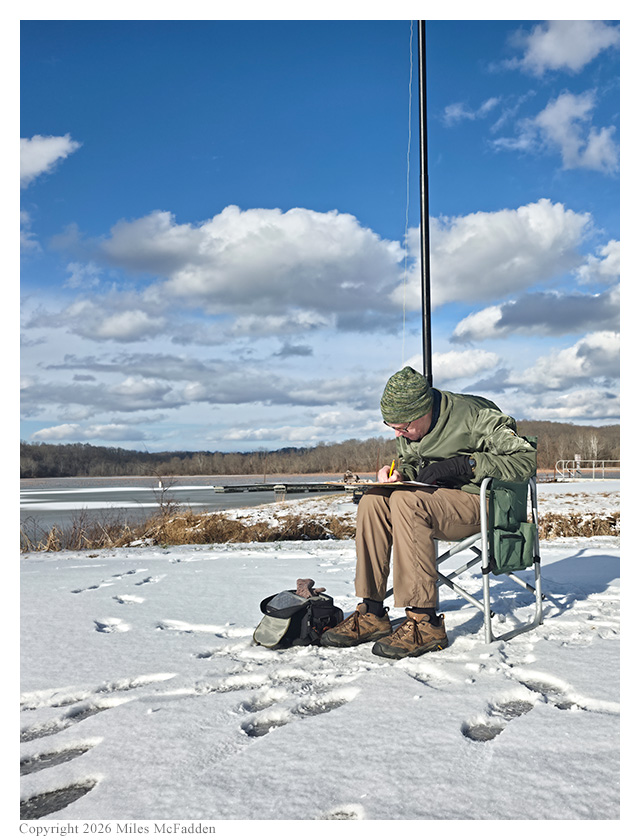
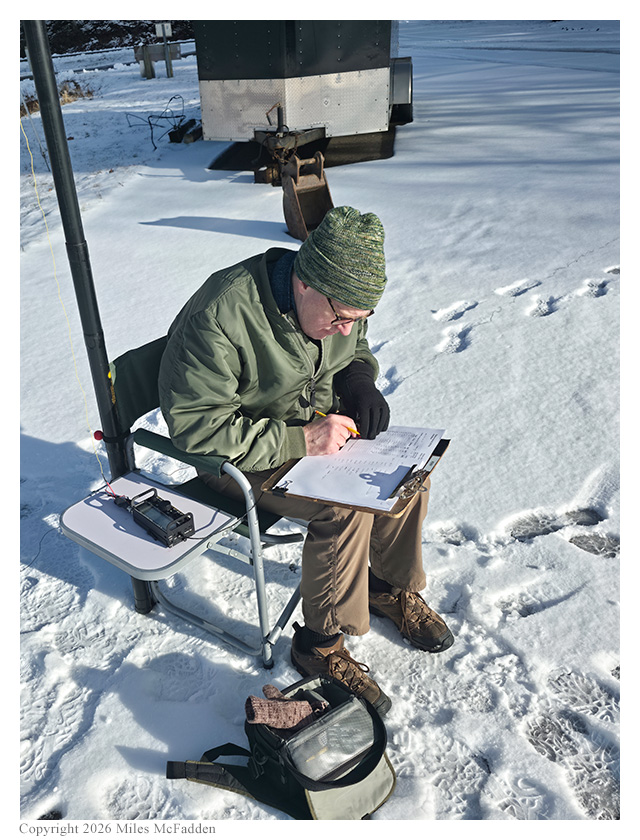
Eric operates; photos by Miles McFadden.
In all, Eric logged nineteen QSOs, including one P2P QSO. All of Eric's QSOs were CW and were made at five watts output.
About halfway into his operation, a sudden gust of wind tried to take down Eric's mast, but Eric was able to stabilize it. About the time Eric was making his fifteenth QSO, Miles came up to announce that his station's 12Ah battery had died. Miles had been running at 20w output, and he had completed four QSOs, so the battery should have lasted longer, but it's possible that the battery hadn't been fully charged at the start of the operation. (Although the dead battery was unfortunate for Miles, it was fortunate for Eric because Miles was able to stabilize Eric's mast as more gusts came while Eric finished his operation.)
After he finished his own operation, Eric offered his KX2 to Miles so he could validate his activation, but Miles declined the offer.
While Miles did not manage a validated activation, he completed four QSOs, all of which were P2P, while running SSB at 20 watts output. This operation helped Miles by allowing him to identify items missing from his portable station.
Eric also submitted his log to the World Wide Flora and Fauna in Amateur Radio (WWFF; link) program for an operation at Burr Oak State Park, KFF-1939.
(return)