
by William Eric McFadden
From the park's website:
-
Located near Ohio's capital city, Alum Creek State Park is a popular boating and camping destination. Visitors can spend the day jet skiing across thousands of acres of water or find a quiet cove to fish or paddle. Perfect for swimming and sunning, the beach is the largest inland beach in the park system. The park's large campground also offers a camp store, boating access, and a nature center for campers. Visitors with children can try the family-friendly mountain bike trail or the half-mile Storybook Trail.
Pictures
Description
On Sunday, January 18, 2026 two members of the Southeast Ohio Radio Adventure Team performed a successful activation of Alum Creek State Park (US-1933) in Ohio as part of the Parks on the Air (POTA; link) program.
Eric McFadden, WD8RIF, and Miles McFadden, KD8KNC, visited Alum Creek State Park as daylight was fading on a bitterly cold (24°) Sunday of POTA Support Your Parks Winter weekend. The pair were accompanied by Eric's wife and Miles's mother Vickie, Eric's granchildren and Miles's nephew and niece Archer and Thia, and the two small dogs Theo and Lily.
Eric and Miles arrived at Alum Creek State Park's Visitor Center at about 2145 UTC. They found the Visitor Center itself to be closed but the parking lot was available. Eric found an out-of-the way parking spot and set up his drive-on mast base.
Since Eric had previously performed an activation of Alum Creek State Park (2019-06-08), his plan was to let Miles set up his Yaesu FT-891 station inside the car and perform his activation first. With this in mind, Eric had brought along a 28½' speaker-wire antenna and 100w-capable UNUN for Miles to use, Miles's PackTenna EFRW being too long to support as a vertical on Eric's 31' mast. If time were to allow, Eric would then perform his own activation, using Miles's FT-891 dialed down to 5w, or swapping it out for his own Elecraft KX2. However, Miles decided 24° wasn't all that cold and chose to set up his station on an available picnic table, deploying his PackTenna as a sloper to the top of Eric's Goture Red Fox Super Hard 720 carbon-fiber mast on a spike, placing a single 17' counterpoise wire on the ground.
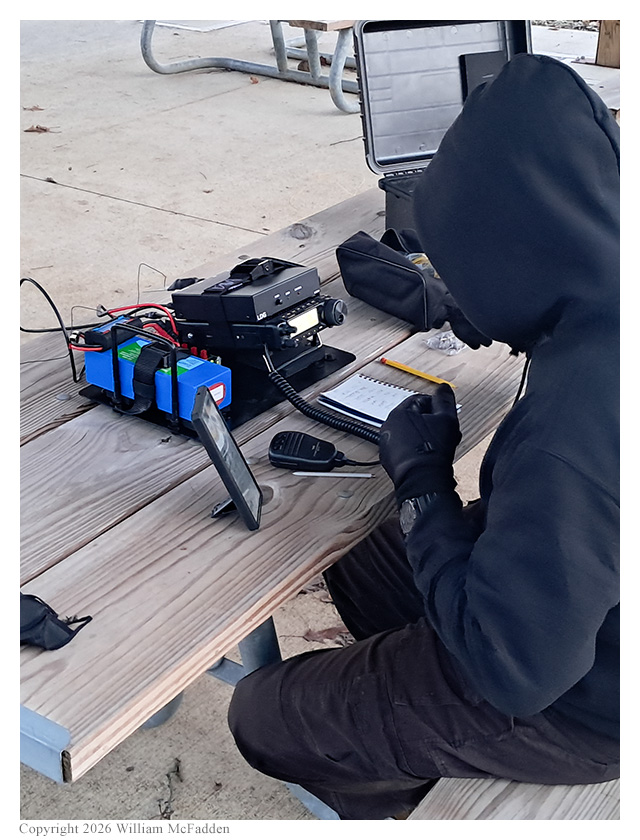
Miles's FT-891 station out in the cold.
While Miles set up his station, Eric set up his station inside the relative warmth of the car, pulling his 29' Tufteln (link) EFRW to the top of his 31' Jackite telescoping fiberglass mast in the drive-on base, placing two 17' counterpoise wires directly on the ground, and placing his Elecraft KX2 on the passenger-side dash of the car. Eric was on the air at 2200 UTC.
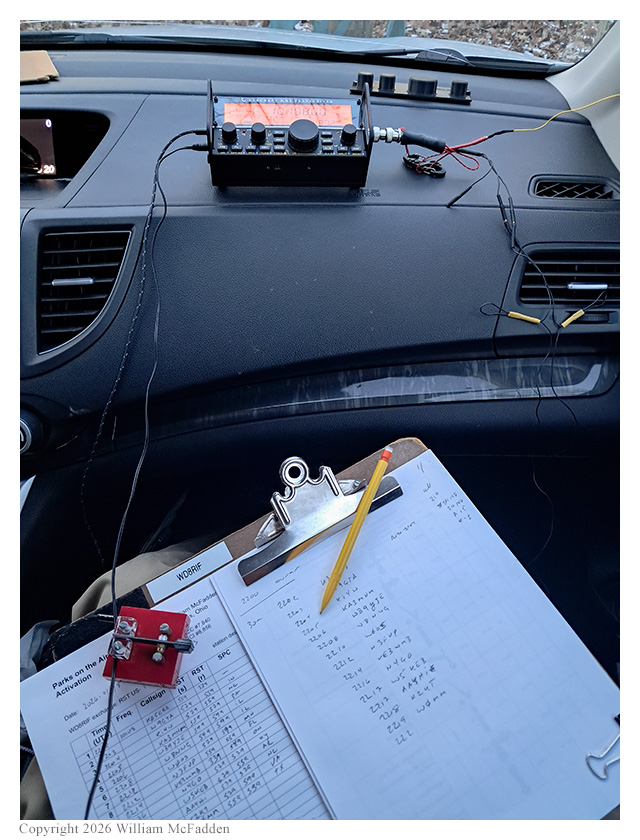
Eric's KX2 station inside the car.
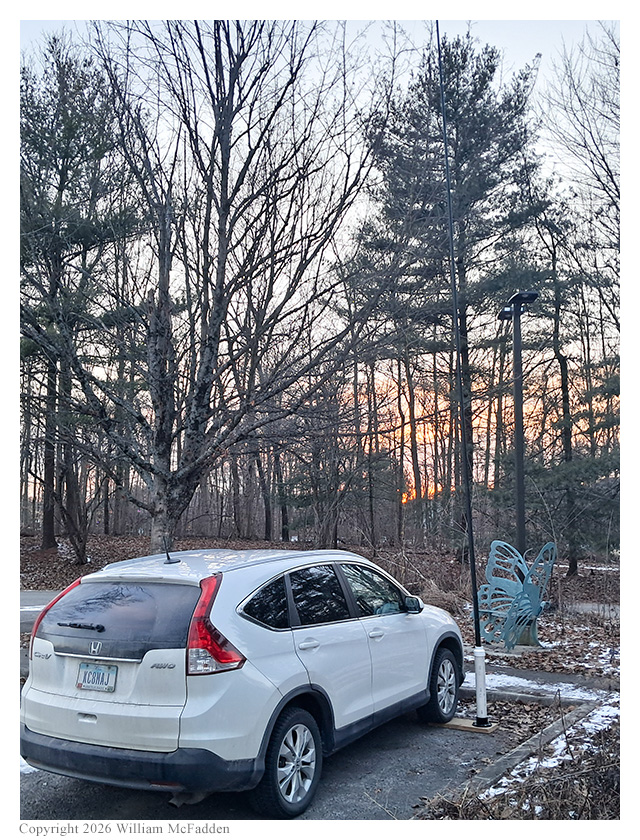
Eric's mast and antenna.
Because they had cell-signal, Eric and Miles would be able to use POTA Spots (link) for spotting themselves and to look for park-to-park (P2P) QSO opportunities.
Miles began his operation on 20m, operating SSB with his FT-891 set to about 20w output, and hunting for P2P stations.
In order to minimize interference with Miles's station, Eric chose to begin his operation on 30m, a band not harmonically-related to 20m. Finding himself a clear frequency to run, Eric began calling "CQ POTA" and was auto-spotted on POTA Spots. His first QSO came at 2202 UTC with KB5EBB in Virginia. QSOs came quickly, with Eric's fourteenth QSO coming at 2219 UTC with W0MM in Texas. This run included QSOs with operators located in Arkansas, Florida, Illinois (2), Kentucky, Indiana, Minnesota, North Carolina (2), Ontario, Pennsylvania, Texas, and Virginia (2).
In all, Eric made fourteen QSOs. All of Eric's QSOs were CW and were made at five watts output.
After his activation was complete, Eric snapped a few photos of his station, and then walked to Miles's station to snap photos of Miles. It was then that he learned that Miles had been able to complete only a single QSO, and that the decreasing temperature and increasing wind were proving to be very uncomfortable. Eric suggested Miles move his station to the car, but Miles declined, so his operation produced only the single QSO. (It was hours later that Eric realized he should have made SSB P2P QSOs with Miles on multiple bands to help Miles validate his activation.)
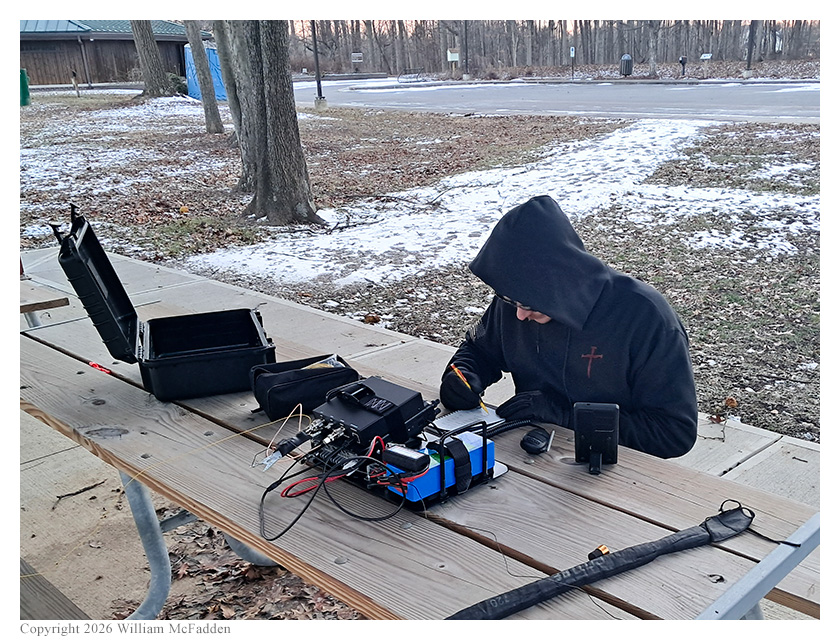
Miles operates in the bitter cold.
Eric also submitted his log to the World Wide Flora and Fauna in Amateur Radio (WWFF; link) program.
(return)