
by William Eric McFadden
From the park website:
-
Nearly 2000 years ago, Native Americans built dozens of monumental mounds and earthen enclosures in southern Ohio. These earthwork complexes were ceremonial landscapes used for feasts, funerals, rituals, and rites of passage associated with a Native American religious movement that swept over half the continent for almost 400 years. Come walk among the earthworks and experience the past.
Pictures
Description
On Wednesday, May 13, 2026, two members of the Southeast Ohio Radio Adventure Team performed successful activations of Hopewell Culture National Historic Park in Ohio as part of the Parks on the Air (POTA; link) program.
While driving from Athens in southeastern Ohio to Dayton for Four Days in May (FDIM, info) and Hamvention (info), and following successful three-fer activations of Tar Hollow State Park, Tar Hollow State Forest, and North Country National Scenic Trail, Eric McFadden, WD8RIF, and Thomas Witherspoon, K4SWL, stopped at Hopewell Culture National Historic Park in Chillicothe.
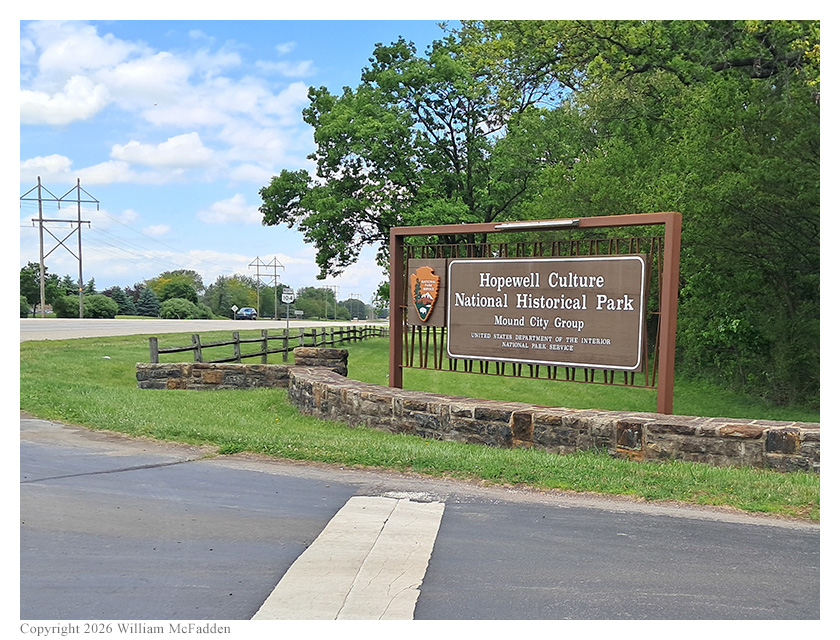
The entrance to Hopewell Culture
National Historic Park's Mound City Group.
Upon arriving at Hopewell Culture, Tom and Eric visited the Visitor Center and, just as it had been during the entirety of National Parks on the Air in 2016, the staff were extremely accommodating. The staff told Tom and Eric that they could set up anywhere within the park except within the Indian mounds, and suggested that the picnic area might work well. Tom and Eric checked out the picnic area and decided it would, indeed, work well.
While walking back to the car to grab the radios, Tom and Eric ran into Steve, VK4CJ, Bryan, VK3LF, and Tony, VK3YV, from Australia, who were in the U.S. for Hamvention, and were at Hopewell Culture to do their own POTA activations.
At the picnic shelter, Tom and Eric quickly set up their stations. Tom threw a line into a tree and pulled up a 40m end-fed halfwave antenna. Connecting the antenna to his Penntek TR-45L, he was on the air.
Tom began his operation on 40m and pretty quickly validated his activation by making the required ten QSOs. Read Tom's report: From NPOTA to POTA: En Route to Dayton and Making New Friends from Down Under.
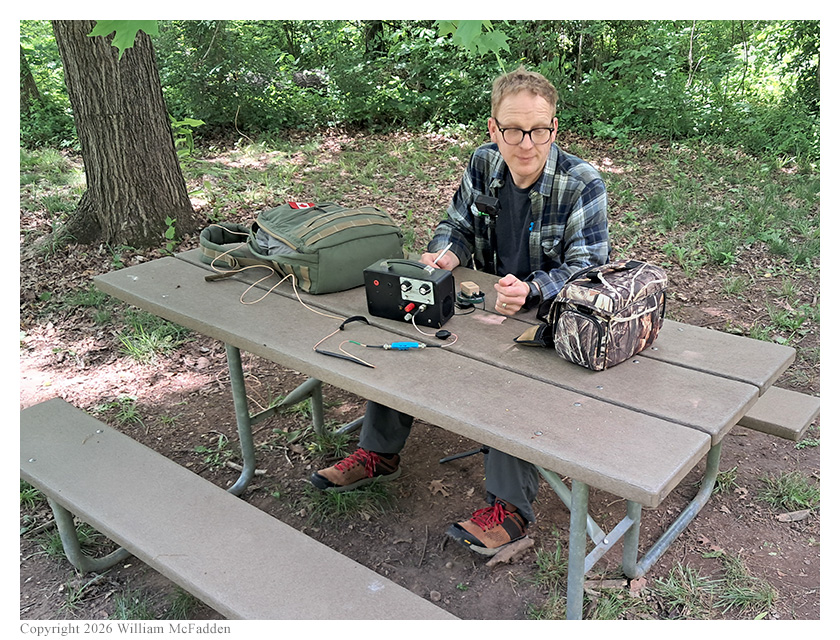
Tom operates his TR-45L.
Eric deployed his Tufteln (link) end-fed random wire antenna as a 29' sloper to the top of his Goture Red Fox Super Hard 720 carbon fiber mast held upright on a spike, placing two 17' counterpoise wires directly on the ground. Placing his Elecraft KX2 on a picnic table and hooking up his Whiterook MK-33 paddle and Sony earbuds, Eric was on the air at 1743 UTC.
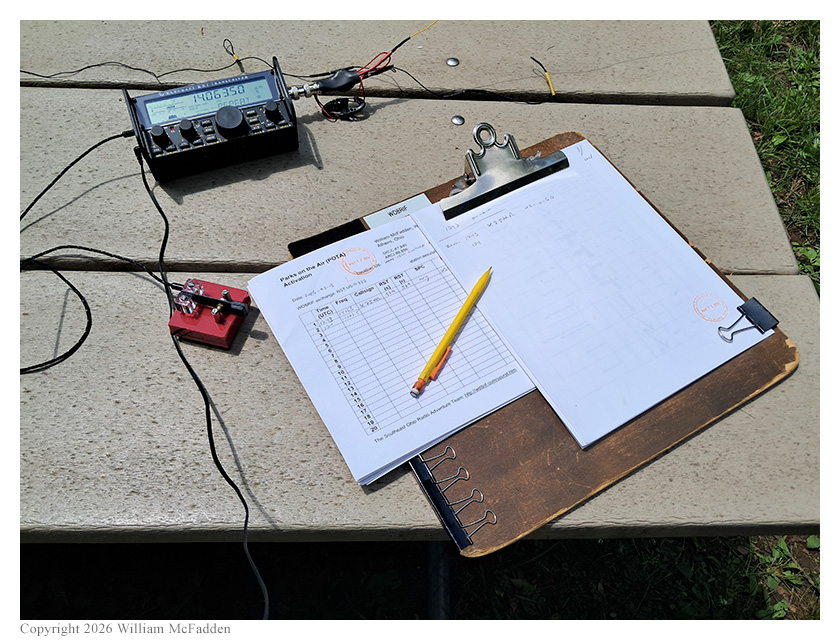
Eric's KX2 station.
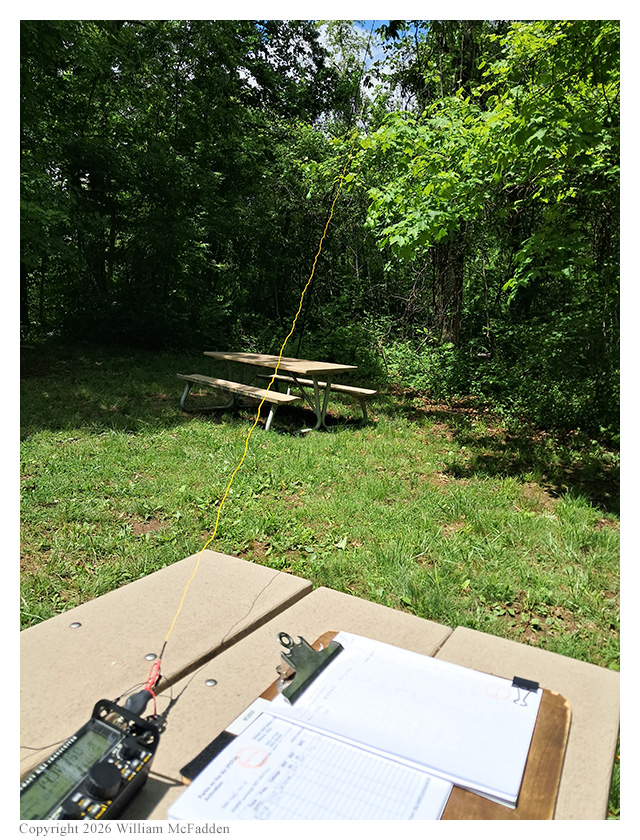
Eric's mast and antenna.
With Tom running on 40m, Eric began his operation on 20m. While trying to find himself a clear frequency, he found K7SHR at Stewart Creek BLM Herd Management Area (US-6160) in Wyoming, and Eric completed a Park-to-Park (P2P) QSO with him at 1743 UTC.
Finding himself a clear frequency on 40m to run, Eric began calling "CQ POTA" and was auto-spotted on POTA Spots. His first QSO in this run came at 1748 UTC with AA8R in Florida. Thereafter, his calls on 20m remained unanswered.
At 1757 UTC, Eric paused to make a P2P QSO with Tom on 40m, at which time Tom surrendered 40m to Eric. Staying on the same frequency, Eric self-spotted himself and began calling "CQ POTA". His first QSO in this run came at 1800 UTC with K4TRA in North Carolina. QSOs came quickly, with Eric's seventh QSO in this run coming at 1813 UTC with KW4CZ in North Carolina. This run included QSOs with operators located in New Jersey, New York, North Carolina (3), and Ontario (2).
With the Australian hams patiently waiting for their chance to activate, Eric finished his operation by hunting for P2P QSOs, and at 1815 UTC he made a P2P QSO on 30m with Ice Age National Scenic Trail (US-4238) in Wisconsin.
In all, Eric made eleven QSOs in about thirty minutes of on-air time. All of Eric's QSOs were CW and were made with five watts output.
After completing their activations, Tom and Eric spent a few minutes chatting with Bryan, Steve, and Tony, before tearing down their own stations, repacking the car, and continuing their drive to Dayton.
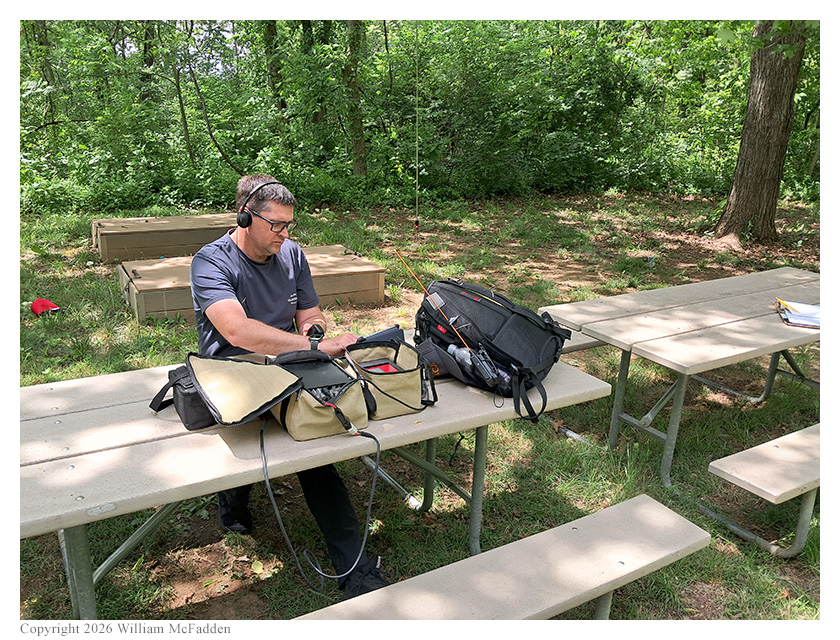
Steve, VK4CJ, operates his Yaesu FT-857 station.
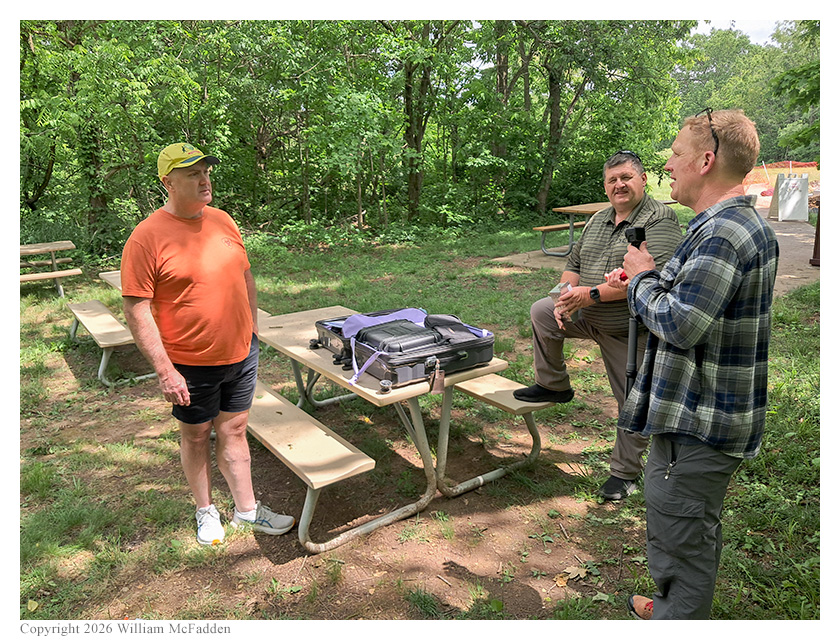
Tom talks to Bryan (left) and Tony (right).
Eric also submitted his log to the World Wide Flora and Fauna in Amateur Radio (WWFF; link) program.
(return)